Gemma 4 12B ships encoder-free, then mistakes a quarter for a silver dollar
Google killed the vision and audio encoders entirely and projected raw signals straight into the LLM. The benchmarks look great; a CMU professor's coin photos tell a different story.
Google deletes the encoder and bets the laptop on it
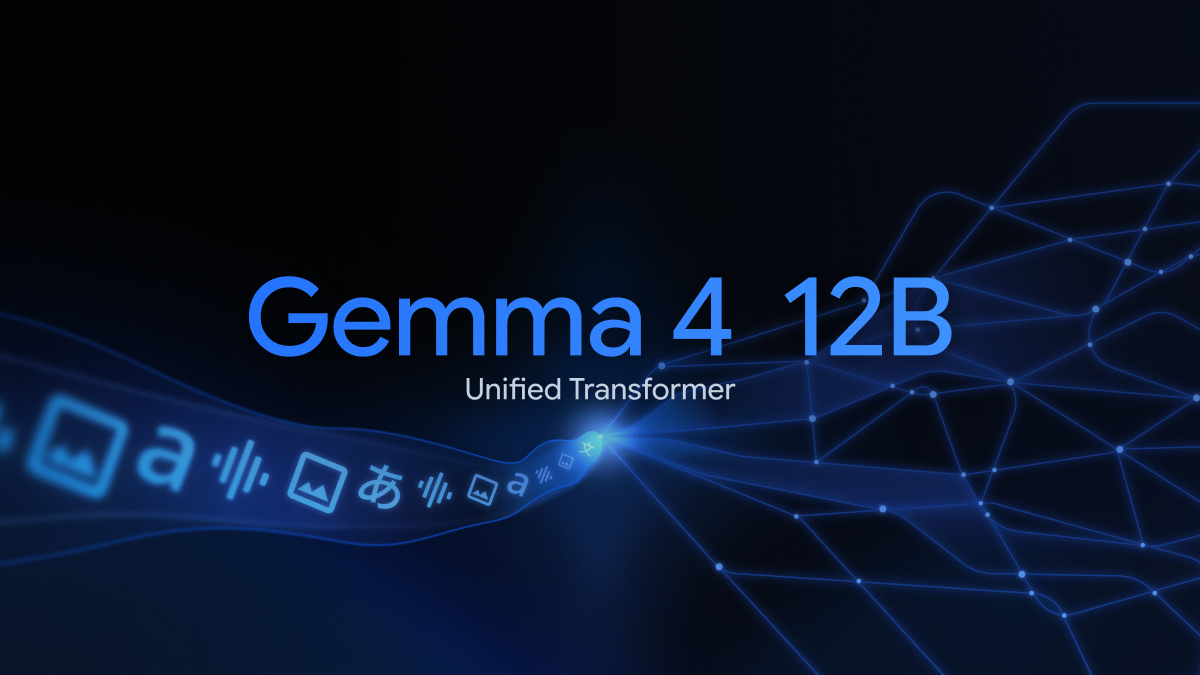
Gemma 4 12B landed on the Google blog as the model that fills the awkward gap between the 4B and 26B tiers — and as a genuine architecture story rather than another checkpoint. It hit the HN front page fast, with the thread splitting cleanly between people impressed by the design and people who actually fed it images.
One matrix multiply where a vision model used to be
The headline claim is "encoder-free." Google replaced Gemma 4's vision encoder — normally a dedicated network like SigLIP — with "a lightweight embedding module consisting of a single matrix multiplication," positional embedding and normalizations. For audio it went further, removing the audio encoder "entirely" and projecting the raw audio signal into the same dimensional space as text tokens. Vision and audio inputs flow directly into the LLM backbone, which is what "unified multimodal" means here. The payoff: 12 billion parameters that fit in 16GB of VRAM or unified memory, Apache 2.0 licensed, results "nearing our 26B model," with Multi-Token Prediction drafters — predicting several tokens at once — to cut latency. Gemma 4 has crossed 150 million downloads.
The coding side held up under scrutiny. One reviewer ran the 4-bit quant through a Minesweeper vibe-coding benchmark and came away surprised:
"It roughly compares with GPT-4.1 (!!), released 14 months ago … Now we got something with 12B of params performing roughly the same" — ex-Pythagora (YC W24) founder doing AI consulting
The vision claims meet actual photographs
Then the multimodal half collided with reality. The sharpest reversal came from a credentialed source:
"I then spent 10 minutes arguing with it that a photo of a 1998 washington quarter was not, in fact, a Morgan Silver Dollar … It went into a crash loop on a british columbia 1 dollar coin." — a Carnegie Mellon CS professor, ex-Google Brain
He noted the older Gemma 4 handled the Canadian coin and Gemini 3.1-flash-lite nailed both. He wasn't alone. Another tester watched it choke on geometry the reference models breezed through:
"when I gave it an image which Gemma 26B A4B and Qwen 3.6 35B A3B has no problem correctly describing … it utterly failed. Its sense of the image was that it was a 'distorted wide panorama'" — a model evaluator running side-by-side vision tests
Even the architecture skeptics weren't buying the marketing framing. Max Woolf, Senior Data Scientist pushed on the "runs on your laptop" line: "I am assuming that involves quantization, which due to the quality loss makes that statement somewhat misleading." Others noted the advertised 16GB figure implies 8-bit, while the actual Hugging Face release ships at 16-bit float — "a little deceptive."
A clever architecture is not yet a clever model
Replacing an encoder with a 35M embedding layer is a real idea, and the text results suggest the backbone is strong. But "encoder-free" is doing two jobs at once: a research claim and a laptop-ready sales pitch. The thread's verdict is that the second job isn't done — when the input is an actual photo of an actual coin, the deleted encoder is exactly the thing you find yourself missing.
Get breakdowns like this every day
The top Hacker News stories, unpacked — by email, Telegram, or RSS.
An LLM rewrites a 1991 sci-fi classic to argue it might be conscious
Max Leiter took Terry Bisson's "They're Made Out of Meat" and swapped the meat for weights. The twist: he wrote it with the very thing it's about, and the disclaimer at the bottom set off the whole thread.