Singapore's 'Third World to First' story is half PAP party line, a historian argues
The plaque under the Raffles statue says he turned an 'obscure fishing village' into a great seaport. A History Today feature picks that founding myth apart — and the thread piled on with the parts the official story leaves out.
The statue, the plaque, and the founding myth under it
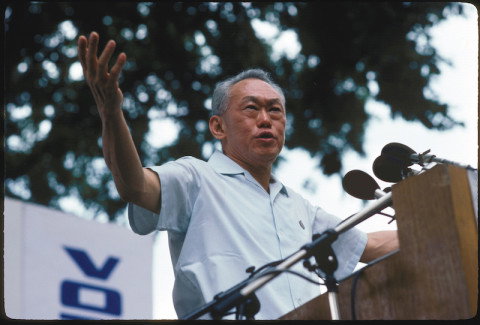
The History Today feature opens at a literal monument: the statue of Stamford Raffles, whose plaque credits him with changing Singapore's destiny "from an obscure fishing village to a great seaport." The essay's argument is that the dominant story of Singapore — the heroic ascent from "Third World" to "First" under Lee Kuan Yew after the forced separation from Malaysia in August 1965 — is told largely in the terms its own People's Action Party prefers, and that both the colonial founding myth and the PAP's redemption arc flatten a much older, messier history.
What the article actually claims about the development model
The piece doesn't deny the achievement; it interrogates the framing. Singapore in 1965 was an island of immigrants — three races, four languages, no natural resources, no water of its own, ejected from Malaysia. Lee's PAP built a state around homeownership, education and order, and the results are not in dispute. What the feature questions is the narrative: the convenient before-picture of a backward fishing village, and the smoothing-over of the authoritarian machinery that came with the prosperity. The thread turned this into a debate, and the most useful correction came fast:
"Singapore was the second richest city in Asia (behind Shanghai) before WW2. While the PAP obviously deserves credit for their economic management… their starting point was far from the opium-riddled fishing village backwater they like to paint it as." — a commenter on the pre-war baseline
A reader went further on the deep history, arguing the "fishing village" line erases millennia:
"This is one of the greatest lies ever told, that Singapore was an obscure fishing village… It has been and always has been for most of its history a successful entrepot for several thousand years before the colonials first visited." — a commenter on Singapore's pre-colonial history
The lived version: from night-soil slums to the first world
The counterweight to the skeptics was a first-hand account that gave the official arc its emotional force. A reader described his father arriving by steamship in the 1950s:
"eighteen years old with 10 dollars to his name… crammed into shophouses, kampongs and squatter settlements with no proper toilets (human faeces and urine were carted away by 'night soil' men)… From a shit-hole to the first world. In one generation." — the son of a 1950s Singapore immigrant
The homeownership policy that anchors the model got quoted from Lee directly by another reader:
"I could not ask their sons to fight and die for the properties of the wealthy… Today, 95 per cent of Singaporean households are homeowners." — a commenter quoting Lee Kuan Yew on the housing scheme
The authoritarian asterisk
The thread refused to let the efficiency story stand alone. A reader who looked up the numbers ended up arguing with himself about whether it was worth it:
"Lee Kuan Yew is praised by Western academia because of 'benevolent authoritarianism'… his policies were authoritarian and dictatorial… And since Singaporeans reportedly have high life satisfaction, it even makes me question whether authoritarianism is really that bad. But I still dislike authoritarianism." — a freelance programmer in Korea
Another, in his sixties, drew a sharp portrait of the method and the man:
"Weaponised the court system to repress union backed opposition, despite having been engaged with the union movement in his early years… It is a kind of workers paradise. If you're well behaved and don't shout you get a good education, health system and housing. 95% owner occupied is pretty damn good." — a longtime observer of Singapore's politics
The comparison that did the most work was regional: Singapore versus the country that expelled it.
"The Malaysian Ringgit vs Singapore dollars was 1 to 1 back then in 1970s. And now it's 3.1 to 1… many [minorities] went to Singapore, to contribute to the economy there — precisely because of [Malaysia's] affirmative action." — a commenter on the Singapore–Malaysia divergence
The model works; the story is doing PR
The honest reading the thread converges on is not that Singapore's success is fake — the currency, the housing, the social mobility figures are real — but that the telling is propaganda-shaped. A pre-war wealthy port becomes a fishing village; a one-party state that jailed its opponents becomes a meritocratic miracle; the trade-off between the 95% homeownership and the muzzled press gets quietly dropped. The feature's value, and the thread's, is in restoring the asterisks the plaque left off.
Get breakdowns like this every day
The top Hacker News stories, unpacked — by email, Telegram, or RSS.
The Netherlands will only let a European company near DigiD — after blocking a US buyer
A week after the Dutch state vetoed an American takeover of DigiD's infrastructure supplier, it wrote the rule into procurement: the next operator of the national login system must be European.