Tesla edited the word 'supervised' into FSD contracts owners already signed
Owners who bought Full Self-Driving as far back as 2016 found their original purchase agreements rewritten to include the word 'supervised' — and in some cases the originals gone from their accounts entirely. The thread's verdict is short and unanimous: that's not how contracts work.
The contract changed after it was signed

The report comes from Fred Lambert at Electrek and centers on a quiet edit: Tesla appears to have altered the text of Full Self-Driving purchase agreements that customers signed years ago, inserting the qualifier "supervised" that wasn't in the original.
What Electrek documented
From 2016 through early 2024, Electrek reports, Tesla sold "Full Self-Driving Capability" as a roughly $15,000 software package implying eventual unsupervised autonomy. In March 2024 it rebranded the product "FSD (Supervised)" going forward — a legitimate business move. The problem is the backward reach: owners now find that word stitched into agreements they executed before it existed.
One owner, Oliver Abcarius, bought FSD for a 2018 Model 3 on August 12, 2019, and went to pull his original contract to build a refund case — only to find the document retroactively updated and now linking to an invalid page. His wife's 2020 Model Y shows the same pattern: only the FSD-related documents are inaccessible.
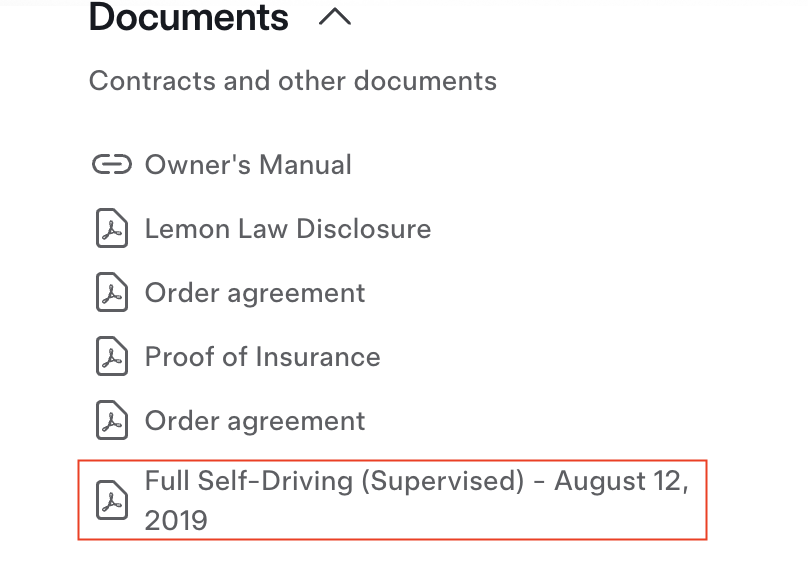
Lambert is careful about the distinction that matters: "There's a meaningful difference between changing a product's name going forward and making existing executed contracts inaccessible after the fact. The first is a business decision. The second raises serious legal questions." The legal hook is timing — Tesla faces up to $14.5 billion in FSD-related suits, including a certified class action covering statements from October 2016 to August 2024, the exact window these contracts span. Altering or hiding executed agreements during live litigation, the piece notes, "starts to look like spoliation of evidence" — destroying or altering material relevant to a pending case.
A short, unanimous thread
The discussion is thin but with one voice. "There's no 'some' would call it fraud, you cannot change the terms of a contract post signing like that," wrote the top commenter on contract law. "That is not at all how contracts work!" echoed a second reader, while a third framed it as a question — "Is this fraud? Contract forgery?"
The most quotable line skipped the law for the linguistics: "Supervised Full Self Driving is oxymoron like Dry water," noted a commenter on the brand itself — the contradiction Tesla spent eight years selling before quietly editing it into the past.
The part that's hard to undo
A rename is forward-looking and defensible; rewriting a signed document is neither. The detail that turns a branding story into a legal one is that the originals are vanishing from owners' accounts at the precise moment those owners need them as evidence — which is exactly the kind of disappearance courts have a name for.
Get breakdowns like this every day
The top Hacker News stories, unpacked — by email, Telegram, or RSS.
Why your pension may be forced to buy a $2tn loss-maker eyeing Mars
The Irish Times does the governance math on the SpaceX float: $29bn of debt, 85% of votes locked to Musk, and waivers that make suing him hard. Then HN's top commenter defends exactly the founder-control the article attacks.