A $549 Sigma lens died from one blown 0603 fuse the size of a grain of rice
The Sigma 45mm looked pristine but went completely dead on the camera body. The culprit was a single surface-mount fuse smaller than a grain of rice — and getting to it meant a teardown that shows why nobody repairs modern lenses anymore.
A flawless-looking lens that the camera refused to see
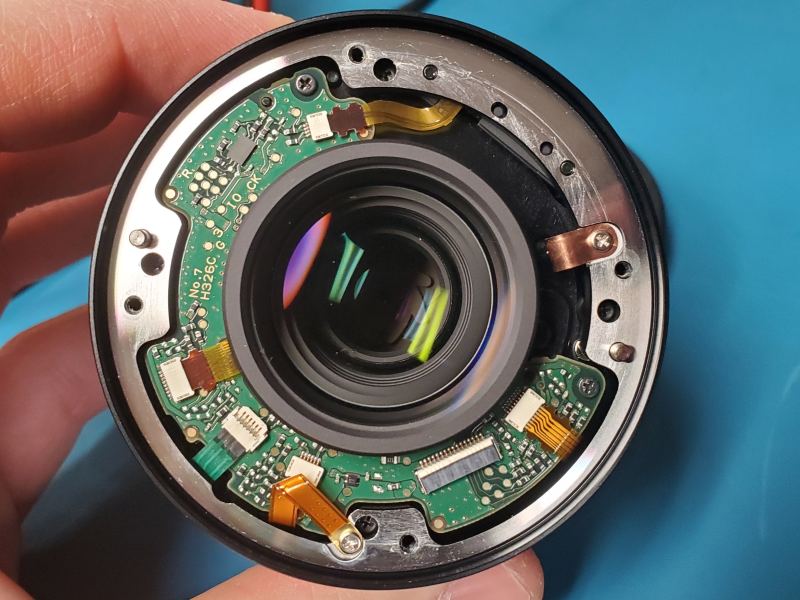
The Salvaged Circuitry teardown starts with a lens that looks perfect and behaves like a brick: a Sigma 45mm f/2.8 that, mounted to a body, shows no electronic life at all — no autofocus, no aperture, nothing. No scratches, no impact, no obvious cause. The whole piece is the hunt for why, and it doubles as a tour of why modern lens repair is a specialist's game.
What's actually inside a modern lens now
The surprise for anyone who still pictures a lens as "metal and glass" is the parts list. Inside the Sigma sit a Toshiba TMPM341FYXBG ARM Cortex-M3 microcontroller, a Rohm BU24020GU motor controller, and a TI TPS62140 buck converter feeding the rail — components that want a tight 2.7–3.6V and live in compact packages that resist probing. A reader who follows the camera world spelled out how far this has gone:
"at this point a lens for a mirrorless camera will have a USB-C port to receive firmware updates… We're far from the days a lens was just metal and glass." — a commenter who tracks the camera industry
The diagnosis: one dead 0603 fuse

The fault traced to a single 0603-sized surface-mount fuse — a 2A part on the input rail feeding the buck converter — that had blown open. The author's theory: sustained autofocus driving can push instantaneous current past the static rating, because during the converter's propagation delay "the actual current can exceed the static current limit." Replacing it with a Panasonic ERB-RE2R00V 2A/32V fast-blow fuse brought the whole lens back to life. Total hands-on time: about an hour.
The fuse detail set off the thread's best technical correction, from an electronics engineer:
"The first rule of fuses (which many modern engineers do not understand!) is that fuses are not there to save your parts… Fuses exist to prevent fires… I've seen transistors blow up to 'protect' fuses." — an engineer on what fuses are actually for
Why these repairs barely happen

The teardown's craft is in the boring discipline. The author worked through the rear beauty ring, the bayonet mount and shims, freeing fragile flex cables — "flex cables tend to fatigue and break if the flex radius is compressed too small" — and using JIS rather than Phillips drivers to avoid chewing the screw heads. One small trick became the thread's most-liked takeaway: laying each removed screw on double-sided tape in the position it came out of.
"Placing disassembled screws on double sided tape is such a great idea, I am going to try that next time I disassemble my electronics." — a commenter adopting the screw-tape trick
The JIS-vs-Phillips warning was seconded by a hardware developer:
"The author says PH screwdrivers may be used on JIS screws, but in my experience they strip every single time." — the developer of the Filmulator photo editor
The economics, not the electronics, are the real lock
The reason a $500 lens dies over a rice-grain fuse isn't that the fix is hard — it's that nobody will pay a tech an hour's bench time to find it. A machine-learning engineer in the thread named the obvious endgame:
"This is the kind of thing I'd love to see robots take over. Companies don't want to service these things much; the labor is too costly. They could just distribute the repair manuals and we could get robots to do it." — a machine-learning engineer on automating repair
Until then, a lens with a Cortex-M3 and firmware updates over USB-C is, for the manufacturer, a throwaway item the moment one 2A fuse gives up — and the only thing standing between it and a landfill is a hobbyist with a logic analyzer and a roll of double-sided tape.
Get breakdowns like this every day
The top Hacker News stories, unpacked — by email, Telegram, or RSS.
ISS crew sheltered over an air leak NASA has been chasing since January
Astronauts were told to take cover during repair work on a leaking Russian segment, then — within the same news cycle — told to return to normal operations. The leak isn't new: NASA reported in January that pressure had stabilized, while admitting it couldn't be sure the air wasn't just escaping somewhere else.