Physicists named the missing ingredient of gravity 'magic' — and the thread revolted
Entanglement could build the fabric of space-time, but that fabric stayed rigid — it couldn't bend in response to matter, which is the whole point of gravity. A quantum property called 'magic' supplies the springiness. Half the thread thinks the name alone is malpractice.
A magazine headline that physicists in the thread called "bullshit"
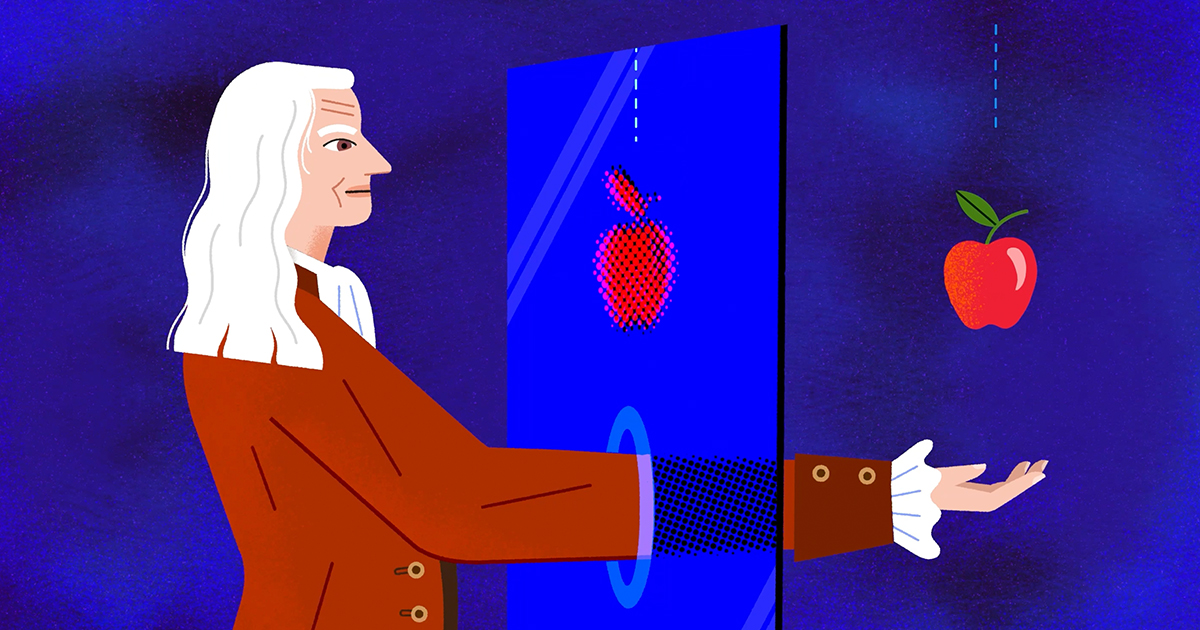
Quanta Magazine's piece carries a sentence almost engineered to provoke a technical crowd: a measure of quantumness called "magic" gives space-time its gravity. It drew 176 points and a thread that spent more energy litigating the word than the physics — though the physics, once you get past the name, is a genuine claim.
What "magic" actually means, and the gap it fills
Start with the established idea: in holographic theories, entanglement — the quantum links between particles — knits together the basic geometric structure of space. That's the "entanglement builds space-time" half. The problem is that entanglement alone gives you a rigid fabric. It can encode geometry, but it can't let that geometry respond to matter — and "matter tells space-time how to curve" is the entire content of Einstein's gravity.
Magic (the dry technical name is non-stabilizerness) is the missing flexibility. The concept comes from quantum computing: Bravyi and Kitaev introduced it in 2004 to measure how many non-Clifford gates a quantum state requires — the operations that make a quantum computer impossible for a classical machine to efficiently simulate. The more such gates you need, the "more magical" the state. Charles Cao (Virginia Tech), working with John Preskill (Caltech) and others, built next-generation quantum error-correcting codes using exactly those gates and showed that magic is what gives the encoded space its springiness — its ability to bend. As one physicist in the piece puts it, with entanglement and magic, "if you have one, you always have the other."

The thread: a naming committee, then the skeptics
The first and loudest reaction was linguistic disgust. "Magic" struck many as the opposite of an explanation:
"Calling something 'magic' is like an admission that you have no clue about what is going on… to go and promote this under the term 'magic' is disingenuous." — a commenter objecting that the name hides real, knowable structure
"Strictly from a linguistic perspective: what a terrible and dumb term ('magic')… How does gravity work? Magic!" — a commenter mocking the term as an anti-explanation
But the more substantive pushback wasn't about the word — it was about the whole holographic enterprise. A commenter who clearly knows the field questioned whether any of it touches our actual universe:
"…unless we actually find a holographic dual of our universe instead of AdS spaces (which are the opposite of our universe if anything), this whole field is starting to feel more like a jobs program for mathematicians out of new ideas." — a commenter skeptical that AdS-based holography maps to reality
And a physics-literate reader corrected the article's own pop-science analogy, the bowling-ball-on-a-mattress picture of gravity:
"On an everyday scale like the Earth orbiting the Sun, almost none of that gravitational interaction is from the bending of space. Far beyond 99% (actually, about 99.999999%) of it is from the bending of time." — a commenter pointing out the mattress analogy gets the dominant effect wrong
Why the name fight is a distraction from the real bet
The "magic" mockery is fair and also beside the point. The defensible claim underneath is narrow and checkable: in toy holographic models, you can separate the part of quantum information that builds geometry (entanglement) from the part that lets geometry curve (magic), and you can write down error-correcting codes where both appear together. The open question isn't the terminology — it's the one the AdS skeptic named. These are results inside anti-de Sitter space, a universe with the wrong sign of curvature from ours. Until someone finds the holographic dual of a universe that looks like this one, "magic gives space-time gravity" is a precise statement about a model that is, geometrically, not our home.
Get breakdowns like this every day
The top Hacker News stories, unpacked — by email, Telegram, or RSS.
Gov.uk dumped Stripe for a Dutch processor — the contract is worth £25.3M
A full UK government payments deal turned out to cost a fraction of a mid-size US company's annual cloud bill. The new supplier, Adyen, won't even take clients billing under a million.