Flock matched a red Alfa Romeo — the man was five miles away
Twenty-three seconds after San Diego police lost sight of a getaway car, a Flock ALPR camera photographed a red Alfa Romeo five miles away in Old Town. A detective matched the vehicles on color and tinted windows alone. Hugo Parra and Ariel Beltran were arrested at a cigar lounge — neither had been near the crime scene.
A Flock camera photographed a red Alfa Romeo — real car, wrong plate, geometrically impossible location. The victim's clothing description didn't match either. Police arrested two men anyway.
Parra and Beltran each seek $1.5 million. Their tort claim: other Flock cameras along their actual route would have cleared them instantly. Nobody checked.
tptacek's reversal: this isn't a Flock failure, it's SDPD treating a color-match as probable cause. The exonerating data was in the same system.
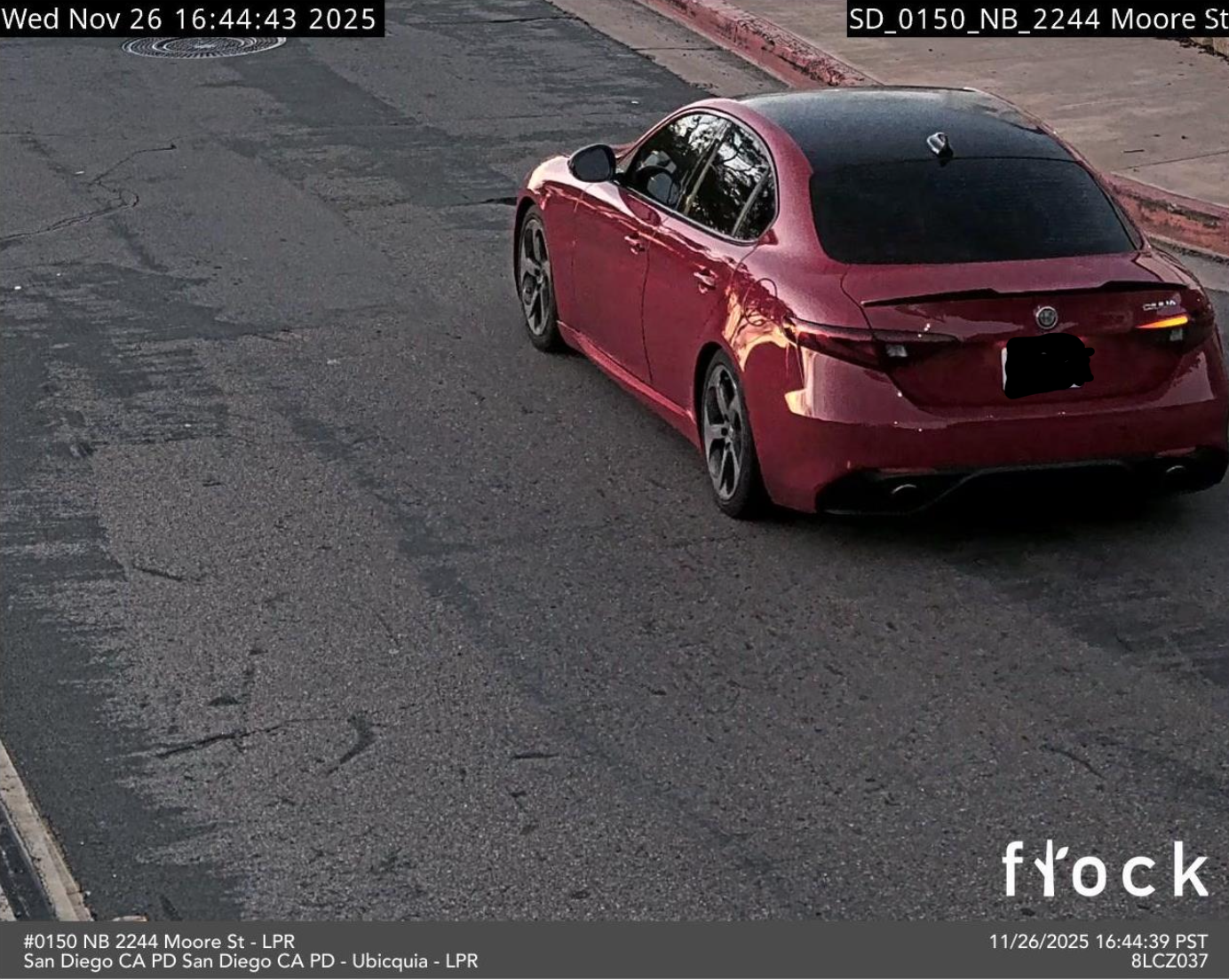
A 23-Second Impossibility That Produced Two Arrests

On November 26, 2025, an attempted carjacking unfolded in Golden Hill's 2800 block of E Street in San Diego. The suspects fled in a red Alfa Romeo at speeds exceeding 100 mph, then vanished near Little Italy. Twenty-three seconds later, a Flock ALPR camera recorded a red Alfa Romeo five miles away in Old Town on Moore Street. Detective Gary Gonzales matched the two vehicles on the basis of color and tinted windows.
What the Article Documents
Hugo Parra said he had been picked up from his apartment and driven directly to a cigar lounge in Old Town — the same lounge where police spotted the three men and arrested them. The victim's description of what the suspect wore (a gray hoodie) didn't match what Parra and Beltran were wearing. No weapons were found on any of the three arrested. A curbside identification — one of the most unreliable tools in criminal procedure — was used to proceed with the arrests.
In April 2026, Parra and Beltran each filed tort claims seeking $1.5 million in damages. Their attorney, Alex Coolman, summarized the structural problem: "Mass surveillance without skepticism is a recipe for disaster." The tort claim specifically notes that other Flock cameras along the path the men actually traveled — from the apartment to the cigar lounge — would have corroborated their story. So would the location data on their cell phones. Neither was consulted before the arrests.

The Thread Reverses the Blame Assignment
In the thread, the most substantive intervention came from tptacek — Thomas Ptacek, a well-known security researcher on HN:
"This doesn't seem like a Flock story so much as SDPD making an arrest purely on a nexus to 'red Alfa Romeo with tinted windows'. From what I understand of the story, the Flock camera did in fact tag a red Alfa Romeo… It wasn't the right one, but ALPR cameras aren't psychic; they tell you features, make/model, and plate, not 'criminal culpability'." — tptacek
That reframing landed, but it also generated a second reversal: the same commenter who criticized the headline framing also implicitly revealed how ALPR evidence was misused. A detective treating a camera match as probable cause for arrest — rather than as a lead requiring corroboration — is a procedural failure, not a technology failure. The technology flagged a car of similar description. The human chose not to check the plate.
A commenter identified an irony at the center of the story:
"Ironically flock is what proves innocence. What would happen here without it?" — an HN commenter
This is the genuine paradox: the same camera network that created the false lead also contained the exculpatory evidence. The cameras along Parra and Beltran's actual route would have shown no match. The failure wasn't surveillance — it was selective use of surveillance.
A third voice added a dimension the article didn't cover:
"Flock camera installations don't follow local or city laws. All poles that hold roadsigns generally need to safely handle impact and get certified / inspected. However, flock cameras have none of it." — an HN commenter citing a video investigation
What Changes — and What Doesn't
The practical lesson isn't that ALPR cameras produce false matches — all probabilistic identification tools do. The lesson is that a single camera hit on a car of similar color, captured five miles from a crime scene 23 seconds after the suspect vehicle disappeared, was treated as sufficient grounds for a curbside identification and arrest. The same database that condemned these two men contained their alibi. Nobody looked. The $1.5 million tort claims may force a procedural standard: ALPR hits are leads, not verdicts, and the rest of the network must be checked before an arrest.
Get breakdowns like this every day
The top Hacker News stories, unpacked — by email, Telegram, or RSS.
Teenage Engineering's $Price-on-Request record lathe weighs 308 pounds
Teenage Engineering just announced the APC-2: a 140-kilogram professional record-cutting lathe built from powder-coated aluminum and granite, distributed exclusively through SUPERSENSE. No price is listed anywhere on the product page — you email [email protected] and wait.