New U.S. grads now have higher unemployment than the average worker — but a degree still beats no degree
For decades a fresh graduate had better odds than the typical worker. That edge hit zero in February 2019 and inverted: 5.6% vs 4.2%, the widest gap on record. The reasons aren't the ones the headline implies.
The crossover, in one chart
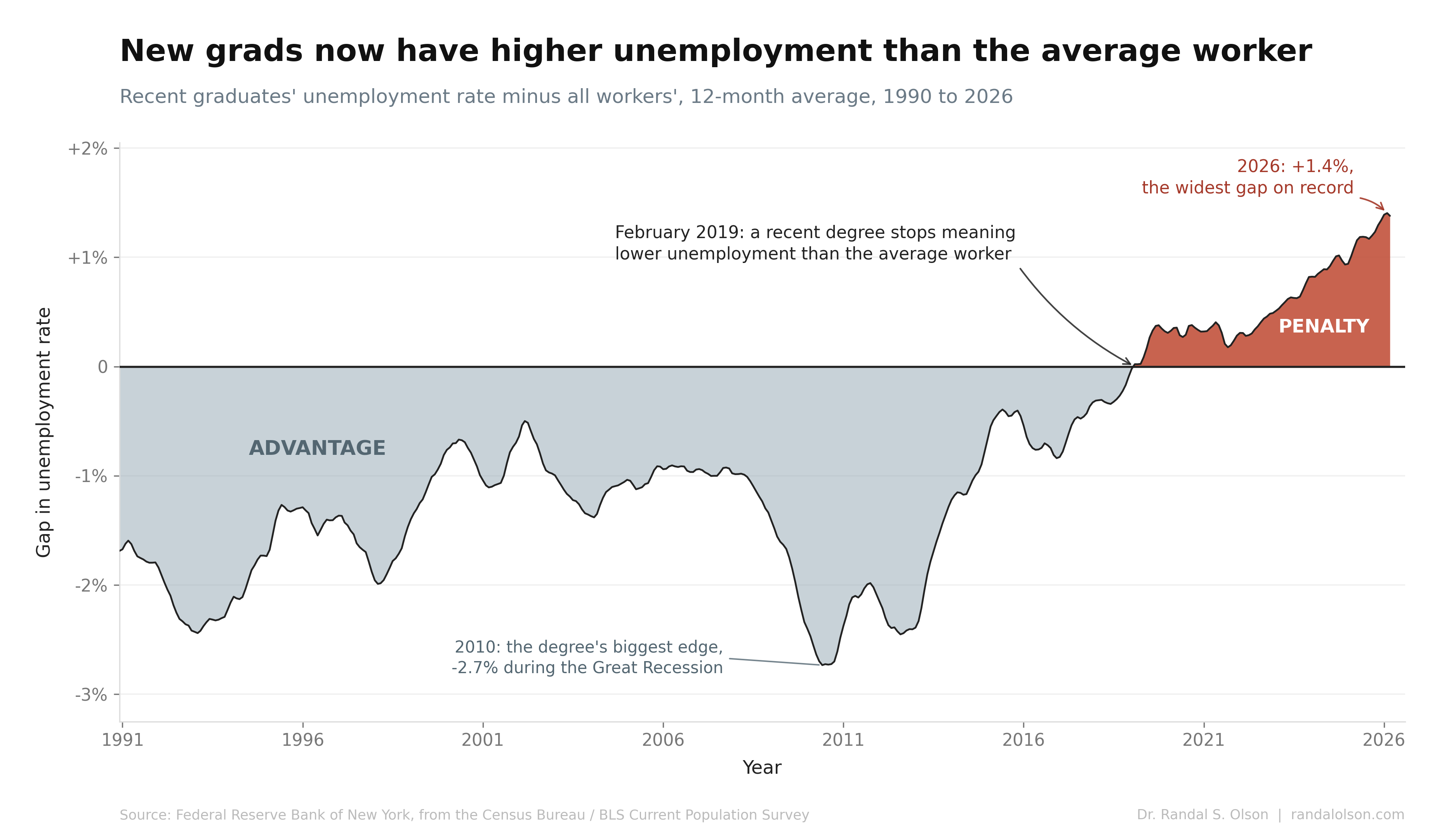
Data scientist Randal Olson's post documents a genuine inversion. In early 2026, U.S. recent-graduate unemployment hit 5.6% against 4.2% for all workers — the widest gap on record. For most of the last few decades a new grad enjoyed better odds than the average worker (the advantage peaked around mid-2010). That advantage fell to zero in February 2019 and has since flipped negative.
It's an easy headline to misread as "college is over." Olson's own numbers — and the thread — say the opposite.
What the headline hides: the degree still wins
"New grads have not fallen behind their peers who skipped college, either. Young workers without a degree sit at 7.2% unemployment, well above the grads' 5.6%. A degree still beats no degree. What it no longer does is beat the average." — a commenter quoting the source to correct the framing
Two facts reframe everything: non-graduate youth unemployment is 7.2%, and experienced degree-holders sit at just 2.8%. So this isn't the death of the diploma — it's a brutal squeeze on the entry point.
One reader offered a structural reason the gap narrowed even before any crisis:
"In 1992, a fresh college graduate had better educational attainment than 42% of the labor force. In 2016 … that was down to 32%. … That shifting distribution would somewhat reduce the advantage of a college degree against the average member of the labor force." — a commenter citing BLS attainment data
The culprits: remote work and AI, aimed at junior roles
Olson cites the NY Fed attributing roughly 64% of the rise to remote work — employers reluctant to mentor inexperienced staff over a screen — and Stanford research finding employment for AI-exposed 22–25-year-olds fell about 16% since late 2022. A commenter in the trenches put it more viscerally:
"So so so so so many people are going to college for cyber not realizing when they graduate, they are in totality unemployable. … the absolute maniacal obsession with job experience has ruined the market." — a mid-career cybersecurity professional
And a sharper question lurked underneath: why did grads ever beat the average?
"Presumably the average worker has more on-the-job experience, so it seems like maybe people are weighting that more heavily now compared to before." — a commenter questioning the baseline
The real read
The story isn't "stop going to college." It's that the bottom rung of the ladder is being sawn off — by remote work that discourages mentoring and by AI that automates exactly the junior tasks new grads cut their teeth on. The degree still pays. Getting the first job to use it is the part that broke.
Get breakdowns like this every day
The top Hacker News stories, unpacked — by email, Telegram, or RSS.
'Python JIT asked to pause' — but the Steering Council set a six-month clock to delete it
The headline reads like a project being killed. Simon Willison says it's narrowly a feature freeze. Read the actual notice, though, and there's a deadline with teeth: no governance PEP in six months, and the JIT comes out of main.