A free Mac app stops Apple Music from launching by doing literally nothing
Tap an AirPod wrong, press the play key by accident, hang up a call — and Apple Music launches itself. MusicDecoy fixes it with a trick that has almost no code: it claims the same bundle identifier as Music, so the system's remote-control daemon thinks Music is already running and leaves you alone.
MusicDecoy is a free, open-source macOS app from the lowtechguys team. It solves a years-old irritation: Apple Music popping open whenever a media key, Bluetooth headset, or call hand-off fires a play event.
The mechanism is the whole story — it registers itself under com.apple.Music, so the remote-control daemon detects a fake 'Music' already alive and never launches the real one. One engineer in the thread called it 'beautiful'; others reached straight for Microsoft's Internet Explorer antitrust case.
The app that wins by impersonating the thing it blocks
MusicDecoy is a free, open-source macOS app that solves one specific, widely shared rage: Apple Music launching itself uninvited. Press a media key by accident, fumble a Bluetooth headset tap, finish a phone call — and the Music app springs open, often grabbing your default audio output and starting playback on whatever device it likes.
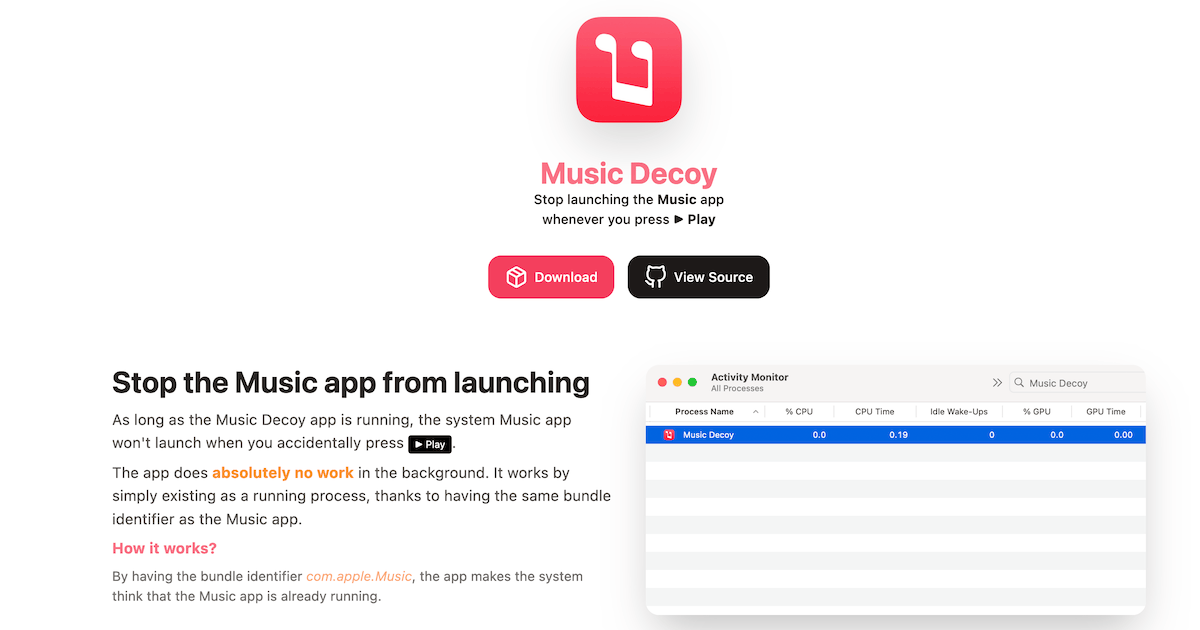
The fix is almost a magic trick. MusicDecoy registers itself with the same bundle identifier as Music (com.apple.Music). When macOS's rcd — the remote-control daemon — checks whether Music is already running before launching it, it finds MusicDecoy sitting there wearing Music's identity, and stands down. The author's own description, quoted in the thread: "The app does absolutely no work in the background. It works by simply existing as a running process." Since v1.1 it can also redirect the Play key to another app like Spotify.
Why engineers in the thread loved the trick
The approach delighted the HN crowd because it's the opposite of brute force:
"I love clever, low-or-no-code engineering solutions like this… the outcome is an app with almost no code at all – just a collision – it's beautiful. (As an aside, coding agents are terrible at this kind of thing; I'd guess Codex… would write some overpowered application that polls in a loop looking for Music App starts and killing them)." — a developer admiring the elegance
The thread also surfaced the blunter, scriptable alternatives. One quoted the StackExchange one-liner that disables the daemon entirely:
"
launchctl unload -w /System/Library/LaunchAgents/com.apple.rcd.plistwill quit the process responsible for the madness (rcd, the 'remote control daemon')… It might be easier to run this app instead; then you have an icon… and an app you can simply quit to restore defaults." — a commenter weighing the manual fix
And the prior-art everyone reached for was noTunes, the older app that blocks Music the heavier-handed way; MusicDecoy's source lives on GitHub under FuzzyIdeas.
The real subject: a default nobody asked for
Underneath the clever hack, the thread is 242 comments of frustration at the behavior itself. The recurring word was "antitrust."
"It's very sad to see Apple using these lowbrow Microsoft tactics. Press ganging your users into launching your other shit product is brand cannibalism." — a commenter on the forced launch
"launching apple music on play, seems very similar to microsoft's early anti trust case and internet explorer" — a commenter invoking the IE precedent
The loss underneath all of it was iTunes. The WebAssembly co-founder in the thread spoke for a generation of CD-rippers:
"I still can't believe they killed iTunes… When they wholesale abandoned iTunes and deleted it from Mac OS in favor of…whatever Apple Music is, I knew I'd never trust them again." — titzer, WebAssembly co-founder
The catch worth noting
One commenter flagged the obvious fragility:
"Slightly concerned Apple would patch this by preventing others from using the same bundle identifier as their official apps, though?" — a commenter on the trick's lifespan
That's the honest so-what. MusicDecoy is a delightful, near-zero-code workaround — and it's also a thumb in the eye of a deliberate Apple default. It works today because Apple hasn't decided to close the bundle-identifier loophole. The fact that hundreds of people will install an app whose entire job is to do nothing is the clearest possible signal that the default itself is the bug.
Get breakdowns like this every day
The top Hacker News stories, unpacked — by email, Telegram, or RSS.
Apple walks back Liquid Glass in the first minute of WWDC, then promises Siri 'later this year'
The very first specific announcement of the keynote wasn't a new iPhone — it was Apple quietly dialing back the Liquid Glass redesign that everyone spent a year complaining about. Then came an 'all-new Siri'... arriving in English 'later this year,' meaning after iOS 27 ships.