Over 450 Thermo Fisher antibody images show signs of digital manipulation
A scientist ran reverse-image searches on a giant catalog supplier's antibody validation pages and kept finding the same Western blot background — flipped, rotated, painted over. The running count is past 450 images, and the company calls it 'optimized for presentation'.
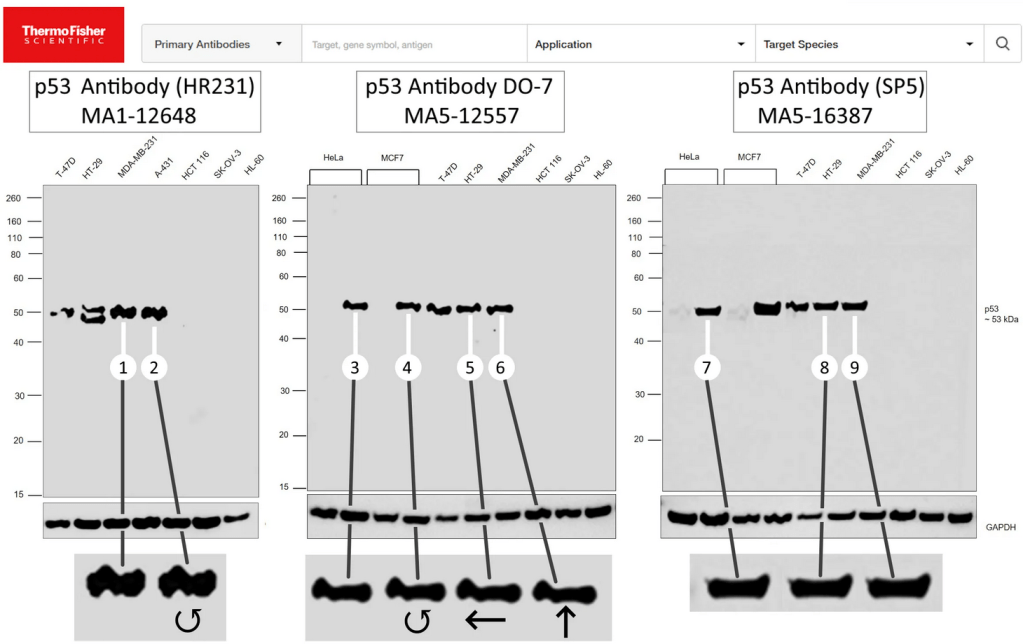
Western blots are the proof that an antibody binds the protein it claims to. On Thermo Fisher's product pages, more than 450 of those proof images show duplicated backgrounds, mirrored bands and 'brushstroke' artifacts visible only after a contrast bump.
A researcher in the thread: years ago his lab quietly flagged faked Ikaros-antibody blots and just kept a private list of vendors never to buy from. Another points out this is only the fraud done badly enough to catch.
A reverse-image search that wouldn't stop turning up the same blot

An antibody is sold on a single promise: it sticks to one specific protein and nothing else. The evidence vendors publish for that promise is the Western blot — a strip of gel where a labeled band appears at the protein's molecular weight. Reese Richardson's post, "How much of Thermo Fisher's antibody data has been manipulated?", argues that a large and growing share of those validation blots on Thermo Fisher's site are not real measurements but digitally edited images — and it hit 418 points in the thread.
The exact tells: a flipped band, a 'brushstroke', the same noise 50 times
The investigation isn't a single smoking gun; it's a pattern repeated across hundreds of product pages. As of early June 2026 the authors had counted more than 450 images on Thermo Fisher pages (plus one from Abcam) bearing signs of manipulation, with over 100 documented in detail and roughly 50 instances of one identical 'background pattern A' reused across supposedly different experiments.
The forensic tells, by category:
| Signal | What it looks like |
|---|---|
| Duplicated bands | The same band reappears after a rotation or horizontal flip |
| Painted artifacts | A contrast bump reveals 'brushstroke' marks — signs of digital painting, not biology |
| Repeating noise | The identical background speckle pattern recurs across unrelated blots |
| Discontinuities | Hard seams where one region was pasted onto another |
Named examples carry real product codes a buyer could be ordering today: MA5-12557 (anti-p53), MA5-32797 (HPRT1), MA5-34786 (UBE2N), MA5-41115 (Synaptophysin), PA5-85730 (BDNF), and PA5-78648 (Neuroligin1). The detection was deliberately low-tech — visual inspection plus Google Lens, Bing Images and DuckDuckGo reverse-image search — which is part of the point: this was catchable by anyone who looked.
'Optimized for presentation and clarity' — repeated six times
Thermo Fisher's reply, per the post, was that the "antibody images may have been optimized for presentation and clarity on the website" — a line Richardson notes the company repeated six times. He calls the framing "galling": copying a background across 50 experiments is not contrast-cleanup, and a fabricated proof is not a presentation choice.
The thread: scientists who already kept a private blocklist
The sharpest reactions came from people who'd hit this years before there was any blog to read. One researcher described catching it firsthand in their own lab:
"We noticed this years ago when looking at -- IIRC -- ikaros antibodies. They were clearly faked. Lacking any sort of platform to gain attention we moved on to Abcam and our lab just sort of maintained a mental map of who not to purchase ANYTHING immuno- from." — a researcher whose lab caught faked blots firsthand
Another framed why almost nobody has sued yet — the antibodies were already assumed unreliable:
"The only reason I think biotech companies are not yet raising hell (and invoking the False Claims Act) is that Thermo Fisher's antibodies are already known to be notoriously bad, and everyone serious seems to have to validate everything themselves." — a commenter on the validation burden
The scariest read came in one line — the caught fraud is the incompetent fraud:
"And this is just fraud that was done with incompetence, so easily caught. How much is done competently?" — a commenter on selection bias
A more cautious voice pushed on what kind of "data" this even is — marketing illustration versus a measurement meant to be relied on:
"If it's essentially marketing material or an instructional example that isn't meant to be representative it being magically clearer than real life doesn't seem like a great sin… If it's something to be relied upon for compliance or as data to be used, that's pretty damming." — a commenter parsing the claim
The distinction matters, but cuts against the company: these blots sit on product pages as validation evidence buyers use to choose a reagent — exactly the "relied upon as data" case.
Why a doctored blot costs more than its price tag
Thermo Fisher offers on the order of 100,000 antibodies; a few hundred flagged blots is, as the top commenter put it, "likely the tip of the iceberg." The cost isn't the reagent — it's the months a grad student burns chasing a result with an antibody that never bound the right protein, and the published papers built on it. A reproduction-quality crisis in reagents propagates into the literature. Underfunded efforts to independently characterize antibodies — like the YCharOS initiative one commenter flagged — exist precisely because the vendor's own validation can't be trusted at face value. The blog's contribution is to make a quiet, lab-by-lab suspicion legible, with product codes attached.
Get breakdowns like this every day
The top Hacker News stories, unpacked — by email, Telegram, or RSS.
A free Mac app stops Apple Music from launching by doing literally nothing
Tap an AirPod wrong, press the play key by accident, hang up a call — and Apple Music launches itself. MusicDecoy fixes it with a trick that has almost no code: it claims the same bundle identifier as Music, so the system's remote-control daemon thinks Music is already running and leaves you alone.