He put a censorship-proof library inside a $20 Wi-Fi light bulb
An ESP32 smart bulb has 4MB of flash. Rick Osgood repartitioned it, dropped in a web server and six banned books, and made a dead drop that screws into any lamp socket. The thread loved the hack and fought about the word 'banned.'
Power it on and it broadcasts an open Wi-Fi network with a captive portal that hands you the library — no internet required. Storage caps it at roughly six ebooks, which the author frames as a feature: each drop reflects whoever made it.
The pushback was semantic and sharp: the titles are Call of the Wild and Huck Finn, not anything actually illegal to own in the US. The build is the star; the framing got the side-eye.
A web server that screws into a lamp socket
Rick Osgood's banned-book light bulb takes an IoTorero smart bulb — an ESP32-C3 with 4MB of flash — tears down the firmware, and repartitions it to hand 2MB to a SPIFFS filesystem, enough for about six ebooks at ~350KB each. Powered on, the bulb broadcasts an open Wi-Fi access point with a captive portal that redirects any request to the library page, so a passerby connects and reads with no internet at all. A password-protected admin panel even sets the LED color so it blends in as an actual bulb.
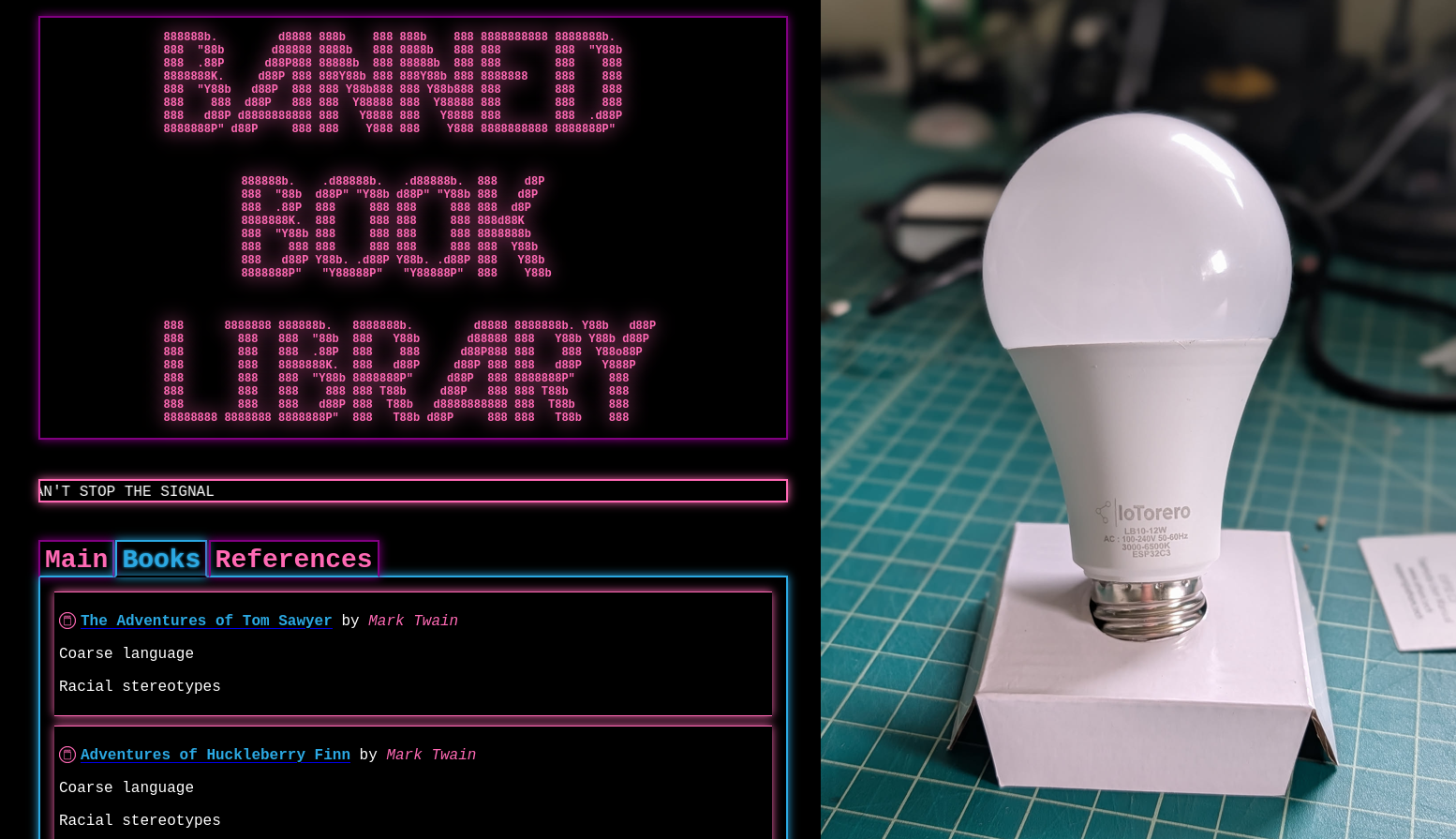
The storage limit, Osgood argues, is the point: "each dead drop will be representative of the person who created it. They have to pick and choose specific books that are important to them." Getting there meant fighting the toolchain — Arduino's safety rails blocked direct flash access, forcing a move to ESP-IDF with raw esp_flash_write permissions enabled. He credits Ben Brown's short story Library for the idea.
The thread split on one word
The build drew near-universal delight and one persistent objection: the label.
"I think calling them 'banned' is so disingenuous. There are actual banned books that are illegal to own in the United States. None of these 'banned books' come anywhere close to meeting that criteria. Very cool project nonetheless!" — a reader contesting the framing
Backing the point, another commenter listed the actual payload: Call of the Wild, Huckleberry Finn, Tom Sawyer, Women in Love — challenged in some school districts, not contraband. The distinction matters to the project's own premise: a censorship-resistant tool is most compelling when the censorship is real.
Prior art and a reality check
The graybeards supplied lineage. One recalled PirateBox and LibraryBox, the flashed Wi-Fi routers that hosted files and forums a decade ago — same idea, new and far smaller hardware. A practical skeptic punctured the stealth claim: "Since the device is a light bulb, it would be difficult to detect" is optimistic, because "a bit of experimentation with turning off power / devices would find it." And a builder pointed at the natural next step — a solar-lamp mesh node — matching Osgood's own note that a friend suggested meshing the drops together.
The hack is the argument
Whether or not these specific titles qualify as "banned," the project lands as a proof of concept for a moment of rising age-verification and KYC mandates: distribution that needs no servers, no accounts, no internet, hidden in the most boring object in the room. The semantics are debatable. The capability — a self-contained library you can mail, plant, and forget — is not.
Get breakdowns like this every day
The top Hacker News stories, unpacked — by email, Telegram, or RSS.
CrankGPT looks like a joke website. The hand-cranked AI inside it is real
The landing page is so absurd that half the thread couldn't tell if it was satire. Behind it: a Raspberry Pi 5 running a local LLM, powered entirely by a hand-crank generator. The crank gets harder to turn while the model thinks.