To escape X, the EU joined a closed-source startup and ignored the open one
The European Commission, the ECB, von der Leyen and Lagarde all moved from Bluesky to W Social in the name of digital sovereignty. The platform had quietly deleted its source code from GitHub a few months earlier.
W Social bills itself as Europe's sovereign alternative to X. In June 2026 the European Commission, the ECB, Ursula von der Leyen and Christine Lagarde migrated their accounts to it from Bluesky.
Elena Rossini's post notes the platform is a for-profit Swedish LLC that quietly deleted its GitHub repo, going closed-source, while an open non-profit network on the same protocol, Eurosky, drew no press and no politicians. The thread's verdict: the same private-platform mistake all over again.
A sovereignty launch that quietly went closed-source first
When European institutions abandon Elon Musk's X, the move is supposed to be about digital sovereignty — European data, European infrastructure, no dependence on an American billionaire's platform. Elena Rossini's post argues the latest version of that move is theater.
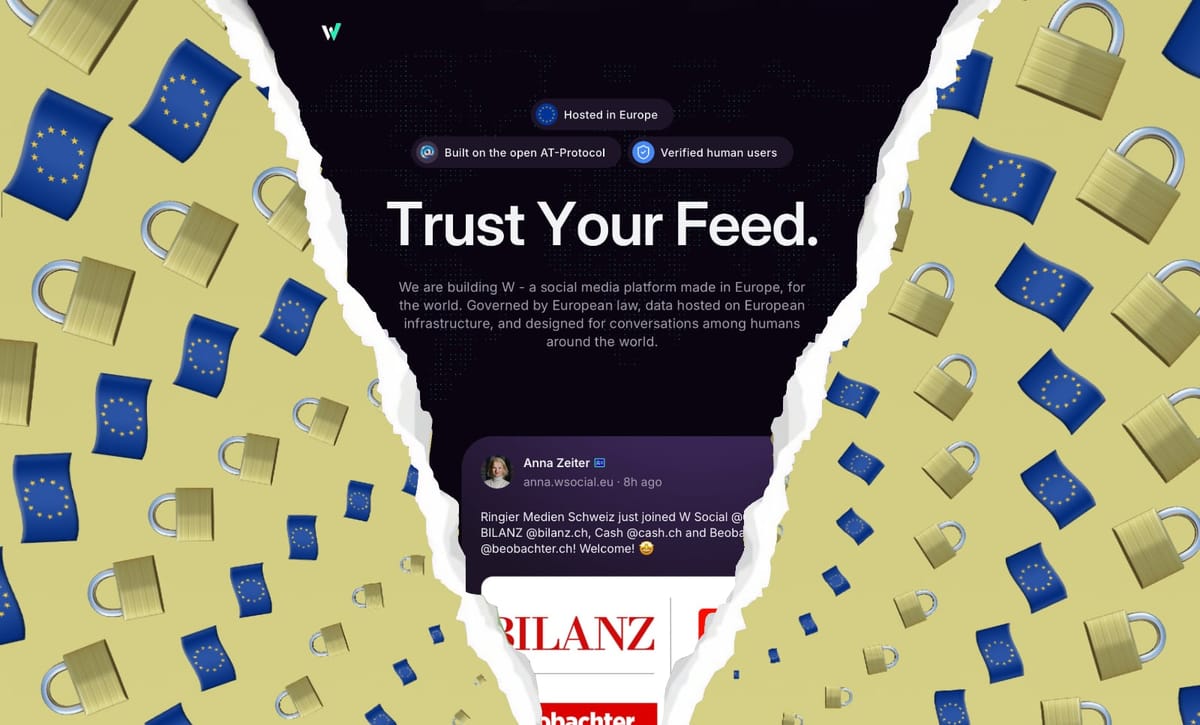
The trigger: in June 2026 the European Commission, the European Central Bank, Commission president Ursula von der Leyen and ECB president Christine Lagarde all migrated their accounts from Bluesky to W Social, a microblogging platform forked from Bluesky's AT Protocol, built by Swedish entrepreneurs and pitched as Europe's answer to X. Rossini's objection is concrete, not vibes-based: W Social is a closed for-profit venture that deleted its GitHub repository around March 2026 without notice, while a genuinely open, non-profit European network on the same protocol, Eurosky, run by the Modal Foundation, got no national-news launch and no high-profile political accounts. She also flags that an advisor to W Social is a privacy officer at Sam Altman's iris-scanning identity company.
"Why make the same mistake all over again?"
The thread read the migration as institutions repeating the exact dependency they claimed to be escaping.
"jumping onto a private platform owned by a company inevitably results in you becoming the product sold and enshittification. … Learn the lesson. Use Mastodon this time." — the founder of PartsBox
The quietest mystery in Rossini's post, why the open option got ignored, got the sharpest version in the thread:
"there was never a peep about this in the press - while the W Social launch was on national news and a bunch of high-profile EU politicians immediately joined. What's going on here?" — a commenter contrasting the two launches
And the verification pitch, central to W Social's sovereignty branding, drew an immediate empirical rebuttal:
"for all their talk about human verification, I have 6 accounts under different names :)" — a commenter who made six accounts
"Sovereignty" as a word that does other work
The most cutting reframe in the thread questioned whether "sovereignty" was ever the real category.
"Sovereignty is mostly just a protectionist racket. … framing industrial policy as 'sovereignty' rather than protectionism just sounds more strategic and security-oriented." — the founder of a competitive-intelligence platform
Another predicted the grift pattern directly: money chasing the right vocabulary.
"many - most? - of these European digital sovereignty projects will end up being grifts. Whenever money is being thrown at any crappy, low-effort startup that knows how to speak the right language, you get grifters coming out of the woodwork." — a commenter on the sovereignty-grift pattern
The open alternative was sitting right there
The practical reply ran underneath the cynicism: the thing the institutions said they wanted already exists, in the open, on the same protocol. Commenters pointed to mu.social, built on the Eurosky stack, as a like-for-like replacement that nobody in Brussels chose. That's the reversal. The story isn't that Europe lacks a sovereign social network — it had a transparent, non-profit one. It's that public institutions, given a choice between an open network with no marketing and a closed startup with a launch event, picked the launch event and called it sovereignty.
Get breakdowns like this every day
The top Hacker News stories, unpacked — by email, Telegram, or RSS.
The same molecule costs $50 or $1,500 depending on the label on the vial
A King's College study says hospitals can run late-stage trials of old drugs at under 10% of pharma's cost. In the thread, an insider names the case the press release softened: a $50 cancer drug and a $1,500 eye drug that are molecularly identical.