Wordle for gerrymandering: a daily puzzle where you rig the map to win
You drag houses into equal-size districts and try to win more of them than the other party - the same packing-and-cracking the game is teaching you to recognize. Players keep noticing the rules are friendlier to mapmakers than real elections are.
Gerrymandle is a daily puzzle: redraw electoral districts on a grid of colored houses so your side wins the most seats. It deliberately picks 'a fun game over representing real gerrymandering accurately' - and that choice is exactly what the thread argued about.
One reader wants it in high-school civics. A mathematician dropped a paper proving you can district fairly with a cake-cutting trick. Another flagged the deeper problem: even defining 'fair' is a contradiction.
A daily puzzle that makes you the gerrymanderer

Gerrymandle is a Wordle-style daily puzzle with an uncomfortable twist: instead of guessing a word, you carve a map. The board is a grid of colored houses - each color a party - and you click adjacent tiles to group them into equal-size districts, every house assigned, no islands. A party wins a district by holding the most houses in it; tie a district and nobody takes it. Win more districts than your opponent and you win the election. The tutorial teaches the two real techniques by name: packing (cramming opponents into a few districts) and cracking (splitting their voters thin across many).
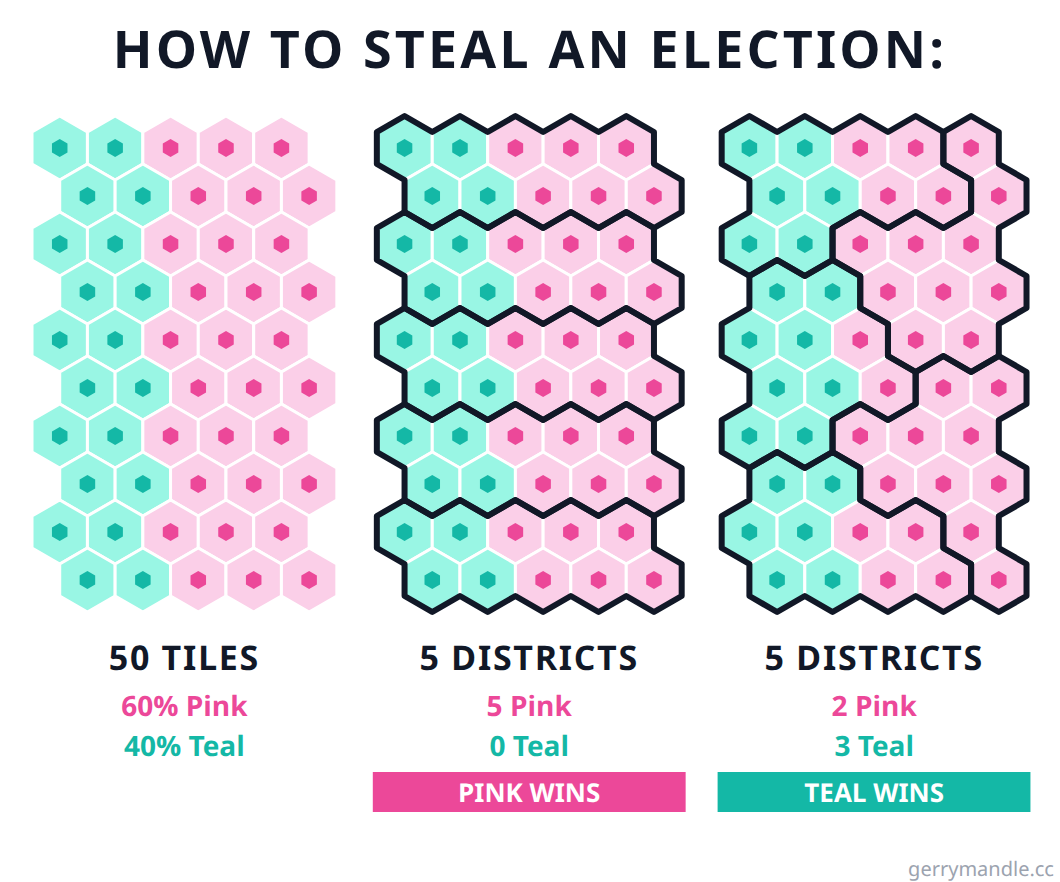
The creator made a deliberate trade, and the thread noticed: gameplay over fidelity. One player praised exactly that.
"I like the decision to prioritise a fun game over representing real Gerrymandering accurately. It looks like a lot of thought has gone into this." — a player who finished the day's puzzle
Where the simplification leaks
The friendly rules drew friendly fire. A reader who'd put it in a classroom flagged the one rule that breaks realism.
"I could see this being a great activity in a high school civics class… One rule that tripped me up is: 'If two parties tie in a district, nobody wins it.' This isn't realistic as ties don't happen in practice" — a commenter who'd assign it in a civics class
A cake-cutting fix, and a 435-seat cap
The discussion quickly outgrew the game. One reader surfaced an actual research result - districting fairly by the divide-and-choose method kids use for cake.
"Some mathematicians worked out a way to fairly do districting, similar to having one kid cut the cake and the other kid gets first choice" — a commenter citing Pegden, Procaccia and Yu's arXiv paper on a partisan districting protocol
Another brought the hard numbers behind why districts are so large in the first place:
"The number of voting members has been strictly capped at 435 since the passage of the Permanent Apportionment Act of 1929. In 1930, there was an average of 294k citizens per Rep. In 2020, there was an average of 761k citizens per Rep." — a neuroimaging scientist and part-time coder
"Fair" is the part the game can't solve
The deepest point was that the puzzle's win condition hides a genuine paradox. If a state splits 60/40 across ten districts, do you want ten representative 60/40 districts (a 10-0 sweep) or six-versus-four seats?
"there's a real tension between 'competitive districts' and 'representative outcomes'." — a commenter working through the 60/40 districting case
That tension is the actual lesson, and the game smuggles it in under a daily-streak hook. Several readers wanted the obvious sequels - puzzles built from real historical maps, or a result screen showing how proportional representation would have killed the sneaky win. The cleverness here isn't the SSL bug some users hit or the fiddly mobile controls; it's that a Wordle clone gets people to internalize packing and cracking by making them do it, then leaves them arguing about apportionment math in a comment thread. The complaint that it's "not realistic" is, quietly, the point.
Get breakdowns like this every day
The top Hacker News stories, unpacked — by email, Telegram, or RSS.
Two people built an open e-paper monitor that refreshes in 50ms instead of 100
E-ink monitors have existed for a decade and all felt like typing through molasses. Modos, a two-person startup, halved the pixel response time and pushed a color panel to 60Hz — by open-sourcing the display controller nobody else would.