A frog-gut microbe wiped out tumors in every treated mouse; read the fine print
A single IV dose of Ewingella americana, a bacterium pulled from amphibian guts, cleared colorectal tumors in 100% of treated mice and beat both chemo and a checkpoint drug. The write-up that put it on Hacker News comes from an outlet the thread calls a crank blog.
Underneath a sensational blog post sits a real paper in Gut Microbes. A strain of Ewingella americana from amphibian guts, given as one IV dose, homes to a tumor's low-oxygen core, multiplies fast, and recruits T cells and neutrophils; in mice it cleared colorectal tumors and beat both chemo and a checkpoint drug.
The flip: the outlet is a McCullough Foundation blog readers call a crank source, the injected tumors were small and tracked for only two weeks, and curing mice is the routine entry ticket that few therapies survive in humans.
What the mouse data actually shows
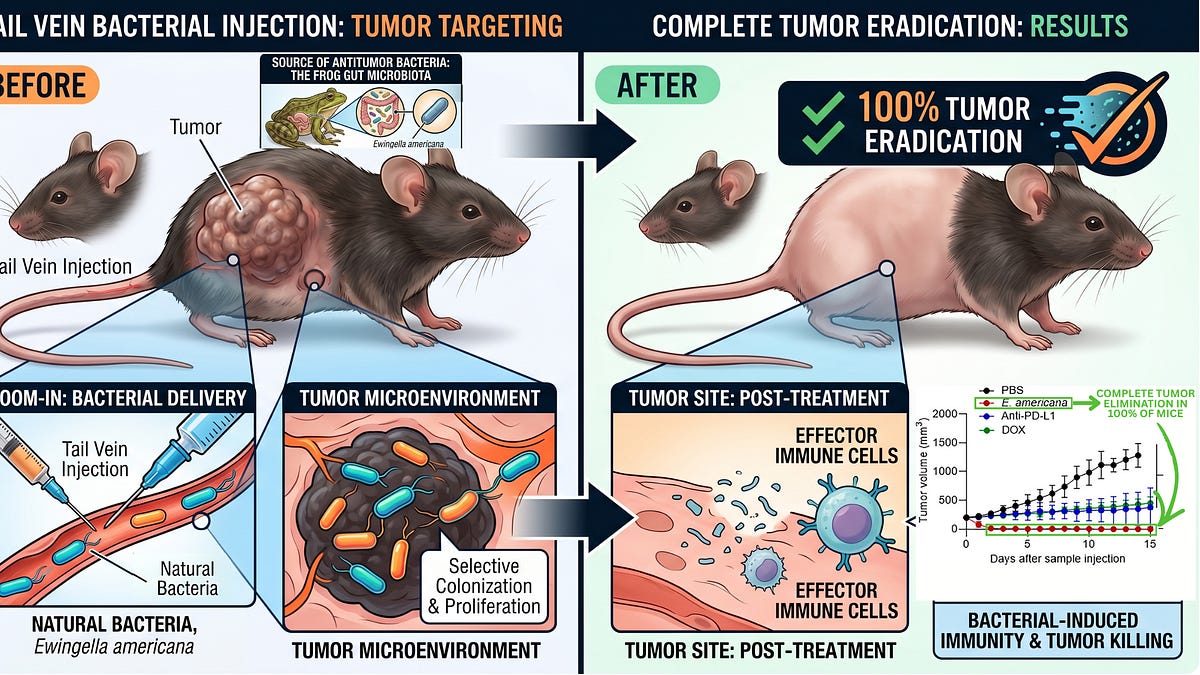
Strip away the outlet and a real experiment sits underneath. Screening bacteria isolated from amphibian and reptile guts, researchers found a strain of Ewingella americana that, given as a single intravenous dose, cleared colorectal tumors in every treated mouse. As a facultative anaerobe it homes to the oxygen-starved core of a tumor, proliferates fast, and floods the tissue with T cells, B cells, and neutrophils alongside inflammatory cytokines such as TNF-α and IFN-γ. In this model it beat the chemotherapy drug doxorubicin and an anti-PD-L1 checkpoint inhibitor, while clearing from the bloodstream within 24 hours. The paper ran in Gut Microbes; the write-up that reached Hacker News is by the McCullough Foundation's Nicolas Hulscher.
The illustration above drew its own complaint: readers judged the blog's AI-generated diagram plausible at a glance but wrong on close inspection.
Real study, wrong messenger
The thread's first task was separating the paper from the blog. One reader vouched for the underlying science:
"the NIH published findings on this same subject last year" — a reader who pointed to the NIH's own write-up
Others were harsher on both the source and the setup:
"a track record of overselling single-study preclinical results with breathless framing… and mice are basically clones of one another" — a data scientist
Then the fine print behind that clean sweep:
"The title hides that it was a small tumor they injected in the mice and more importantly that it disappeared for two weeks until the experiment ended." — a reader who dug up the earlier discussion
A historical rhyme sharpened the caution:
"Coley and other practitioners claimed some substantial success, but the mechanism of action was not understood, and the treatment varied so much that scientific verification was elusive." — the operator of DamnInteresting
In oncology, curing a mouse is the entry ticket, not the finish line: only a low-single-digit share of therapies that erase rodent tumors survive the move into human patients.
Get breakdowns like this every day
The top Hacker News stories, unpacked — by email, Telegram, or RSS.
Conception grew mini-ovaries from a blood draw, and the thread argued about mitochondria
From a routine blood draw, Conception reprogrammed cells into stem cells, then coaxed them into miniature human ovaries holding early eggs, which it calls the first human follicles built entirely from iPSCs.