A 100-year-old federal report describes 1926 America — and the thread argues over whether we're better off or just louder about it
Nineteen million cars, radio arriving in the living room, half the country still rural and draining into cities: a forgotten government survey of 1926 reads like a rough draft of 2026's anxieties. Then a commenter drops the fact that upends the nostalgia — wealth was more concentrated then than now.
Derek Thompson's dive into the 1926/1933 'Recent Social Trends' report argues America's present unease over technology, work, family and values rhymes with a century ago, when the car, radio and rural-to-urban flight destabilized the old order. Life is materially far better now, he insists, yet the emotional echoes are real.
The thread turns it into a referendum on progress. One reader notes wealth was more concentrated in the 1920s; a Xoogler argues the poorest American today outlives Rockefeller.
The report that makes 1926 rhyme with 2026
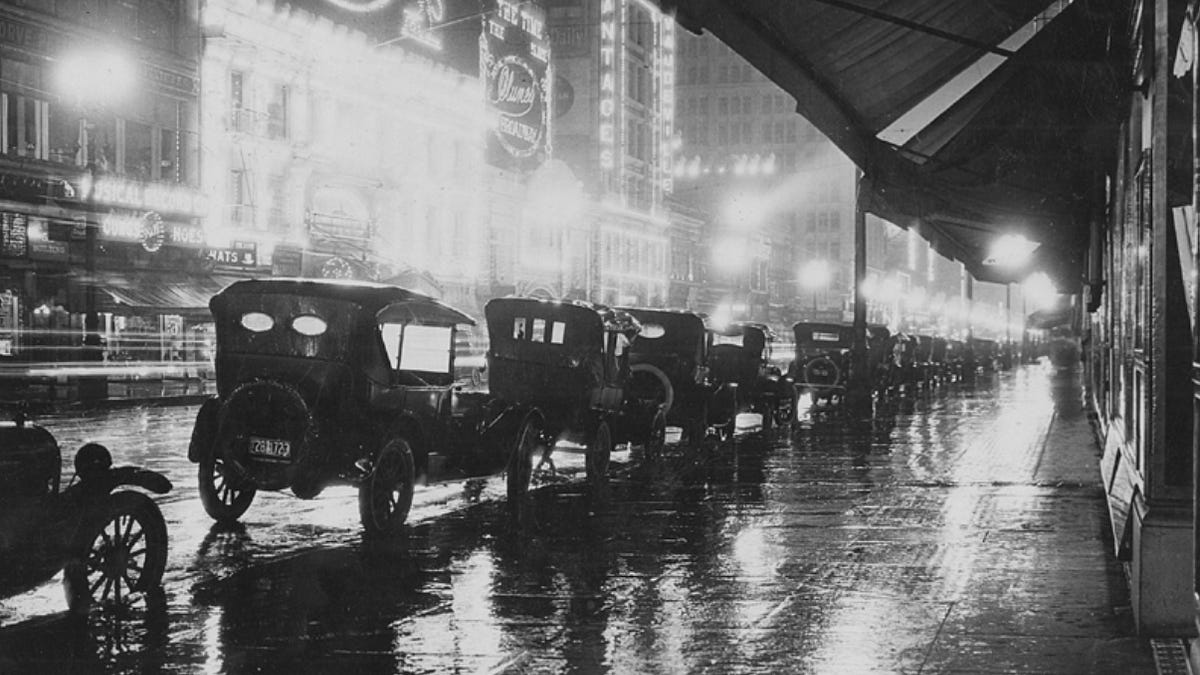
Derek Thompson's *America, 1926* mines the federal Recent Social Trends survey to argue the country's current anxieties are a re-run. The 1926 snapshot: ~120 million people, about half still rural; 19 million cars on the road, up from 8,000 in 1900, a Model T rolling off the line roughly every 10 seconds; radio and, by 1927, sound film arriving to rewire attention; 1,200 manufacturing and mining mergers between 1919 and 1928 as chain stores swallowed Main Street. Mechanization, mass media, and migration were dissolving a settled order into a market-driven one — the same sentence you could write about now. Thompson's twist is that he refuses the decline narrative: by nearly every material measure, he argues, today is radically better.

The thread relitigates 'are we better off?'
The discussion became the very pendulum the article describes. The most counterintuitive fact came with receipts:
"You might be surprised to hear that wealth concentration was worse a hundred years ago than it is now. It's very easy to assume otherwise when the numbers are so much larger now across the board." — a founder, formerly at Indeed, Apple and Amazon, linking historical wealth data
Someone backed the article's optimism to its limit:
"today U.S. citizens in the bottom economic decile live longer lives… with more comfort and convenience than even the wealthiest and most powerful people of 100 years ago. Not even… Carnegie and… Rockefeller… had access to anything approaching modern health care…" — a former Google employee arguing the floor has risen
Even the article's craft got audited — a reader flagged that it repeatedly calls Bill Bryson a "historian" when he's a popular-humor writer. And a claim that circulated in the thread — that the Greatest Generation drifted left with age — met a firsthand rebuttal:
"My dad lived through the Great Depression, and fought desperate battles in WW2 and Korea. As a young man, he was a socialist. His experience in fighting for American freedoms changed all that… I don't believe you'll find many communists in the greatest generation." — a commenter recounting his father's arc
The thread never settles it, which is the point worth leaving on: whether 2026 feels like decline or progress depends entirely on whether you measure the ceiling or the floor — and 1926's readers were arguing the exact same axis.
Get breakdowns like this every day
The top Hacker News stories, unpacked — by email, Telegram, or RSS.
A new paper proves markets stay competitive only if P≠NP. The thread's rebuttal: we watch cartels fix prices all the time
Philip Maymin's theorem says competition survives only because catching a cartel-cheater is computationally too hard to make punishment credible. Elegant — except, the thread notes, stable price-fixing cartels demonstrably exist, and NP-hard problems get solved with heuristics every single day.