America built a 76,000-square-foot artificial wound to breed 200 million flies a week — then forgot why
To erase a flesh-eating parasite, the US ran a factory that was, in essence, one giant heated wound, dropping sterile flies from planes for decades. The barrier held until 2022. Now the screwworm is marching north again, and a commenter notes the original cure could never be built today.
The New World screwworm was eradicated from the US via the Sterile Insect Technique — radiation-sterilized males flooding the wild population — then held back for decades by a fly-drop 'barrier' at the Darien Gap. The barrier breached in 2022–2023 and the parasite is spreading north again.
The thread frames it as a solution that became a victim of its own success — and flags that the foundational research, irradiating flies with cobalt-60, would never clear an ethics board now.
The grotesque marvel that beat the screwworm
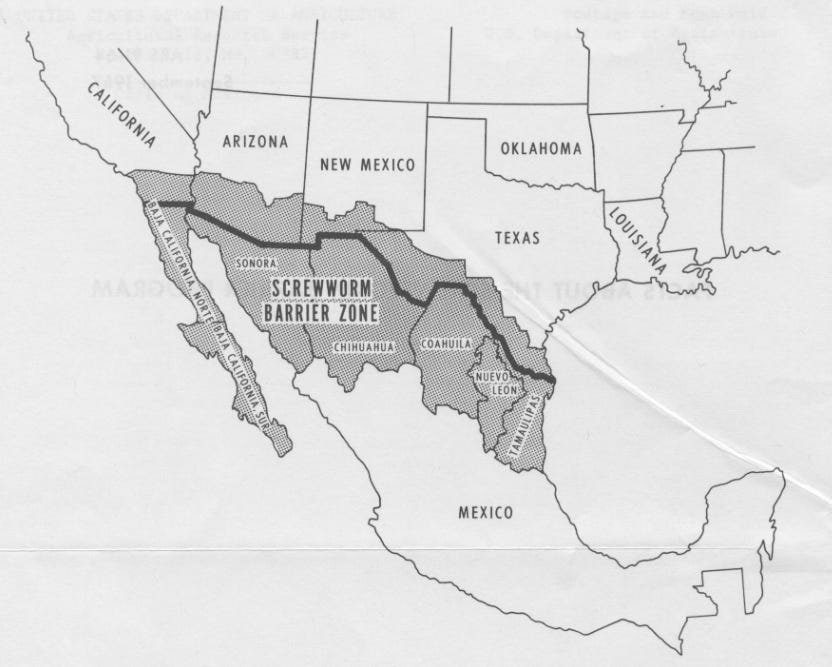
*The Fall and Rise of Screwworm* tells one of the great eradication stories and its unraveling. A 1935 USDA survey counted 1.2 million screwworm infections and 180,000 dead animals in Texas alone. The weapon that beat it was the Sterile Insect Technique: irradiate male flies into sterility, release them by the hundreds of millions, and let them out-compete wild males until the population collapses. The Mission, Texas factory (1962) ran 76,000 square feet, 24/7, producing over 200 million flies a week — a facility one commenter called, quoting the piece, essentially "a 76,000-square-foot artificial wound." The US mainland was cleared by 1966; a fly-drop barrier at the Darien Gap then held the line for decades at roughly $15M a year.
The barrier breached in 2022. By 2025 Mexico had 30,000+ cases, and the fly is moving north again.
A solution undermined by its own success
The thread latched onto the article's Chesterton's-fence framing — a problem solved so completely that we dismantled the conditions maintaining the solution. The most resonant objection was about whether the founding science is even repeatable:
"It sounds like the original research done 30s-50s would not be possible today. No one is getting an ethics approval for that. And 'let me just get some cobalt-60' is probably also not happening" — a commenter on the institutional impossibility of the original program
Another raised the biological long game the technique may be losing:
"Isn't there a risk that the artificially introduced reproductory pressures would select for screwworms that produce males that are resistant to radiation… increasing the proportion of radiation resistant varieties" — a commenter raising the evolutionary-selection risk
And someone caught the article soft-pedaling a live political thread — its one-line wave-off of DOGE-era cuts to the monitoring programs, in a piece otherwise obsessive about detail. The implication the thread lands on is uncomfortable for any long-running public program: the screwworm barrier worked so well that the memory of why it existed faded, the funding frayed, and the fly is now collecting on decades of forgetting.
Get breakdowns like this every day
The top Hacker News stories, unpacked — by email, Telegram, or RSS.
A viral post says Zuckerberg 'admitted' the AI layoffs failed. Ex-Meta engineers say the quote doesn't say that
The headline is damning: Meta fired thousands betting AI could replace them, and Zuckerberg just confessed it didn't work. The trouble, per Meta veterans in the thread, is that his actual quote — progress 'hasn't accelerated as expected' — is a thin wrapper the post inflates far past what Reuters reported.