The EU's new anti-distraction camera keeps distracting the drivers it's meant to protect
Over Christmas, a driver spent several minutes hunting for the source of an intermittent dashboard beep. The culprit: the car complaining his eyes weren't on the road enough. Diagnosing which alert it was, of course, meant looking away from the road.
From 7 July, every new car sold in the EU must ship an infrared camera aimed at the driver's face: the Advanced Driver Distraction Warning system. It arms above 20 km/h, tracks your gaze, and beeps when your eyes leave the road for 3.5 seconds. You can mute it, but never permanently.
The thread filled with cars that get it wrong: a Volvo that reads singing as yawning, then nags you for looking at the screen it just lit up. One Ford owner disagreed, saying his system only pings him when he's genuinely distracted, and might save lives.
What the camera actually does, and what the law forgot to say
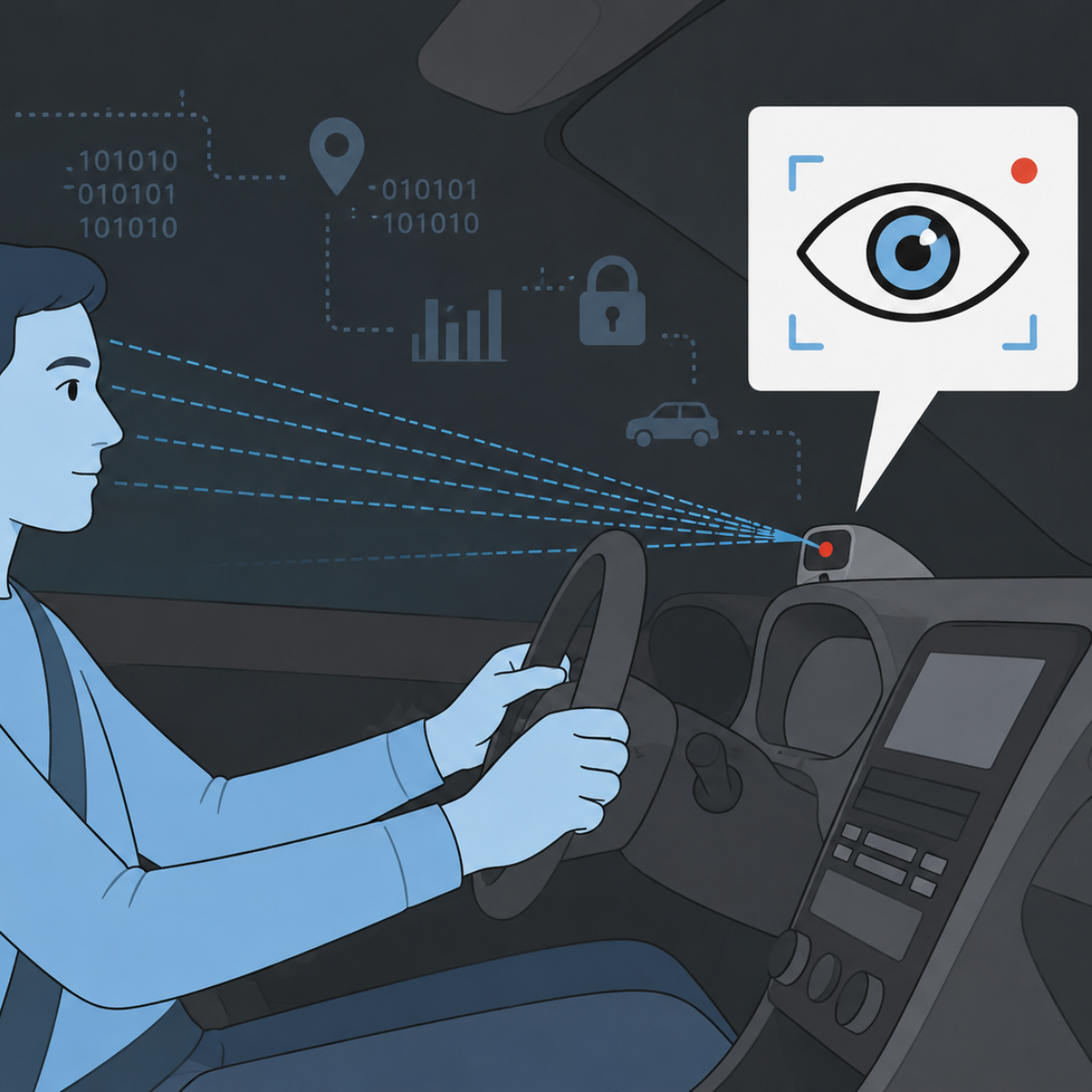
From 7 July 2026, every new car sold in the EU must ship the Advanced Driver Distraction Warning system (ADDW), mandated by the EU General Safety Regulation. An infrared camera near the steering column tracks the driver's gaze: look away from the road for more than 3.5 seconds at highway speed (6 at lower speeds) and it warns you. It arms above roughly 20 km/h and cannot be permanently switched off. Mute it, and it returns next trip.
The regulation tries to pre-empt the obvious privacy objection. ADDW must run as a "closed loop," processing faces locally and sending no biometric data to the manufacturer or third parties. The hole, per the source: the GSR never defines what data retention counts as "necessary," sets no deletion deadline, and mandates no independent audit that the loop is really closed. That matters against the industry's record, which the report puts starkly: 84% of car brands share or sell driver data and 76% sell it outright, with GM and Honda feeding driving-behavior data to the brokers LexisNexis and Verisk.
The drivers who live with it: yawns read as fatigue, wheels that fight back
Owners of today's systems filled the thread with failure modes. A Volvo EX30 owner described a loop worthy of a sketch:
"singing or talking being mis-interpreted for yawning ... a noise telling me 'maybe it's time for a break', which makes me look at the screen in the center console, which then triggers a second notification telling me to 'please look at the road'." — a Volvo EX30 owner
Sometimes the car does more than nag. One driver recounted a rented Kia on a downhill curve near a group of cyclists:
"The car detected them as a hazard to avoid and STRAIGHTENED AND LOCKED MY STEERING WHEEL in the middle of the curve turn. I ran into a shallow ditch." — a driver describing a Kia rental
Not everyone is against it. A Ford driver running BlueCruise made the case for the mandate:
"It also seemed really accurate. I never remember it beeping at me when I was actually paying attention ... It's totally plausible to me that this kind of nudge will save a lot of lives." — a Ford BlueCruise driver
The deepest objection came from aviation. dmitrygr, an engineer who has passed through VMware, Google and Apple, argued the outcome is already documented:
"This sort of nonsense is well studied in aeronautical world, and will lead to too many alerts, which, in turn, lead to predictable outcomes" — dmitrygr
He pointed to the Flight Safety Foundation's work on "normalization of deviance": flood a human with alarms and they learn to ignore all of them. One reply pushed back that the parallel breaks down, since a cockpit has a copilot, an autopilot and FAA-regulated work hours, while "your uncle coming back from the bar at 2am doesn't have any of that."
That is the unresolved bet. The law forbids selling what the camera sees but sets no retention limit and mandates no audit, so a driver's only guarantee that the loop stays closed is trust in an industry that, by the report's own numbers, already sells the data it collects.
Get breakdowns like this every day
The top Hacker News stories, unpacked — by email, Telegram, or RSS.
Rejecting Chat Control now needs 361 EU votes. Passing it needs a simple majority
On Tuesday the European Parliament voted 331 to 304 to fast-track a fresh vote on Chat Control 1.0, the lapsed rule letting Meta, Google and Microsoft scan private messages for abuse imagery. The re-vote lands Thursday, the last sitting before summer recess, when the benches are half-empty and rejection needs an absolute 361-seat majority that almost never shows up.