An engineer designed a RISC-V game console's CPU, GPU, and PCB from scratch
Luke Wren spent his spare time writing his own RISC-V processor core, graphics pipeline, and PCB layout, then fit the whole console onto a low-end FPGA with room left over. By day he designs chips at Raspberry Pi; RISCBoy is what he builds after hours.
RISCBoy fits on a $65 prototyping board, but nothing above the silicon was borrowed: a custom RISC-V core that passes the official compliance and formal-verification suites, a from-scratch graphics pipeline, and a complete KiCad PCB layout, all written solo in Verilog.
The thread placed the author fast — Wren also built the RP2040's DVI video trick — then produced a bigger reversal: the founder of an open-silicon shuttle service says a version of RISCBoy already got taped out as real hardware. He still doesn't know if it works.
A Game Boy Advance from a universe where RISC-V shipped in 2001
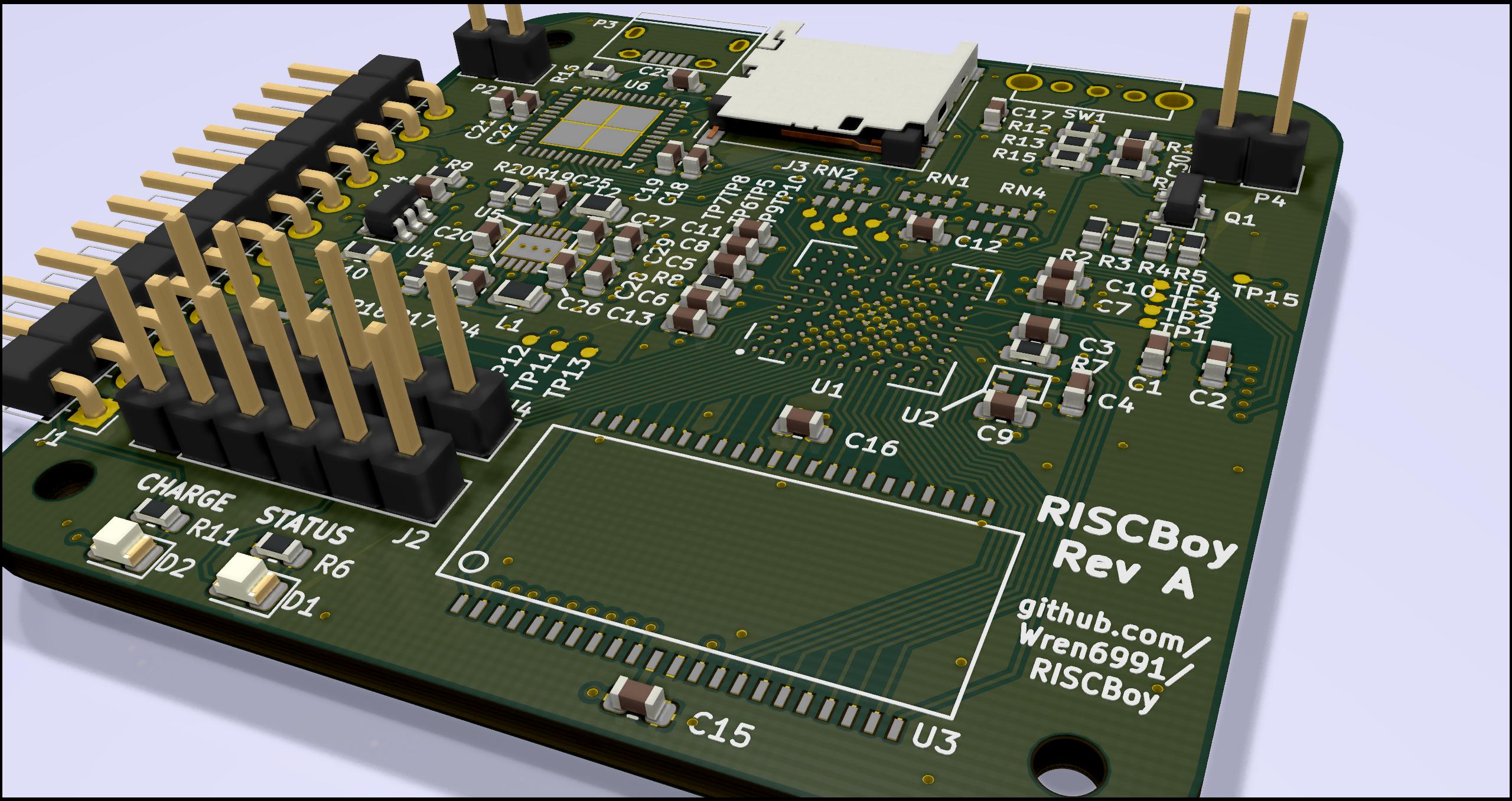
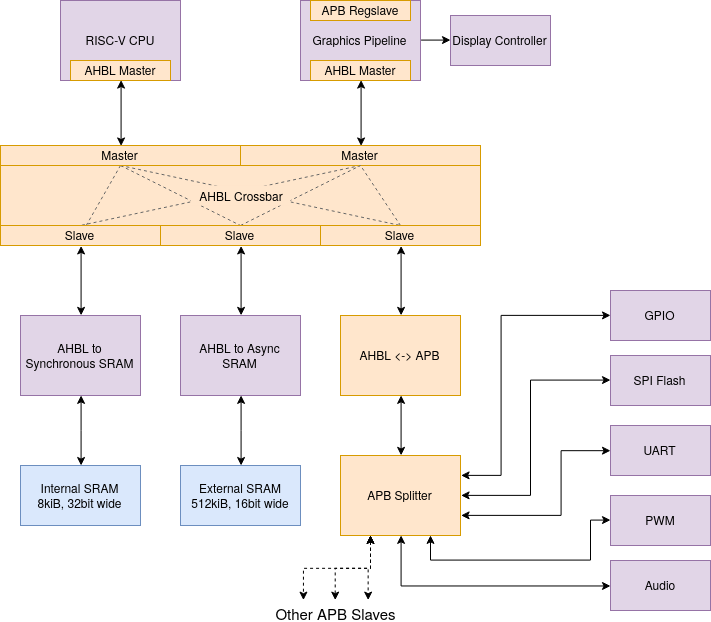
On its GitHub page, RISCBoy introduces itself in one line: "It is a Gameboy Advance from a parallel universe where RISC-V existed in 2001. A love letter to the handheld consoles from my childhood, and a 3AM drunk text to the technology that powered them." Everything underneath that line is built, not assembled. The processor is a custom core called Hazard5, implementing the RV32IMC instruction set; it passes the official RISC-V compliance suite plus the riscv-formal verification suite, along with the author's own formal checks for bus compliance. The raster graphics pipeline and display controller are custom too, as is the surrounding chip infrastructure: an AHB-lite crossbar, an APB peripheral fabric, memory controllers, UART, GPIO. The PCB is a full KiCad layout, sized to fit a cheap four-layer prototyping run.
All of it is written in synthesizable Verilog 2005 and squeezed onto a Lattice iCE40-HX8k, a LUT4 FPGA with just 7,680 logic elements. That's small enough that the README compares fitting a 32-bit console onto it to using "a crowbar and some vaseline." The whole build chain is open source too: Yosys for synthesis, nextpnr for place-and-route, Project IceStorm for the bitstream, no vendor tools involved. A companion PDF in the repo, doc/riscboy_doc.pdf, documents the design in more depth, including a programmable scanline-buffer-based rendering pipeline on the graphics side.
The RP2040 engineer's spare-time project just became real silicon
Commenters placed the author fast: he's Luke Wren, an ASIC design engineer at Raspberry Pi and one of the team that shipped the RP2040 chip. He's also the person behind PicoDVI, which pulls DVI video output out of an RP2040 that has no dedicated video hardware at all. Both projects share the same trick: take a small, unglamorous chip and make it do far more than its specs suggest.
Then the thread produced a genuine reversal. RISCBoy targets a cheap FPGA, but a version of the design has already gone further:
"The design was taped out on the first wafer.space run … but I have not heard if it actually worked or not." — Tim "mithro" Ansell, founder of wafer.space
wafer.space bundles dozens of independent open-hardware designs onto one shared silicon wafer, so an individual engineer can get a real chip made without funding an entire production run alone. RISCBoy, listed as RISCBoy-180 on that first shuttle run, was one of forty projects manufactured on GlobalFoundries' 180nm process. Whether the chip actually boots is still an open question, even to the person who ran the shuttle.
What "from scratch" costs, down to the bus protocol
The depth of the from-scratch claim surprised more than one reader. An engineer in the thread admitted he'd avoided learning the AHB and APB bus protocols for years, assuming they were locked behind ARM's licensing — RISCBoy implements both anyway, built straight from the public specification documents rather than borrowed IP.
For the graphics side, the retro-hardware crowd pointed straight at the documentation:
"The programmable scanline-buffer-based rendering pipeline described in the PDF is worth a read for fans of such things." — the creator of the 8bitworkshop retro-computing IDE
And the appeal wasn't only technical. One of Hacker News's earliest well-known users summed up the pull in a single line:
"i love the 'hardware from an alternate universe' projects." — Joshua Schachter, founder of Delicious
Nobody in the thread answered the one question that actually decides RISCBoy's future: is the harder problem the hardware itself, or the total absence of a developer ecosystem and toolchain around it? Wren solved the silicon side alone, on a hobbyist's FPGA board and now, maybe, in a real chip. Getting anyone else to write games for it is a problem no single engineer can solve after hours.
Get breakdowns like this every day
The top Hacker News stories, unpacked — by email, Telegram, or RSS.
Cory Doctorow: the 'reverse centaur' who takes the blame for AI's mistakes
A Hearst freelancer got the byline on a 64-page summer reading guide stuffed with books that don't exist — the job of three interns and a fact-checking desk, done by an AI, with him left to absorb the blame. Cory Doctorow calls this a 'reverse centaur': not a human riding a tireless machine, but a machine riding the human.