FreeInk brands its open e-reader PCB as a $60 build. The receipts say otherwise.
FreeInk markets a solder-it-yourself circuit board, complete with a charging circuit, battery protection, and an optional frontlight, as roughly $60 to build. A Hacker News reader ran the project's own parts list and got $63.74, and only if you order five boards at once.
FreeInk ships an open-source stack for e-paper readers: software, firmware, and a build-it-yourself PCB, aimed squarely at ESP32-class chips like the ones inside cheap Chinese readers such as the Xteink X4.
Half the Hacker News thread showed up asking for a Kindle, Kobo, or reMarkable port anyway. A self-described veteran electronics engineer had the same answer for every request: wrong chip entirely, nothing a firmware update could fix.
Every layer is open, if you own the right chip
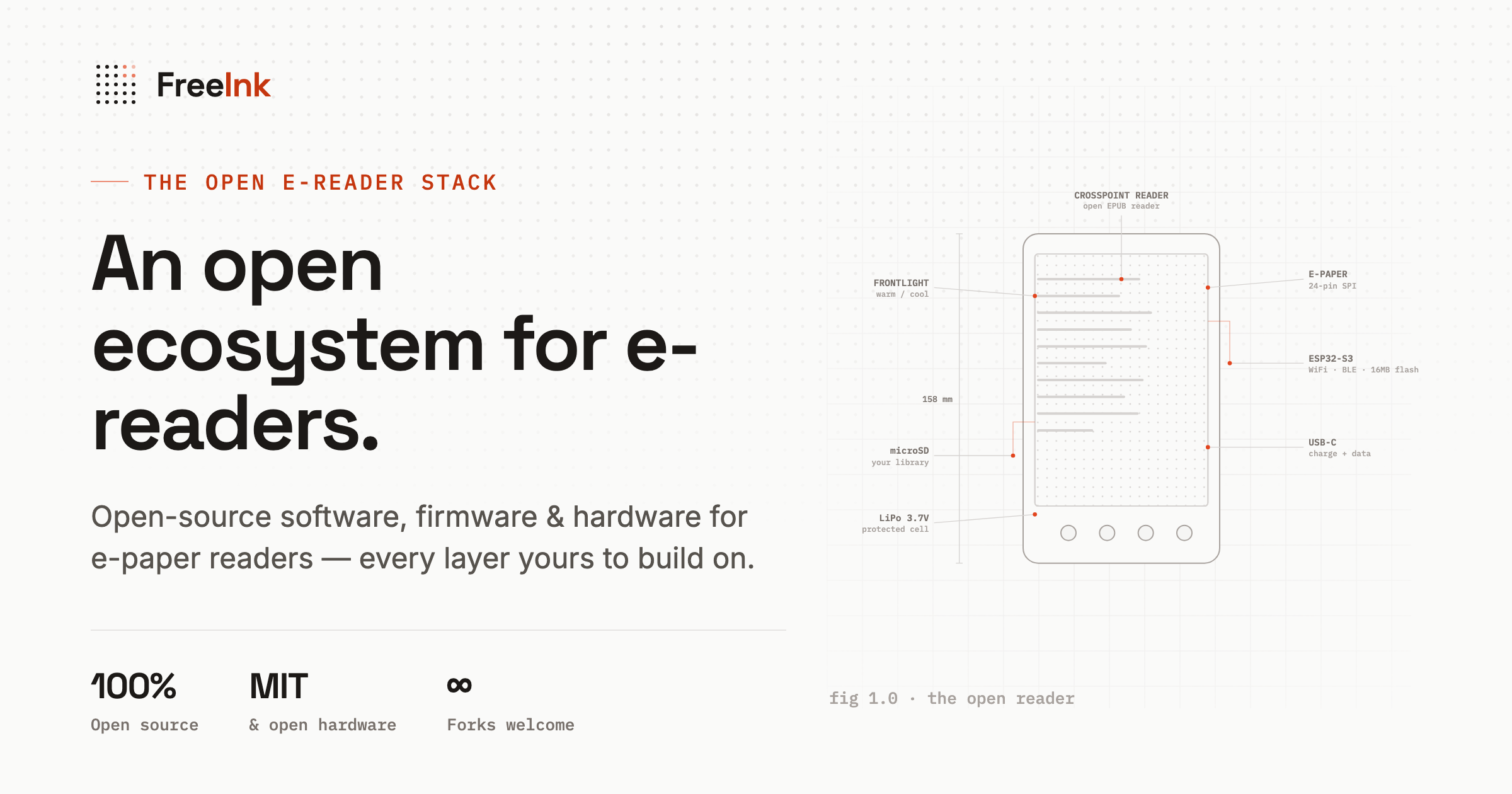
FreeInk describes itself plainly: an open-source collective building the software, firmware, and hardware for e-paper readers, with every layer released for anyone to pick up, extend, and make their own. That's not a device you order, it's a stack you assemble. The hardware end is a PCB you solder yourself: a charging circuit, battery protection, an optional frontlight, and a 24-pin e-paper interface, all on one board the site prices at "around $60." It targets ESP32-class chips, the same family already inside cheap Chinese e-readers like the Xteink X4 that several commenters in the thread already own and flash with third-party firmware. The front page also carries a matrix of supported devices and, quietly in the footer, a link to CrossPoint, an existing firmware project for the same hardware.
The thread priced the "$60" board itself
One reader didn't take the number on faith.
"According to their own parts lists, if you are build 5 of these, you're in for $63.74 (plus shipping?) So if you want just one (like a normal person), it's going to cost more." — an engineer with 6,500+ karma who ran the actual numbers
That's before a case: FreeInk's site has no plans for one, so the "$60 build" ships as a bare board.
Every Kindle and Kobo request gets the same answer
Half the thread was asking for ports before that math even landed.
"Lots of the comments here are about porting to older kindles or eReaders, but the firmware is currently for the ESP32 chipset which none of these use." — a self-described "crusty-old electronics and computer engineer"
It's not a software gap FreeInk could close with an update. Kindles, Kobos, and reMarkable tablets run different silicon entirely, so every "please support my old Paperwhite" request in the thread is asking for hardware the project was never built on.
A red "Full" and a footer link nobody explained
Not everyone in the thread was doing math. Some were just reading closely.
"Regard the Supported Devices table, where the last column declares all devices Full (in red). Firmware too chonky for any of them! Oh Claude." — a reader who noticed a detail everyone else scrolled past
Red for a "Full" rating reads like a leftover from an AI coding assistant that never got a design pass, the kind of detail a human reviewer usually catches on the first look. Then there's the genealogy question nobody in the thread answered:
"I've used CrossPoint on X4. I'm not sure how this is related (CrossPoint is linked in the footer)" — a commenter already running CrossPoint firmware on the same Xteink hardware
Nobody from the project showed up to say.
None of that sinks the project. Enthusiasts in the thread were already elbow-deep regardless, tuning custom firmware and image formats for the X4's tiny CPU before the pricing thread even cooled. But it does reset the pitch: this isn't a one-click alternative to Kindle, it's a hobbyist stack with an unexplained tie to older firmware, real money for parts, and a chip requirement that quietly rules out every device most of the thread actually wanted it for.
Get breakdowns like this every day
The top Hacker News stories, unpacked — by email, Telegram, or RSS.
Big Tech's Hidden AI Debt Hit $1.65 Trillion. It's Completely Legal.
Meta's newest data center, Hyperion, sits inside a joint venture with Blue Owl Capital that carries $27 billion in debt. Meta is the sole tenant, yet none of that $27 billion appears on Meta's own balance sheet.