TokyoDev Calls VTubing a New Global Wave. HN Says: Try 2020.
TokyoDev framed VTubing, anime avatars fronted by hidden performers, as a Japanese trend just now breaking worldwide. Commenters immediately pointed to Hololive's Gawr Gura singing the seventh-inning stretch at a Dodgers game back in 2024, two years before this piece went up.
VTuber viewership hours have been flat or dipping for a while now, several commenters said, and a number of major English and Japanese names have already retired.
An actual indie VTuber who also works as a Nintendo engineer jumped in to correct the article's own read on AI, calling its optimism "wishful thinking" and pointing to the real reason big agencies hesitate: contracts with the illustrators who draw their characters, not fear of AI itself.
A webcam, a character commission, and you're a VTuber
TokyoDev, the English-language site that covers Japan's tech industry, published a survey of VTubing: performers who stream from behind a computer-generated avatar instead of their own face, a format born in Japan in the mid-2010s. The piece leans on figures from the first quarter of 2026 and frames the format's spread beyond Japan as a current, still-unfolding story.
Its real argument is about cost. What once required a dedicated capture rig and custom animation work now runs on a webcam, free face-tracking software, and a character design commissioned from an artist for a few hundred dollars.
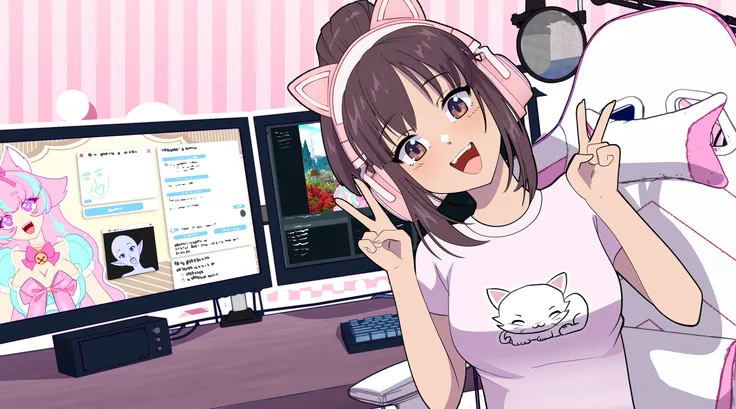
That collapse in the entry price, the piece argues, is what turned VTubing from a niche of Japanese idol culture into a global indie scene, sitting alongside a handful of publicly traded talent agencies that scout and manage the biggest corporate names. The article also takes on the AI question directly, describing a broadly wary mood among VTubers and their audiences toward generative tools, framed as protective of the hand-drawn art and voice work that make a character feel like someone specific rather than a template. Its closing section tries to explain the appeal itself, pointing to eccentric, expressive personalities as the differentiator in an oversaturated field of anonymous streamers.
The "worldwide" part already happened
That framing is where the thread pushed back hardest.
"The phenomenon 'went worldwide' several years ago by the means of COVID. These days the vtubing as an industry is in a somewhat stable state, if not a possible decline, going by viewership hours over the same period." — the first reply underneath the piece
A reply lower in the thread put it in four words: *"Went worldwide, half a decade ago."*
The examples came fast. One commenter recalled watching HikaruStation, once a singer, become a whale-themed VTuber named Bao, and AmaLee build a fanbase on anime song covers before shifting into VTubing full time, transitions that both predate the article by years. Hololive's English cohort, the same reply noted, hit its cultural peak around its first English generation, well before this piece went up.
Two of the biggest names are public companies, and Tokyo isn't impressed
The two largest VTuber agencies, Hololive's parent and Nijisanji's parent, both trade on the Tokyo Stock Exchange, a commenter noted, linking their Yahoo Finance Japan pages as proof.
"The stock prices are not great all things considered... I think investors would rather put money into AI related stocks than IP/vtuber related stocks." — a commenter tracking both agencies' Tokyo Stock Exchange listings
That fact went somewhere sharper one reply down, where a commenter with 30k+ karma wrote that being publicly traded and professionally scouted "makes their popularity as organic as the explosion of the K-Pop mania." Not grassroots, in other words. Manufactured, and financed like it.
The anti-AI mood has a very popular exception
The article's read on AI skepticism ran into an obvious counter-example. A reply further down the thread pointed out that Neuro-sama, the third most-watched English-language VTuber, is literally an LLM, and is widely accepted by other VTubers and their audiences as a legitimate, even celebrated, use of AI. Neuro-sama isn't hiding what she is, other replies noted: she openly banters on stream with Vedal, the human developer who built and runs her, and her novelty has pulled new viewers toward the human VTubers she's collaborated with rather than cannibalizing their audience.
An actual indie VTuber corrects the article's read on AI
The most credentialed pushback came from a Nintendo of America engineer who is also an indie VTuber himself, self-supported and doing it "just for fun." He confirmed the entry barrier really is close to zero now: you don't need a commissioned character at all, just a modified VR avatar generator model where the license allows it, already common practice in the indie scene. He also had a number the article skipped: a large share of VTubers never clear YouTube's own monetization threshold.
But on AI he corrected the piece directly:
"I think the article overgeneralizes the AI topic a bit and leans more toward wishful thinking. A lot of the hesitation around AI, especially at major agencies, comes from the fact that their character designs are often commissioned from well known artists. That creates a relationship between the performer and the artist, often referred to as the 'Mama' or 'Papa' relationship, and there can be a lot of sensitivity around how those designs are used." — a Nintendo of America engineer who is also an indie VTuber
Independent VTubers without that commissioned-art relationship, he added, tend to be far more relaxed about generative tools; the hesitation isn't fear of AI in general, it's a contract problem with a specific illustrator.
What the article never answered, the replies did
One commenter, after finishing the piece, summed up its real gap: "the last section should have been titled 'Why Do People Watch It?' because I finished the article still wondering." The thread answered anyway. A longtime Hololive viewer wrote a reply running well over a dozen paragraphs explaining what actually keeps him watching:
"Accumulated personal knowledge of the streamer is the social currency of VTuber fans... it can only be gained by watching and following them for a long time." — a longtime Hololive viewer
TokyoDev tried to answer "why VTubing is spreading" with market data and a lowered price of entry. The actual answer, per the people doing the watching, has nothing to do with cost or access at all: it's a slow-built relationship with someone who, by design, doesn't exist.
Get breakdowns like this every day
The top Hacker News stories, unpacked — by email, Telegram, or RSS.
The Clearest Explanation of an AI Math Proof Was the AI's Own Chat Log
On July 20, Anthropic said its model Claude Fable 5 had produced a hand-checkable counterexample to the Jacobian conjecture, an open problem in polynomial geometry since 1939. The next day, Terence Tao devoted a full blog post to walking through the construction step by step, and still lost several of his most technical readers by the second section.