Three index operators quietly bent the rules for SpaceX's IPO
An ex-Tesla short-seller argues the SpaceX listing is engineered so insiders cash out while index funds are forced to buy. The thread can't decide whether to believe a man famous for being wrong about Elon.
The man who got Tesla wrong, on SpaceX
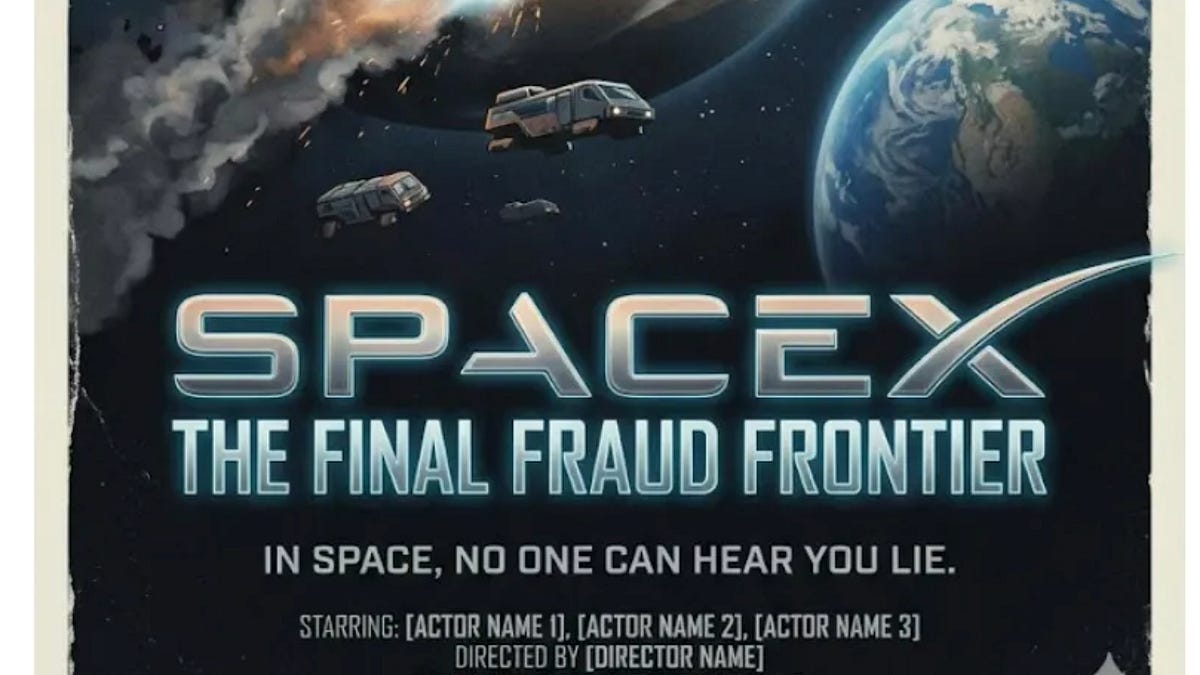
The piece comes from Lawrence Fossi — the "Montana Skeptic," a longtime Tesla bear — and lands as SpaceX's IPO machinery starts turning. Its hook, posted to the thread by the submitter, is blunt: "An S-1 full of fantasies, insiders who will pocket millions, index companies that have changed the rules: it's all a recipe for regular people to have their pockets picked."
What the essay actually alleges
The essay splits into a business case and a wealth-transfer case. The business half is the usual bear math: Starship has reached only 121 miles when Starlink orbits at ~300, the company needs roughly $235 billion through 2030 but an IPO raises maybe $85 billion, leaving a $150B+ hole to be filled by dilution.
The wealth-transfer half is the load-bearing part. Fossi says three index operators changed their rules to fast-track SpaceX: Nasdaq dropped its 15-day seasoning requirement and will weight a 5% public float as if it were 15% of shares — manufacturing demand — then snap the weighting to 100% in December exactly when insider lockups expire. S&P 500 and FTSE Russell, he claims, dropped profitability requirements to match. The result: index funds are obligated to buy billions just as early holders and Musk sell.
The thread litigates the messenger
The top objection is character, not arithmetic. "This is just the dude that's famous for getting Tesla wrong constantly? If he's convinced it's going south it's probably an easy 100% gain from the IPO," wrote one commenter on his track record. A reader who followed his TeslaQ days was more precise: "They believed Tesla to be (extremely) overvalued… They lost a lot of money shorting Tesla… They were right about a couple of things back then. But majorly wrong in aggregate."
But the index mechanic survived the pile-on. "passive funds are becoming active funds by way of manipulating the index itself," observed a confused-but-correct reader, reaching the essay's core point on his own. And a commenter on Musk's bundling habit flagged the structural risk: "Elon has mastered the art of hiding real jewels (in this case the Starlink business) behind a whole pile of shit, and then forcing you buy the whole thing as a package."
The skeptics-of-the-skeptic had a clean rebuttal too. "Observe that almost all the complaints about what the indices are doing originate from outside of finance… the people who are complaining are not the ones putting their money where their mouths are," argued a market-defender.
The tell
The most useful read in the thread isn't bull or bear — it's the trade. If the rule changes are real, you don't need to believe SpaceX is doomed to profit: you buy at IPO and sell into the forced index buying, which is precisely the asymmetry the essay describes. A theory you can arbitrage either way is a theory worth taking more seriously than its author's batting average suggests.
Get breakdowns like this every day
The top Hacker News stories, unpacked — by email, Telegram, or RSS.
Anthropic's red team phished its own staff into leaking AWS keys, 24/25
Anthropic published how it boxes in Claude across its products: ephemeral containers, OS sandboxes, sealed VMs. The most striking numbers are the failures — users approve 93% of permission prompts, and an internal phishing prompt got the model to exfiltrate AWS credentials 24 times out of 25.