For one month, wind and solar out-generated gas worldwide — 531 TWh to 477
Ember's data shows April 2026 was the first month wind and solar together produced more electricity than gas across the entire planet. The thread's reflex was healthy skepticism about the word 'power' — and a pile of receipts from people who just installed panels.
The milestone, and the asterisk on the milestone

According to Ember's data, April 2026 was the first month in which wind and solar together (531 TWh) out-generated gas (477 TWh) across the whole world — 22% of global electricity versus 20% from gas. The scale of the shift is clearest in the comparison: in April 2021, gas sat at a nearly identical 476 TWh, but renewables managed only 245 TWh — gas was almost double. Output grew across major markets year-on-year: China +14%, EU +13%, the UK +35%, the US +8%.
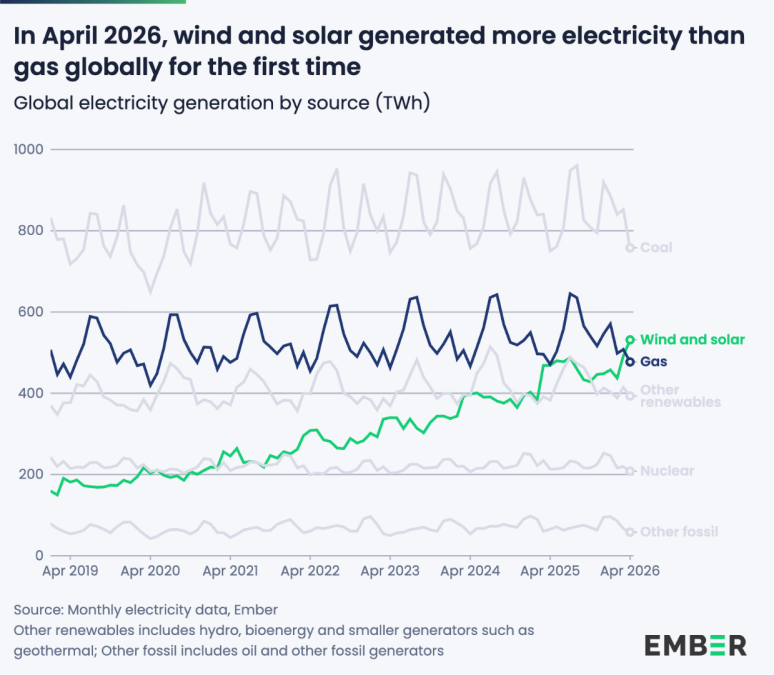
The honest framing, which Ember itself supplies: this happened in one month, not on an annual basis. April is the easy month — Northern Hemisphere spring pairs strong wind with rising sun and low demand between heating and cooling seasons. It's a real crossover, but a seasonal one.
The thread sharpens the claim
The single most upvoted technical correction was about a word:
"The term power here should really be replaced with electricity… Electricity only accounts for roughly 20-25% of all power / energy used." — a reader tightening the terminology
That's the fair caveat — cars, ships, heating and industry still run mostly on fuel. But a counter noted it isn't apples-to-apples either: electrifying those uses is far more efficient, so a TWh of electricity displaces more than a TWh of combustion. The reliability worry — can you add renewables without adding gas backup and risk? — got answered with a real-world experiment:
"Just ask California. They've basically conducted the experiment… They haven't had a blackout since 2020 and are the most stable grid in the entire US." — a commenter pointing to California
And underneath the macro debate, the thread filled with install receipts. One European household reported 10 kW of panels plus a 32 kWh battery for 11,000 euro, with an 8-10 year payback; the cheapest-energy logic was put plainly — solar and wind win because they have no fuel cost.
A seasonal first that points one way
Strip out the hype and the skepticism both, and what's left is a trend with a date on it: the same gas number that dwarfed renewables in 2021 now trails them in the favorable month. It's electricity, not all energy, and it's spring, not the year. But the curve that produced a one-month crossover in 2026 is the curve that decides whether it's a permanent one by 2030.
Get breakdowns like this every day
The top Hacker News stories, unpacked — by email, Telegram, or RSS.
Anthropic open-sourced an AI bug-hunting harness, and tptacek called it a shop jig
Anthropic released a reference harness that runs Claude as an autonomous fuzzing-and-patching pipeline. The top comment from a veteran security engineer wasn't 'wow' — it was that everyone serious already builds their own, and that's fine.