xAI now makes more renting GPUs to its rivals than running Grok
xAI built Colossus to train a frontier model. Now the bulk of the revenue comes from leasing those same GPUs to Anthropic and Google — two of the labs Grok is supposed to beat.
Anthropic is paying roughly $1.25B a month for about 300MW of xAI's compute; Google adds about $920M a month for 110,000 GPUs. That is a ~$26B annual run rate from renting silicon that was earmarked for training Grok.
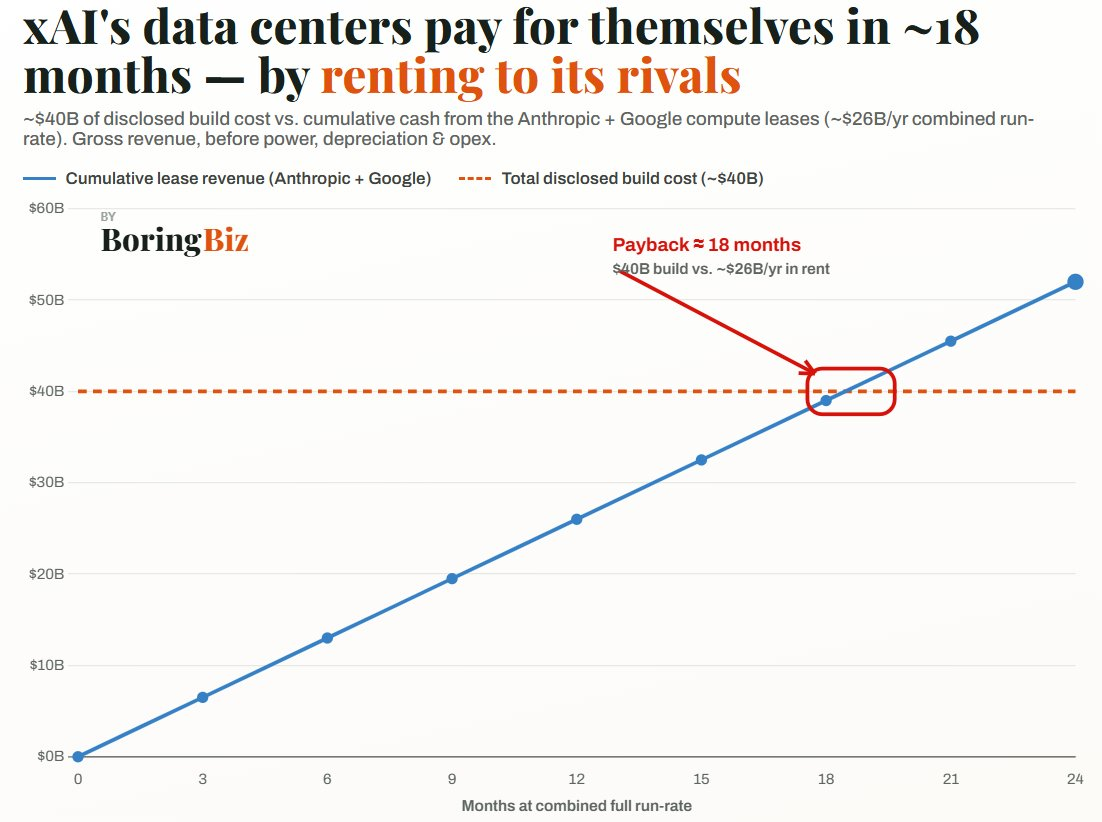
At those prices, one analysis argues, 18 months of leases pay back the entire ~$40B build — power is barely 1% of the bill. The catch a thread skeptic raised: heavily used GPUs are obsolete in 2-3 years, so this is a low-margin rental book wearing a frontier-lab valuation.
A frontier lab that quietly became a landlord
Martin Alderson's post lays out a quiet pivot hiding inside the SpaceX/xAI numbers: the compute xAI built to train and serve Grok is increasingly being rented out to the very competitors Grok is meant to beat. His verdict, after running the figures: "the more I look at it, the more xAI is starting to resemble a datacentre REIT with a frontier lab attached, rather than the other way around." The piece hit 483 points and a sharp thread on Hacker News.
The lease numbers: ~$26B a year to rent GPUs to Anthropic and Google
The core of the post is two rental agreements. Anthropic is paying roughly $1.25 billion a month for about 300MW of capacity — on the order of 220,000 GPUs — an annual run rate near $15 billion. Google adds about $920 million a month for 110,000 GPUs. Both contracts reportedly carry 90-day cancellation clauses after an initial lock-in.
What makes the deal look like real estate rather than AI is the cost structure. Alderson notes power is almost a rounding error against the lease revenue:
| Item | Figure |
|---|---|
| Anthropic lease | |
| Google lease | ~$920M / month |
| On-grid electricity | ~$160M / year |
| On-site gas turbines (Colossus) | ~$90M / year |
| Power as share of Anthropic revenue | ~1% |
His payback math is the punchline: "if the deals continue for 18 months, xAI recoups all the capex they spent and still has many hundreds of MW of GPUs available." The cumulative-lease chart crosses the ~$40B build cost around the 18-month mark.
The awkward part Alderson flags: capacity "destined for Grok training and inference" is now being leased to a direct competitor. The infrastructure won.
The thread: a payback model that only works if the music keeps playing
The sharpest pushback in the thread targets the depreciation hand-wave. A long-tenured commenter who works through the unit economics argued the rental book barely earns its multiple:
"xAI is more than half of SpaceX revenue with the Google sublease… how long does anyone expect heavily utilized GPUs to run? It will be broken down or out of date in 2-3 years. This… is low margin business that barely justifies a 10x earnings multiple let alone a… 100 revenue multiple for the xAI unit." — a commenter pricing the rental book
Others pointed out the 18-month payback quietly assumes the boom holds. One reader pulled the load-bearing footnote straight out:
"if the deals continue for 18 months, xAI recoups all the capex they spent… even older H100s are likely to be extremely useful even 18 months out." if the bubble doesn't burst until then… — a skeptic on the timing assumption
Not everyone bought the gloom on depreciation. One reader argued the "chips rot" framing is wrong because supply, not obsolescence, sets the floor:
"The idea that the AI data centers would depreciate in just a few years is plain wrong… demand is significantly outpacing new chip manufacturing, and until it catches up… the efficiency argument doesn't matter at all." — a commenter on the chip-shortage floor
And a counter-voice accused the whole thread of motivated reasoning — that the same people who valued SpaceX on Starlink speculation refused to update when real revenue showed up:
"Yet when we learn of this new $26B in yearly revenue… the conversation does not return to that discussion. It transforms into: 'xAI's tech sucks'… This is called motivated reasoning." — a reader accusing the thread of bias
The rebuttal landed quickly: spending capital to chase a modest rental ROI instead of a frontier model both "invalidates the speculation AND proves they have tech issues," as one reply put it.
Why xAI might be doing this on purpose
A recurring read in the thread is that this isn't a retreat but a setup. Several commenters noted xAI has "long since fallen behind the big 3" on model quality, so monetizing Colossus is the rational move — and that supplying compute is a more defensible position than losing the SOTA race. A longtime observer who'd flagged xAI dropping out of the AGI race earlier summed up the flywheel problem: OpenAI and Anthropic turn revenue into compute into smarter models, and once you can't keep up, "being able to supply compute makes more sense."
The most speculative branch tied it to SpaceX's other assets — Starship cadence plus Starlink's high-bandwidth links feeding solar-powered orbital datacentres. A commenter sketching the LEO angle called it a REIT "that no other datacentre provider could dream of." A reply cut it down fast: comms is maybe 1% of the challenge — "you're hand waving the whole 'data center' part away."
The real tell isn't Grok's benchmarks — it's where the GPUs went
Strip out the Mars-and-orbit speculation and a concrete fact remains: a company raising money as a frontier AI lab now earns the majority of its compute revenue by renting hardware to its competitors, on contracts with 90-day exits, against assets that lose value in a few years. Whether that's a clever infrastructure pivot or a tacit admission that Grok can't win depends entirely on what comes after the leases — and on whether the demand that makes the 18-month payback work is still there in 18 months.
Get breakdowns like this every day
The top Hacker News stories, unpacked — by email, Telegram, or RSS.
Xiaomi's MiMo hits 1,000 tokens/second on a 1T model using eight commodity GPUs
Until now, four-figure token rates meant Cerebras-class custom silicon. Xiaomi says it broke 1,000 tokens/second on a trillion-parameter model with a single standard 8-GPU node — at 3x the price for 10x the output.