Apple's new Siri foundation models were co-developed with Google's Gemini
Apple says its rebuilt Apple Intelligence runs on foundation models co-developed with Google using Gemini, with user data sealed inside Private Cloud Compute. The thread's read: Google sold Apple the right to run Gemini on Apple's own hardware, like the original iPhone running Google Maps.
Apple rents the right to run Gemini models on its own data-center hardware, then owns the orchestration layer on top, the thread reconstructed. The most cited worry: why hand your assistant's brain to your biggest mobile rival, who could quietly feed you an inferior Gemini?
The other smell is the EU, where Siri AI won't launch at all, because the DMA would force Apple to give third-party assistants the same deep access. The optimists' read: Apple never sold the model, it sells the delivery.
Apple's "foundation models," co-developed with Google's Gemini
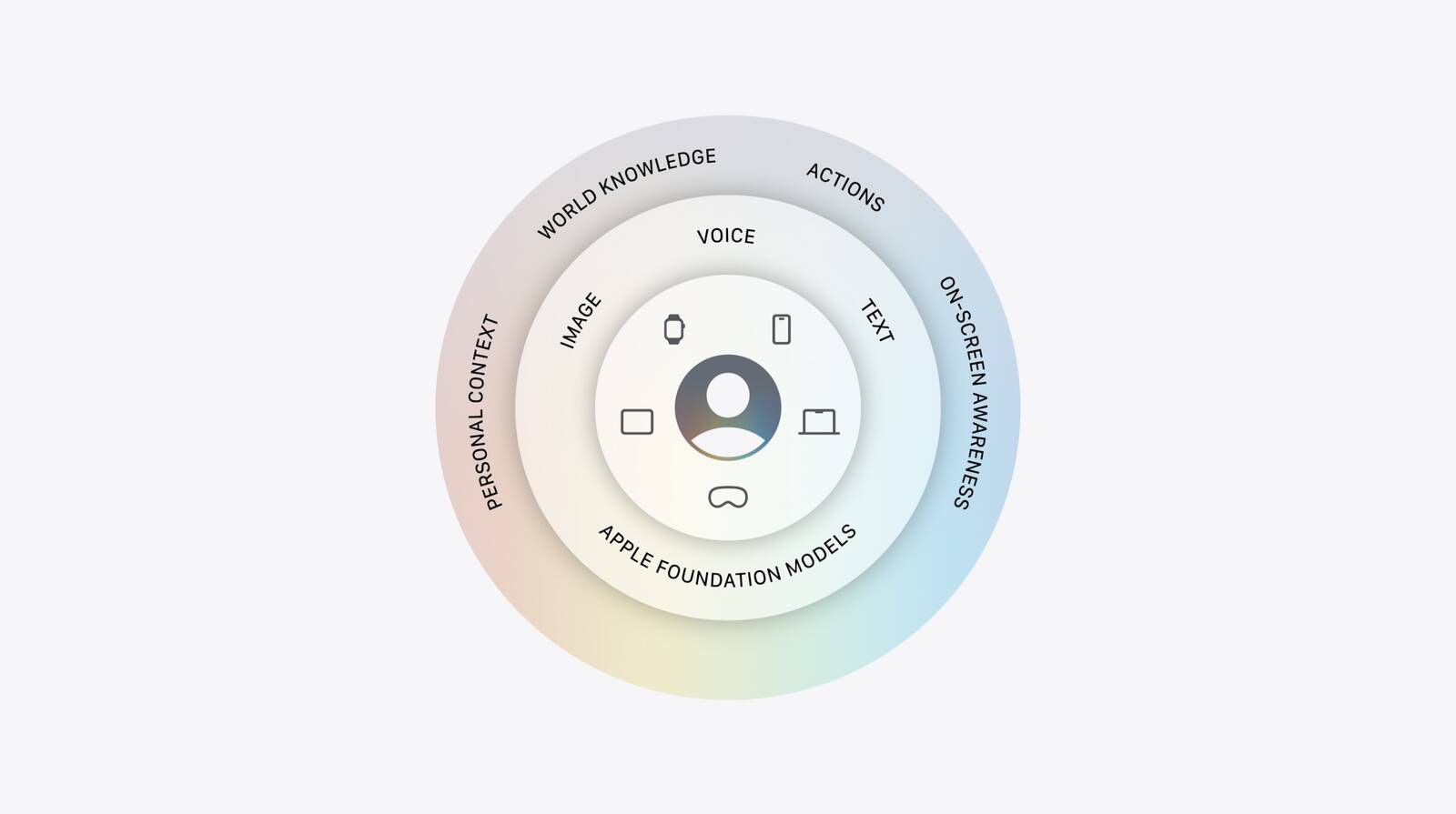
On June 8, 2026, Apple revealed a rebuilt Apple Intelligence architecture whose foundation models were "co-developed with Google" using Gemini technologies. The 451-point thread zeroed in on one question Apple's slide deck danced around: how much of the new Siri is Apple, and how much is just Gemini wearing an Apple badge — and whether Apple's privacy promise survives putting Google's model at the core.
What Apple actually announced
Per Macrumors, the system centers on Apple Foundation Models built by adapting Google's Gemini model technologies, run through two paths: on-device processing for immediate tasks and Private Cloud Compute for heavier server-side work. A new system orchestrator routes features depending on the active app and task. The upgraded models add realistic image generation, advanced photo editing, visual question answering, multimodal understanding, a higher-power speech-generation model, and stronger natural-language understanding.
Apple's privacy framing is the load-bearing claim: Google does not handle user data — its involvement was limited to model development — and data is "only used to execute the immediate request and is not accessible to Apple or third parties," verifiable by outside experts. What the article does not disclose: the financial terms, which devices get the higher-power model, or any executive quotes.
How the deal actually works, per the thread
The clearest reconstruction of the arrangement came from a commenter who laid out the layering Apple's marketing blurred:
"Google sold Apple the ability to run certain Gemini models on Apple's data-center hardware, using Google's orchestration layer. Apple hooks into that not dissimilar from an API-provider, and then builds everything upstream … the system prompt(s), harness, entry and exit points, and skills." — a commenter reconstructing the Apple/Google layering
Confirmation came from a datacenter and cloud-networking expert, ex-IBM Research, answering whether Siri now runs on Google TPUs: "No, Siri runs on Apple Silicon" — with the heaviest models on Nvidia. The most-cited framing of the whole move was its elegance and its echo:
"Very Apple-ish approach to AI catch up: wrap an external tool in a privacy architecture, embed into the OS and productize the orchestration layer." — a commenter on Apple's playbook
"This reminds me of the original iPhone with Google Maps. You're competing with Google, but you're using their infrastructure." — a commenter on the Maps-front-end parallel
"Couldn't Google feed Apple an inferior Gemini?"
The recurring worry was strategic dependence: why hand your assistant's brain to your biggest mobile rival?
"It's strange to me that Apple would choose to disadvantage themselves by selecting Google … Thinking more cynically, couldn't Google, if they wanted, feed Apple an inferior version of Gemini, ensuring they stay ahead?" — a full-stack engineer raising the bait-and-switch risk
A reply argued the moat is integration, not the model — "mostly fungible" — and that Apple runs the weights on its own compute, so a swap is hard to sneak in. Another commenter predicted the money flows the other way entirely:
"Google will probably eventually pay Apple to be the assistant, a la search." — a commenter on the likely payment direction
The EU cut, and the privacy asterisk
The detail that read as a "smell" to several commenters: Siri AI isn't launching in the EU at all. Apple says the bloc's DMA would force it to grant third-party assistants the same deep device access Siri gets, breaking its privacy guarantee.
"The smell is that Apple doesn't want to give the same level of access to third-party AI assistants that Siri will get … I suspect it was way more inconvenient for third-party developers than Apple lets on." — a commenter parsing the DMA standoff
Others doubted the privacy story survives a Google-built model at all — "this seems to strongly undercut Apple's claims about privacy" — while an author and ML practitioner pushed back that paying enterprise customers already get firm privacy guarantees from Google, and Private Cloud Compute is auditable by outside experts.
The real bet: Apple sells delivery, not the model
The sharpest read reframed Apple's two-year "AI failure" as a deliberate posture. Apple was never going to win on frontier models, the thread's consensus ran — its value has always been delivery, and an orchestrator wired into Shortcuts, app actions, and on-device context is exactly that:
"I take it as a signal they don't see any of their value being provided by the models. Their strong point was never frontier technologies. It's always been the delivery of the technology." — a commenter on where Apple's value sits
If the Apple/Google story is true as told, Apple traded the pretense of a homegrown frontier model for a working one, sealed user data inside Private Cloud Compute, and bet that owning the orchestration layer matters more than owning the weights. The skepticism is earned — handing your assistant's brain to your biggest rival, then pulling the whole thing out of the EU over access rules — but as one commenter put it, this may position Apple "extremely well for when the bubble bursts," free to go with whichever model wins.
Get breakdowns like this every day
The top Hacker News stories, unpacked — by email, Telegram, or RSS.
xAI now makes more renting GPUs to its rivals than running Grok
xAI built Colossus to train a frontier model. Now the bulk of the revenue comes from leasing those same GPUs to Anthropic and Google — two of the labs Grok is supposed to beat.