The Fn-key rant that hit #1 in 13 minutes: when Alt+F4 puts your laptop to sleep
Dan Q's complaint is specific: a keyboard whose function lock silently flips, so Alt+F4 stops closing a window and starts hibernating the machine. It struck a nerve so fast the post hit the HN front page in minutes — and unleashed a parallel war over 'natural' scrolling.
His three rules: double-duty keys should be low-impact and reversible, default to the traditional function, and persist the mode through a power loss. Most keyboards break all three.
One commenter keeps 'a bin full of pristine keyboards' he can't use because of Fn, arrow, Home and End placement.
The specific failure that started it
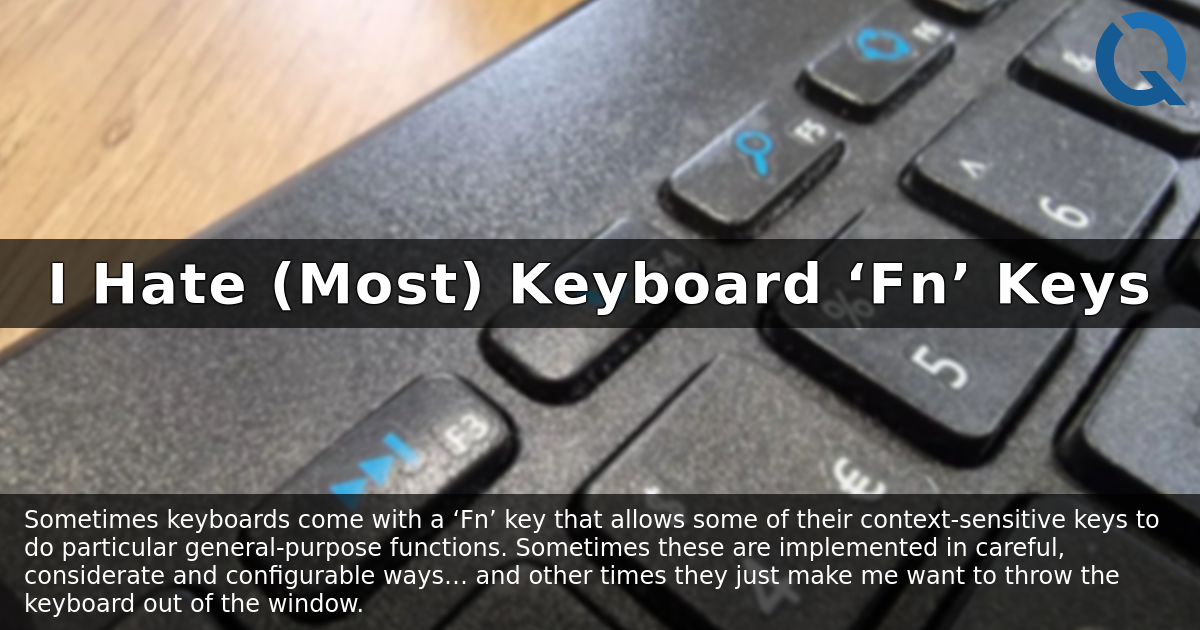
Dan Q's post isn't a generic gripe — it's a precise one. On a Microsoft keyboard, the F-row defaults to media functions, and the function-lock that fixes that is unreliable:
"If the batteries get changed, or if the keyboard gets turned-off for an extended period, or sometimes – seemingly – just randomly… that function-lock gets switched off." — Dan Q, in the post
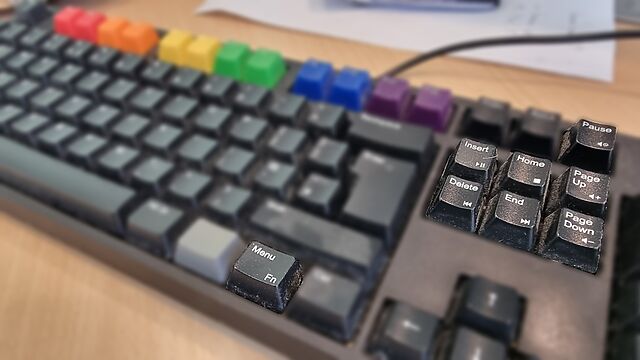
The consequence is what makes it rage-inducing rather than annoying: with the lock off, Alt+F4 doesn't close a window, it triggers sleep — a high-impact, slow-to-undo action. From this he derives three rules a keyboard should follow: double-duty keys should be "low-impact and quickly reversible," the default should be the traditional key function, and the mode must persist through power loss. He praises the Keychron K10 because "When you lock it to traditional F-key mode it stays that way, even if it's disconnected and left unpowered."
Why it detonated on HN
The speed of the front-page climb became its own subplot, narrated live by a devtools writer:
"this is currently #1 on HN gaining 11 points in 13 mins. never seen this before." — swyx
The reason it resonated, in one comment: people have abandoned hardware over this:
"I have a bin full of pristine keyboards that never see the light of day because of Fn, arrows, Home, and/or End placement. … it's so mentally taxing." — kgwxd
The tangent that ate the thread: "natural" scrolling
As these threads do, it spawned a holy war one layer down — Apple's "natural" scroll direction. The ergonomic objection:
"most scrolling is downward and 'natural' is an ergonomically inferior pushing action instead of pulling. It's only natural on the actual display itself." — the author of the Filmulator photo editor
The defense reframed it around the trackpad, not the mouse: "You're 'pushing' the document, not moving the scroll bars … just like what would happen to a piece of paper being slid up a table," one user argued. And the most-agreed conclusion was that the real crime is OS settings tying mouse and trackpad direction together: "OSes let you pick different scroll directions for mouse and touch pad, not specific devices … Just can't win," noted the keyboard-bin commenter.
Why a keyboard rant is actually about defaults
Underneath the venting is a real principle that applies far beyond keyboards: a mode toggle should fail safe, default to the least surprising behavior, and never silently reset to the dangerous state. Dan Q's keyboard violates all three, and so do a lot of the devices and apps people fight daily. The reason the post hit #1 in thirteen minutes isn't that Fn keys are important — it's that everyone has their own version of Alt+F4-puts-the-machine-to-sleep, and finally someone wrote the rules down.
Get breakdowns like this every day
The top Hacker News stories, unpacked — by email, Telegram, or RSS.
9,321 Japanese stations light up by year — and the map turns into rice paddies and rivers
An animated timeline opens every Japanese train station from 1872 to 2026. The peak: 272 stations in 1929 alone. A filter by kanji reveals the rail map is secretly a map of the country's geography — and the thread can't stop noticing it was built by AI.