Commerce banned 'noise infusion' from Census data. A privacy researcher says only attackers win
An order dated June 11 prohibits the Census Bureau and BEA from adding statistical noise to published data. The technique it bans was adopted in 2020 precisely because the older method let people reconstruct individuals.
Damien Desfontaines walks through a trade with no good side: strip the noise and the only privacy tools left are coarsening and suppression, which gut accuracy for small and minority populations while still leaving the data attackable.
Reconstruction attacks, he notes, are just solving a system of equations, and removing the noise makes that trivial. A privacy-company founder complicates the villain story: the 2020 rollout, he says, was a genuine internal disaster.
What the order bans, and why the noise was there
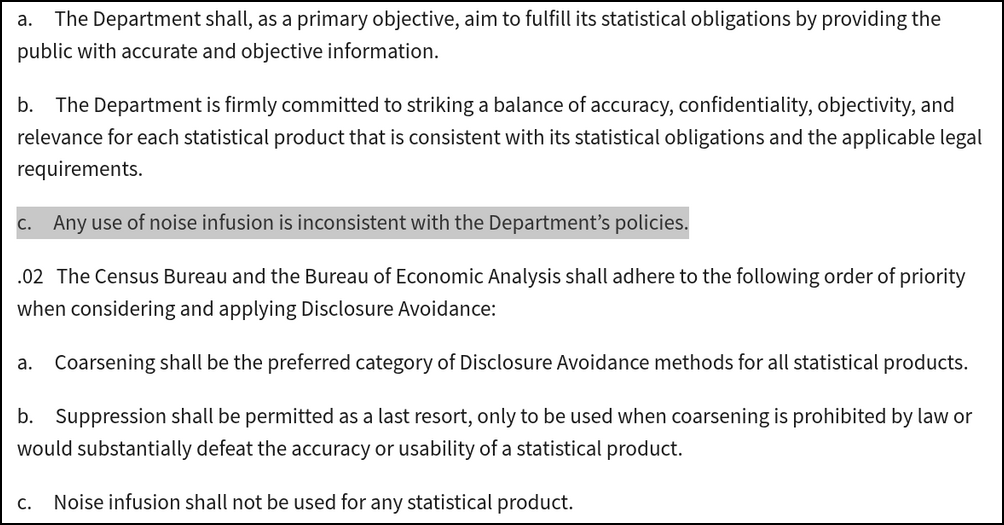
A June 11, 2026 Department of Commerce order declares "noise infusion" inconsistent with policy and prohibits it across Census Bureau and Bureau of Economic Analysis products, ranking the permitted alternatives: coarsen the data first, suppress as a last resort, never add noise. Privacy researcher Damien Desfontaines, who runs a privacy-engineering consultancy, lays out why that ordering backfires.
His history is the part the headline omits. The Census used "swapping" from 1990 to 2010, then switched to differential privacy for the 2020 count — not for elegance, but because swapping was shown to enable record-reconstruction attacks that broke the Bureau's own confidentiality obligations. Differential privacy won the internal bake-off because, among the methods that actually protect people, it preserved the most usable signal. A reconstruction attack, he explains, is just solving a large system of equations; the injected noise is what keeps that system from having a clean solution. Remove it and the attack becomes trivial. The blunt instruments left behind, coarsening and suppression, either destroy utility for exactly the small and minority populations that need the data, or remain attackable anyway.
A privacy insider says the 2020 rollout really was botched
The thread's most credentialed voice refused to treat differential privacy as a clean martyr. The math may be sound; the deployment, he argued, alienated the people who use the numbers.
"there was a lot of dissatisfaction from users of the census data… Some people I talked to in the privacy field even called the whole thing a total disaster and… put blame on John Abowd who… pushed this through despite a lot of internal opposition… many invariants that data users cared about weren't preserved." — the founder of anonymization company KIProtect
That reframes the fight. It isn't simply good privacy math versus bad politics; a real constituency of demographers and planners got burned by the 2020 implementation, and that resentment is fuel the ban can ride.
Where the ban came from, and the darkest reading
One commenter traced a concrete political origin, from the room itself:
"At the Republican TX state convention this week, they proposed to add wording against differential privacy to their proposed platform… how it was common-sense silly because one homeless guy under a bridge can become five via DP." — a maker who attended the convention
And a high-karma reader connected the ban to the attack it re-enables:
"powerful people were already reconstructing individual data from census for the purpose of gerrymandering, and they wanted to continue gerrymandering." — a commenter linking the author's earlier reconstruction-attack writeup
Not everyone bought the framing. The sharpest dissent argued Desfontaines had the epistemics upside down:
"I think he has it backwards… differential privacy hide[s] the fact that a trade-off exists, except for a small cadre of experts… If data about the public is so dangerous that we must disguise the results, then perhaps it's data we shouldn't be collecting in the first place." — a reader challenging whether the noise hides the wrong thing
A dry stats rule with a sharp edge
Read coldly, "no more noise infusion" sounds like internal methodology housekeeping. It isn't. It collides a genuinely mishandled 2020 rollout, a grassroots party push against the phrase "differential privacy," and a strong suspicion that the point is to make the published tables solvable again, for whoever wants to reconstruct who lives where. The trade-off Desfontaines describes doesn't vanish when you ban the math. It just stops being visible.
Get breakdowns like this every day
The top Hacker News stories, unpacked — by email, Telegram, or RSS.
An open-source LLM tool archived itself overnight. The founder says most of the $7.3M is unspent
TensorZero's GitHub repo flipped to read-only on June 12. The headline read like a flameout after a fresh raise; the founder showed up in the thread to correct the timeline and the burn.