Topic

Databases & Data

60 stories

ClickHouse deleted a Postgres rewrite from its benchmark after finding per-query code in the binary (github.com)

ClickBench's maintainer removed pgrust, a Rust reimplementation of Postgres, saying its entry measured "a lookup table of the benchmark, not a database." Probes with slightly altered queries were refused with errors.

pgrust's creator showed up in the thread to say the accusations are false. Commenters wanted to know why the paths were in the binary.

Not just a headline — the discussion unpacked

The top HN threads: facts from the discussions, both sides, insider voices. Email, Telegram, or RSS.

A 3-person data team replaced a $150k Looker licence with Claude-written HTML dashboards (david.lequin.dev)

The author says the rebuilt version costs about $20k a year against $150k for Looker, with Snowflake permissions doing the access control and dashboards running in sandboxed iframes.

He leaves out engineering hours: eight months of part-time work by three engineers, 325 commits and about 74k lines of code.

🚀Tech ★ 121 · 💬 73 · 4 days ago · #AI#data#dev tools#Claude#dbt#Looker+1

UUIDv7 only promises uniqueness, and Python's version can run ahead of your clock (alexsci.com)

Alex Scott's post argues the three properties people credit to UUIDv7, monotonic order, a trustworthy creation time and unguessability, are not guaranteed by RFC 9562. Even Postgres warns that an extracted timestamp may differ from the creation time.

Commenters said that misses the real reason to use it: keeping new rows together in the index.

🚀Tech ★ 114 · 💬 99 · 4 days ago · #data#programming#web#Postgres#Python#RFC 9562+1

DuckDB 2.0 adds a server mode and async I/O, and files that 1.x cannot open (duckdb.org)

The release adds a Quack server protocol, background reads for Parquet and CSV, VARIANT with automatic shredding, and triggers. A new PEG parser is now the default, ICU is gone, and 2.0 is supported until at least October 2027.

One user reports shrinking 7 TB of Azure NDJSON logs to 2.5% of their size in Parquet in under two hours on a medium VM.

One power failure in one London zone took down HSBC, Revolut and Lloyds (neowin.net)

The outage began 19 October at 23:08 PDT; Google called it a power event in a single zone. Per the Neowin headline, HSBC, Revolut, Bank of Scotland, Lloyds and Equifax were hit.

An SRE in the thread says multi-zone setups exist everywhere but zone failure is almost never rehearsed.

🚀Tech ★ 342 · 💬 172 · 7 days ago · #big tech#data#Google Cloud#HSBC#Lloyds+1

Mistral's Timestral forecasts time series on a CPU in 10 to 140 milliseconds (mistral.ai)

Mistral released Timestral, its first time-series foundation models. The 209M model tops three zero-shot benchmarks with a single checkpoint, and the 28M model reportedly beats Chronos-2, which is about four times larger.

On an 8-thread server CPU, the smallest takes roughly 10 ms per forecast, with no GPU needed.

🚀Tech ★ 556 · 💬 104 · Oct 20 · #AI#data#Chronos-2#Hugging Face#Mistral+1

PostgreSQL for everything is a design choice with a price (raphaelbauer.com)

PostgreSQL can cover relational data, full-text search, queues, and extensions in one familiar operational surface, which is attractive to small teams.

The counterpoint is not that Postgres is weak. It is that a default becomes cargo cult when workload shape, scale, or failure modes have not been examined.

🚀Tech ★ 307 · 💬 190 · Aug 20 · #data#dev tools#programming#PostgreSQL

GitHub Trending: Today — Immich, Qlib, Trivy, CUDA Samples, Cookbook (github.com)

In today’s GitHub Trending: Immich manages self-hosted photos and video; Qlib supports quantitative ML research; Trivy scans containers, repositories, and cloud configurations.

Immich supplied the clear spike with 636 stars. The pattern is not a single new category; it is developers choosing more inspectable control points around data, compute, and operational risk.

Protobuf finally gets an IDE brain through Buf's LSP server (buf.build)

Buf released a production-grade Language Server Protocol server for Protobuf, bundled with its CLI and available through its VS Code extension or editor configuration.

The real upgrade is incremental, query-driven analysis that can diagnose schema mistakes while developers work, rather than treating .proto files as second-class text.

657,607 old links expose the web’s disappearing memory (0.mk)

The project followed 657,607 historical links after recovering a 0.mk backup. The count turns link rot from an anecdote into a record of a web that quietly vanished.

HN’s reaction was not nostalgia alone: readers pointed out that archives are a design problem, not a promise the original web ever made.

🔥Hot Discussion ★ 133 · 💬 116 · Aug 14 · #culture#data#web#0.mk#Hacker News

McDonald’s 515 pages make loyalty data feel personal (wired.com)

The 515-page record makes a familiar loyalty-program bargain visible: small discounts in exchange for a detailed, automatically assembled customer history.

HN’s sharpest correction was uncomfortable, not reassuring. The dossier is unusual to see, but the collection methods are ordinary for large US loyalty programs.

🔥Hot Discussion ★ 209 · 💬 287 · Aug 14 · #big tech#data#privacy#McDonald's

GitHub Trending: Today — free-for-dev, OpenBB, awesome-go, Playwright, Web Dev (github.com)

In today’s GitHub Trending: free-for-dev (a catalog of developer free tiers), OpenBB (an open data platform for analysis), awesome-go (a curated Go ecosystem), Playwright (cross-browser testing), and Web Dev for Beginners (a 24-lesson curriculum).

The unifying signal is reuse: each project shortens the path to a capability that would otherwise require searching, building infrastructure, or assembling a learning plan from scratch.

Fastmail adds an EU data region for email customers (fastmail.com)

Fastmail says it now offers an EU data region. For organizations with residency requirements, the change is useful only if location, migration, support, and operational boundaries are equally clear.

HN readers treated it as a privacy and procurement question rather than a decorative location setting.

GitHub Trending: Today — Tokio, Blackbird, PhoneInfoga, HAMi, Pigsty (github.com)

In today’s GitHub Trending: Tokio (Rust async runtime for networked applications), Blackbird (username and email OSINT), PhoneInfoga (phone-number investigation), HAMi (Kubernetes GPU sharing), and Pigsty (self-hosted PostgreSQL platform).

The contrast is unusually direct: two tools help identify people from public traces, while three make shared compute or databases easier to run. Community evidence is uneven; practical maintenance questions, not a single hype wave, connect the list.

AI is making progress on Erdős problems; verification is the bottleneck (quantamagazine.org)

The Quanta story tracks how AI is contributing to progress on Erdős problems. Readers accepted the intellectual excitement but emphasized the next constraint: systems can generate more candidate arguments than mathematicians can manually check.

That makes formalization and verification central. The value of machine-assisted proof is not just that a difficult statement falls, but that the resulting reasoning can be tested, explained, and reused.

🚀Tech ★ 126 · 💬 124 · Aug 6 · #AI#data#science#Paul Erdős#Quanta Magazine

GitHub Trending: Today — System Design Primer, nixpkgs, PostHog, NautilusTrader, CCXT (github.com)

System Design Primer packages interview and architecture study material; nixpkgs is NixOS’s package collection; PostHog combines product analytics with developer tooling; NautilusTrader is an event-driven trading engine; CCXT unifies exchange APIs.

The unexpected pattern is age. Each project has an established user base, and the list reads as a demand for dependable infrastructure rather than another disposable wrapper.

GitHub Trending: Today — LibreTranslate, Superset, Directus, Activepieces (github.com)

In today’s GitHub Trending: LibreTranslate, a self-hosted offline-capable translation API; Apache Superset, a data exploration platform; Directus, a database-to-API and CMS layer; Activepieces, an automation system with agents and MCP servers.

The outlier is an OSINT directory, but it reinforces the same practical mood: packaged capability is attractive when teams want a usable control surface instead of a cloud-only black box.

Today’s GitHub list favors durable developer infrastructure (github.com)

[directus/directus](https://github.com/directus/directus) offers instant APIs, authentication and an admin layer over an existing database. [jrouwe/JoltPhysics](https://github.com/jrouwe/JoltPhysics) is a multithreaded rigid-body and collision library used by shipped games.

The day also includes [apache/superset](https://github.com/apache/superset), a data-exploration platform, and [electron/electron](https://github.com/electron/electron), the JavaScript desktop runtime. These are tools teams adopt for years, not experiments to sample once.

ARC-AGI-3 measures adaptation under a budget, not just a model’s puzzle score (arcprize.org)

ARC-AGI-3 moved beyond static puzzles: systems must adapt in unfamiliar interactive environments. The leaderboard includes reasoning systems at different thinking levels, base models, and competition submissions constrained to a $50 budget for 120 tasks.

HN readers welcomed the new benchmark while questioning how easily a leaderboard can be gamed, how models are prompted, and why a large score gap does not always show up in ordinary work.

🚀Tech ★ 167 · 💬 139 · Jul 26 · #AI#data#ARC-AGI-3#ARC Prize#Kaggle

Postgres LISTEN/NOTIFY can scale — if your definition is specific (dbos.dev)

DBOS argues that LISTEN/NOTIFY can serve high-throughput workloads with the right design. The thread accepted the measurement but resisted the headline, noting that its 8KB notification payload limit and delivery semantics define where it fits.

The valuable takeaway is architectural rather than tribal: use notifications to signal durable rows or work, not to pretend they are an unrestricted message bus. A system that handles 60,000 events per second may be excessive for one team and inadequate for another.

A Postgres guide told startups to normalize their schema first. HN said monitoring should come before that (hatchet.run)

Hatchet's Postgres guide walks startups through schema design, query optimization, and scaling, with real thresholds — sequential scans get costly past 20k rows, autovacuum runs over an hour mean tuning is overdue.

A commenter who'd run Postgres at an early-stage startup pushed back: monitoring deserved to rank above schema design, because failure modes like transaction ID wraparound give almost no warning — and the AWS alert email is easy to miss, especially on Boxing Day.

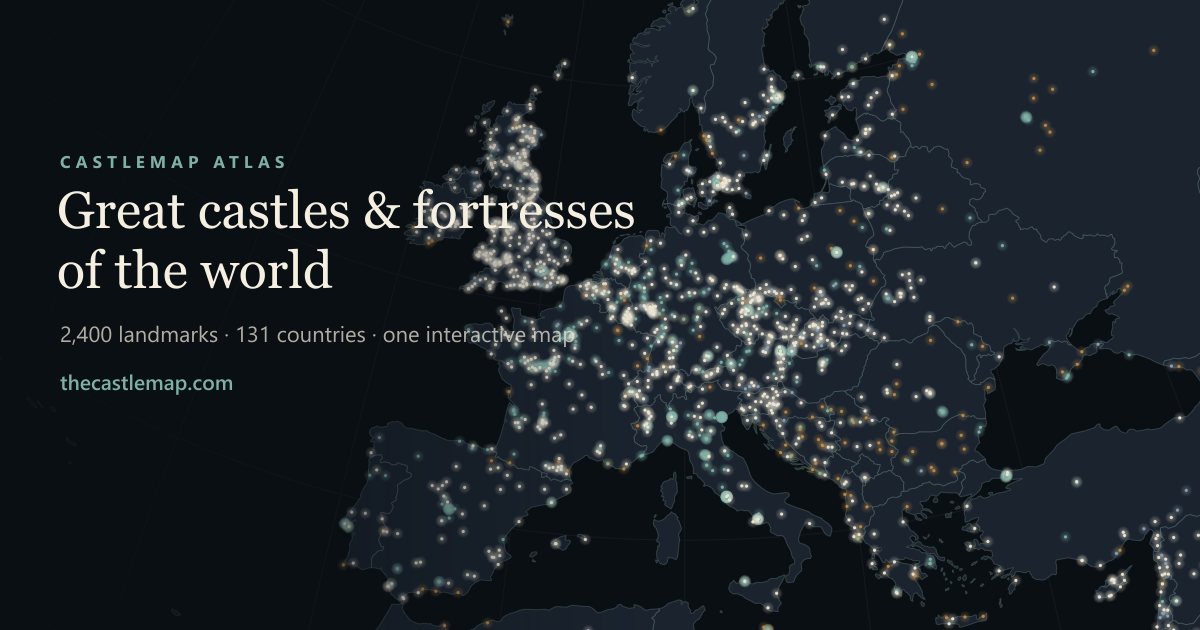
A map claims 2,438 world castles; readers found most of theirs missing (thecastlemap.com)

Readers ran the numbers on their own countries: Saxony alone has 700-plus historic fortifications against nine pins on the map; France counts roughly 180 listed castles against an estimated 45,000 nationwide.

One commenter guessed the map was only reading English-language Wikipedia before anyone confirmed it. Then the site's solo builder turned up in the replies, admitted the whole thing was built in a weekend, and promised to actually fix it.

🌍Other ★ 180 · 💬 134 · Jul 22 · #AI#culture#data#Acropolis#Castlemap#Versailles+1

A hacker wiped Romania's land registry with the password 'P@ssw0rd' (news.risky.biz)

Security firm KELA has named the attacker as Zakaria Mahdjoub, working out of Oran, Algeria, the same actor blamed for breaching Sweden's e-government systems and land registries in five other countries within the past three years.

One HN commenter noted Algeria has an extradition treaty with Romania, an odd choice of target for someone hoping to stay unreachable.

🚀Tech ★ 574 · 💬 326 · Jul 21 · #data#policy#security#ANCPI#ByteToBreach#KELA+1

SQLite happily stores the text 'garbage' in a column typed INTEGER (evanhahn.com)

It's not just numbers pretending to be text. SQLite also accepts a column declared with a type it's never heard of, like DATETIME, JSON, or a typo such as BLOBB, no questions asked. Evan Hahn's fix is one word: STRICT.

In the thread, an engineer traced a real data-corruption bug back to exactly this looseness: a UUID silently turned into the wrong number, caught only after rebuilding the table under STRICT.

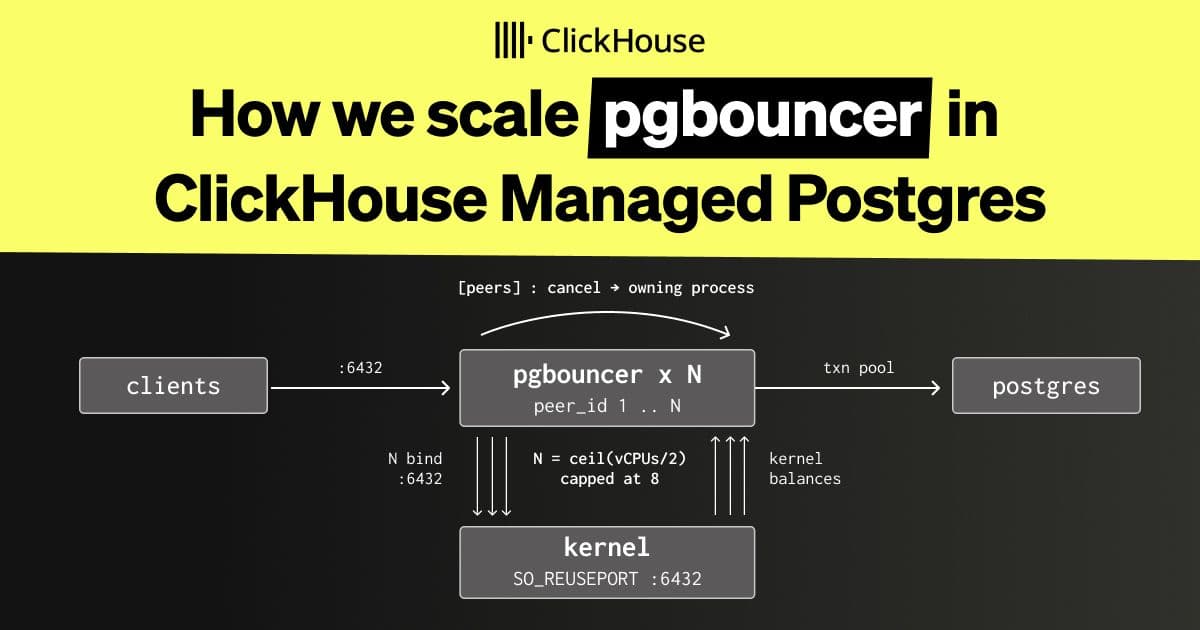
ClickHouse turned PgBouncer's one CPU core into sixteen for 4x throughput (clickhouse.com)

On a 16-vCPU box, one PgBouncer process topped out around 77,000 transactions per second at 256 clients while using under 8 percent of the machine. ClickHouse's Postgres team ran sixteen processes on the same port instead, using a kernel trick called so_reuseport, and throughput jumped to 336,000 — roughly 4x — with a fix for cancel requests that used to vanish into the wrong process. One reply in the thread was blunter: Yandex already ships a pooler built to do this natively, no patch required.

The mapping app that hides OpenStreetMap's schema until the moment you need it (streetcomplete.app)

StreetComplete finds gaps in OpenStreetMap near you and turns each into a one-tap quest: is this street paved? what are this shop's opening hours? You answer on-site, and it writes straight to OSM in your name, with no editor and no tags to read first.

Its real trick, one contributor argued: hide OSM's intimidating tagging model until you actually need it, since most tools expose the schema too early. The flip side is that the complexity is hidden, not gone. Another mapper admitted he's never sure he tagged a crosswalk the 'right,' undocumented way.

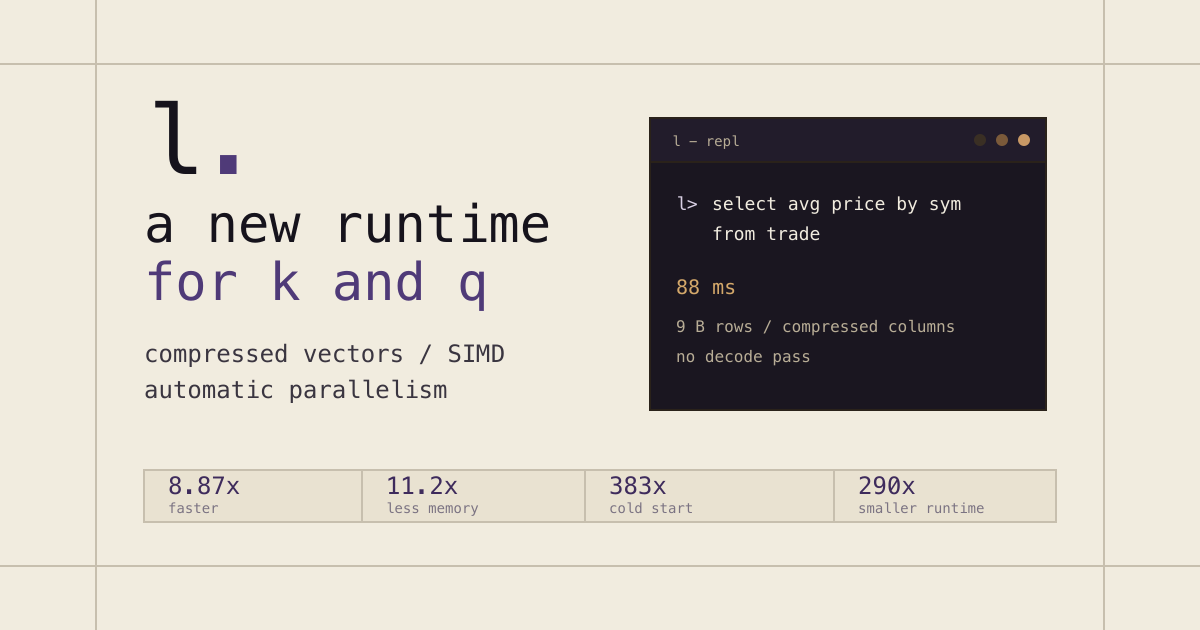
A new runtime for kdb+'s language ships closed-source, benchmark-free, and 'likely AI' (lv1.sh)

The pitch is concrete: run existing k4/q/qSQL unmodified, crunch 86.5M rows on one CPU with 'no decode pass,' compression throughout. For shops reluctantly licensing kdb+ from Kx, an independent compatible runtime is the escape hatch they've long wanted.

The top reply ignored the speed. It flagged the copy, 'the vector as the unit of thought,' as pseudoscientific and 'extremely likely to be AI,' and pointed out l is closed-source with no benchmarks against Shakti or kdb+ itself.

A Postgres pooler that fixes the leak where one client's session bleeds into another (pgdog.dev)

PgDog ships its own SQL parser so it can track SET, LISTEN/NOTIFY and prepared statements per client and restore them before each query, the exact features PgBouncer's transaction mode makes you give up. Kokotov says it's run a year in production at 2M queries/sec.

The thread's war stories agreed the tax is real: one engineer who'd just moved a Django app behind PgBouncer found queryset.iterator()'s server-side cursors didn't survive pooling, and statement_timeout in libpq startup params got silently ignored.

One database for everything: the case against Redis, Mongo, and Pinecone (postgresisenough.dev)

The catalog is specific: UNLOGGED tables instead of Redis, SKIP LOCKED instead of a job queue, pgvector instead of Pinecone, PostGIS instead of your geo stack, with a rule that you may leave Postgres only after documenting why it wasn't enough.

A developer running an email CRM on Redis isn't buying the premise: it's trivial to set up and never crashes, so what difficulty is this genre even describing?

Amazon stops taking new Mechanical Turk customers as the crowd-work era ends (techcrunch.com)

A 2023 analysis found that 33 to 46% of MTurk workers were themselves running LLMs to complete tasks. The human labour Amazon resold was, increasingly, machines wearing a human badge.

Yet the top-voted diagnosis isn't "AI ate the job." It's simpler: a bad product finally outcompeted.

📈Biz ★ 142 · 💬 53 · Jul 7 · #AI#big tech#data#Amazon#AWS#Mechanical Turk+1

A live map of Britain's trains, some ploughing through the M25 and Channel (map.signalbox.io)

The clever part is how Signalbox says it works: it identifies which train a phone is riding by matching a snapshot of the device's data to each train's trajectory, with no background location tracking and no hardware. Slick in theory.

In practice, locals weren't impressed. One watched a Liverpool Street service plough across the M25, forty miles off its route; another who lives beside a line calls the whole thing as good as useless.

A museum API flags art "not viewed much" — and the moment you look, you disqualify it (iamwillwang.com)

Will Wang spotlights `has_not_been_viewed_much` — under 200 views since Jan 2010 — in the museum's public API, as an invitation to discover overlooked works rather than a finished app.

The thread names the observer paradox — look, and the count ticks up — and remembers Forgotify, the site that played only zero-listen Spotify songs and thereby deleted them from its own pool.

Simon Willison shipped a release mostly written by AI for $149.25 — the number everyone will misuse (simonwillison.net)

Willison used Fable to do a pre-release review of sqlite-utils 4.0rc2: 37 prompts, 34 commits, five blocker bugs found — the worst, delete_where() leaving a transaction open so later writes silently rolled back. He estimates $149.25 in API cost; a cross-review by GPT-5.5 caught two more.

The reversal: $150 spent by an expert who knows exactly what to ask is not the $150 a novice will spend chasing invented problems — because these models never say "nothing found, good to go."

Ubicloud says the Linux OOM killer can drop every Postgres connection at once. Its own co-founder says the post oversells it (ubicloud.com)

The mechanism: Postgres backends share memory segments, so an OOM kill of one can force the postmaster to terminate every backend at once. Ubicloud's answer is strict overcommit (vm.overcommit_memory=2): Linux refuses over-limit allocations with ENOMEM, and Postgres cancels just the offending transaction.

The thread splits. A commenter says the article describes the kernel's overcommit modes wrong and ignores oom_score_adj; the company's own co-founder concedes the framing was too strong.

Virginia just banned selling your location data — with a loophole you could drive a Flock truck through (hunton.com)

The ban amends Virginia's Consumer Data Protection Act and took effect this week, joining Maryland and Oregon. It targets a real harm: location feeds have already been used to track visitors to hundreds of Planned Parenthood clinics for an anti-abortion ad campaign.

The thread's privacy lawyers zeroed in on the wording. Maryland and Oregon ban exchanges for 'monetary or other valuable consideration'; Virginia only says 'monetary.' That one missing clause is exactly the gap the license-plate-camera firms already live in — sell the cameras, hand over the dashboard 'for free.'

Scott Aaronson and Cynthia Dwork warn: a new order tells the Census to protect privacy like it's 1975 (scottaaronson.blog)

Their demonstration is a brewery: five aggregated statistics about beer-related businesses form a solvable system of equations that recovers individual firms' employee counts, even after careful rounding. Coarsening, they argue, loses usefulness AND fails at privacy — the worst of both.

The thread added context and doubt. A Stanford CS voice noted 2020 was the first census to use differential privacy, that lawsuits question its constitutionality, and that citizenship status could be inferred by cross-referencing products. A practitioner just sighed that an interesting technology had gone political.

Immich 3.0 adds non-destructive editing — the thread argued about the feature it still doesn't have (github.com)

Version 3.0 is a real step: non-destructive crop/rotate/adjust on mobile, a Workflows automation engine, HLS on-the-fly transcoding, and integrity checks that catch missing or mismatched files. Breaking changes hit third-party integrations.

Encryption was the fault line. Several users said the lack of E2EE is why they picked Ente instead. A contrarian pushed back hard: for a home photo library, end-to-end encryption is arguably pointless — lose your keys and you lose the only copy of grandma. The sharpest bug report was an operator finding 20% of his disk eaten by duplicated per-user thumbnails.

Why 24-bit/192kHz audio makes no sense — and the three practitioners who complicate it (people.xiph.org)

The physics is unforgiving: ears top out near 20kHz, so 44.1kHz captures all of it, and ultrasonic content can fold distortion back into the audible band. A Boston Audio Society test nailed it — 554 trials, listeners correct 49.8% of the time. A coin flip.

But the practitioners drew real lines. A music producer swears he hears 16-bit vs 24-bit in his own renders. A film sound designer records to 100kHz because slowing that audio reveals real content above hearing. A DSP researcher prefers high rates for more forgiving filters — all while agreeing about final playback.

Postgres 19 finally reorganizes tables without locking, and borrows GROUP BY ALL from DuckDB (snowflake.com)

Snowflake's Craig Kerstiens walks through the Postgres 19 beta: REPACK CONCURRENTLY reorganizes bloated tables without locks (no more pg_repack), partitions can now merge and split in place, autovacuum gets parallel workers, and SQL/PGQ brings graph queries to relational data.

The thread wanted what's still missing more than what shipped. A 15-year Postgres user in science flagged the absent columnar storage as datasets balloon; others miss materialized views and in-place major upgrades. And the top nitpick: GROUP BY ALL was DuckDB's idea first.

5,000 restaurant menus from 1880-1920, and the ham sandwich cost 25 cents (pudding.cool)

A data-story walks through five thousand American menus from 1880 to 1920, digitized from the NYPL's Buttolph Collection and labeled dish-by-dish by volunteers at menus.nypl.org.

Readers noticed what changed and what didn't: oysters and clams lead the page, 'green turtle soup' turned out to be literal turtle meat, and celery sat as a delicacy because before refrigeration it barely survived the trip to the city.

A fintech handbook hit the front page. Then the author showed up — and so did engineers who'd built the real thing (w.pitula.me)

A solo-posted Fintech Engineering Handbook — money as integers, ledgers, idempotency, webhooks — climbed the front page, and the author turned up in the replies, baffled by his own reach.

What followed was a working seminar. Ex-fintech CTOs validated the core; others flagged the 'minor-units' integer trick as a trap with stablecoins, called event-sourcing-everywhere overkill, and argued the PII-deletion advice would get a compliance team a very bad day with regulators.

Why marathon finish times spike at 3:30 and 4:00, and what that says about every threshold you've trusted (danluu.com)

Dan Luu's 2020 essay maps the spikes that appear wherever a hard threshold sits: 9.8M marathon finishes clump at round times, Polish exams bunch at the pass mark, drug charges pile up exactly at the sentencing cutoff.

The thread adds fresh cases — chess ratings, AWS gaming its own P90 latency target — and one self-correction: a commenter called the lead example bogus, realized it predated a policy change, and withdrew it. The marathon spikes turn out to be social, not just vanity: pace-runners with flags.

🌍Other ★ 216 · 💬 65 · Jun 28 · #data#economy#science#AWS#Dan Luu#Lichess

Open-weights LLMs are either 5 months behind forever, or caught up by Christmas — pick your benchmark (blog.doubleword.ai)

On a single intelligence index the open-vs-closed gap projects to zero by Christmas; spread across 18 benchmarks it's stayed near five months for two years. Coding is the one clear mover, from 15 months behind to one or two.

The thread's reframe: the number doesn't matter, because closed access can be revoked and an open weight can't be put back in the bag — whatever capability it reaches stays reachable forever.

🚀Tech ★ 132 · 💬 108 · Jun 27 · #AI#data#open source#DeepSeek#GLM#Qwen

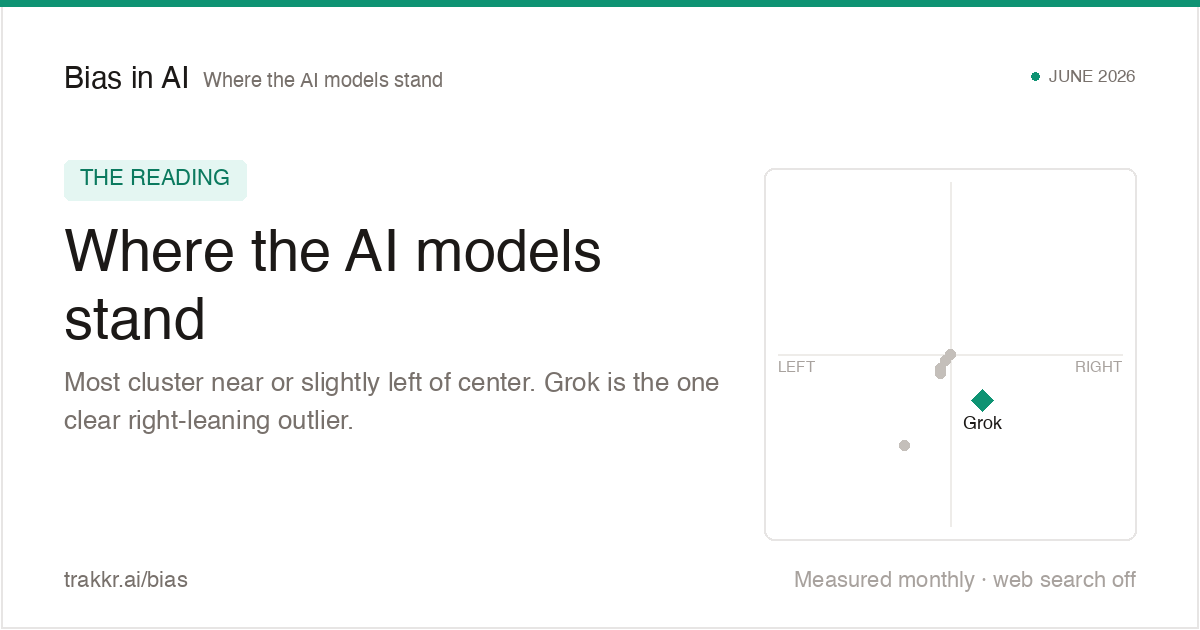
4,392 answers later: the AI political-bias map and the fight over the grader (trakkr.ai)

Trakkr ran six models through 61 political questions, twelve times each, web search and reasoning off to mimic the consumer default. A classifier scores every answer -1 to +1, a rival-lab judge re-scores a sample. Gemini lands neutral, ChatGPT at -0.29, Grok at +0.21.

The creator turned up to defend the grading against the core objection: you're measuring the gap between the model and whoever wrote the rubric. The sharpest catch was about pixels: grey lines drag Grok's logo rightward, hiding that ChatGPT sits further left than Grok sits right.

🔥Hot Discussion ★ 125 · 💬 241 · Jun 26 · #AI#data#policy#ChatGPT#Claude#DeepSeek+3

He indexed 45M Hacker News comments to chart 18 years of tech hype (hackernewstrends.com)

A solo dev fed the entire ~48GB Hacker News archive into a search index and built a date-histogram over 45 million posts and comments going back to 2007. Overlay any terms and the tech cycle plays out as a literal chart: lk-99's one-week spike, Stuxnet's lonely persistence, crypto handing the baton to chatgpt.

Then ClickHouse's lead developer dropped by to note he already hosts the same HN dataset as a public SQL database. And the sharpest voice warned it isn't Google Trends at all: it counts what people wrote, not what they searched.

LastPass breach #3 leaked no vaults: it spilled through a CRM vendor, Klue (9to5mac.com)

LastPass's third breach notice didn't come from its own servers. A vendor called Klue — a CRM-attached "market intelligence" platform for sales teams — got compromised, exposing LastPass customer names, phone numbers, emails, and physical addresses. Encrypted vaults were untouched.

On HN the pile-on was instant. But the sharpest comment cut the other way: a security engineer noted every sales org has a dozen of these tools wired in, and the only surprise is that this kind of breach doesn't happen far more often.

🌍Other ★ 479 · 💬 210 · Jun 26 · #data#privacy#security#Bitwarden#HackerOne#Klue+2

At one bank, the Python source code lives in the database, not on disk (calpaterson.com)

Investment banks run secret forks of the entire Python ecosystem. In Paterson's account, one bank's system reads and writes Python dataclasses straight into a single global object database, called Barbara, shared by the whole firm.

The platform's own source code is stored in that same database, not in files. A thread of ex-bankers traces the idea back to Goldman's SecDB and Slang in the 1990s, and one calls the result "an alternate IT reality" you can't even google your way out of.

A scroll carbonized by Vesuvius in 79 AD was read without unrolling it (scrollprize.org)

The Vesuvius Challenge team took a scroll that turns to powder if you touch it, scanned it at a synchrotron, digitally unwound 1.4 metres of papyrus, and trained ML to spot ink on carbonized fibre. The result: a 2nd-century-BC Stoic treatise on human nature, readable for the first time.

One catch a contributor pulled from the preprint: columns 1 to 4 are simply gone. "Entire" is generous.

A 16,000-line Rust parser written by Claude that the author never read (posthog.com)

The old parser interpreted an ANTLR grammar at runtime; the Rust rewrite is a recursive-descent parser with a Pratt expression core. It ran 70x faster on a laptop and 454x faster in production, with zero divergences across millions of shadow-mode queries.

The thread calls it the anti-vibe-coding playbook: an engineer who builds the same oracle setups says you can generate corpuses large enough to trust code you never read. A skeptic asks the question nobody answered: why not compile the grammar instead of fuzzing a code generator into agreement?

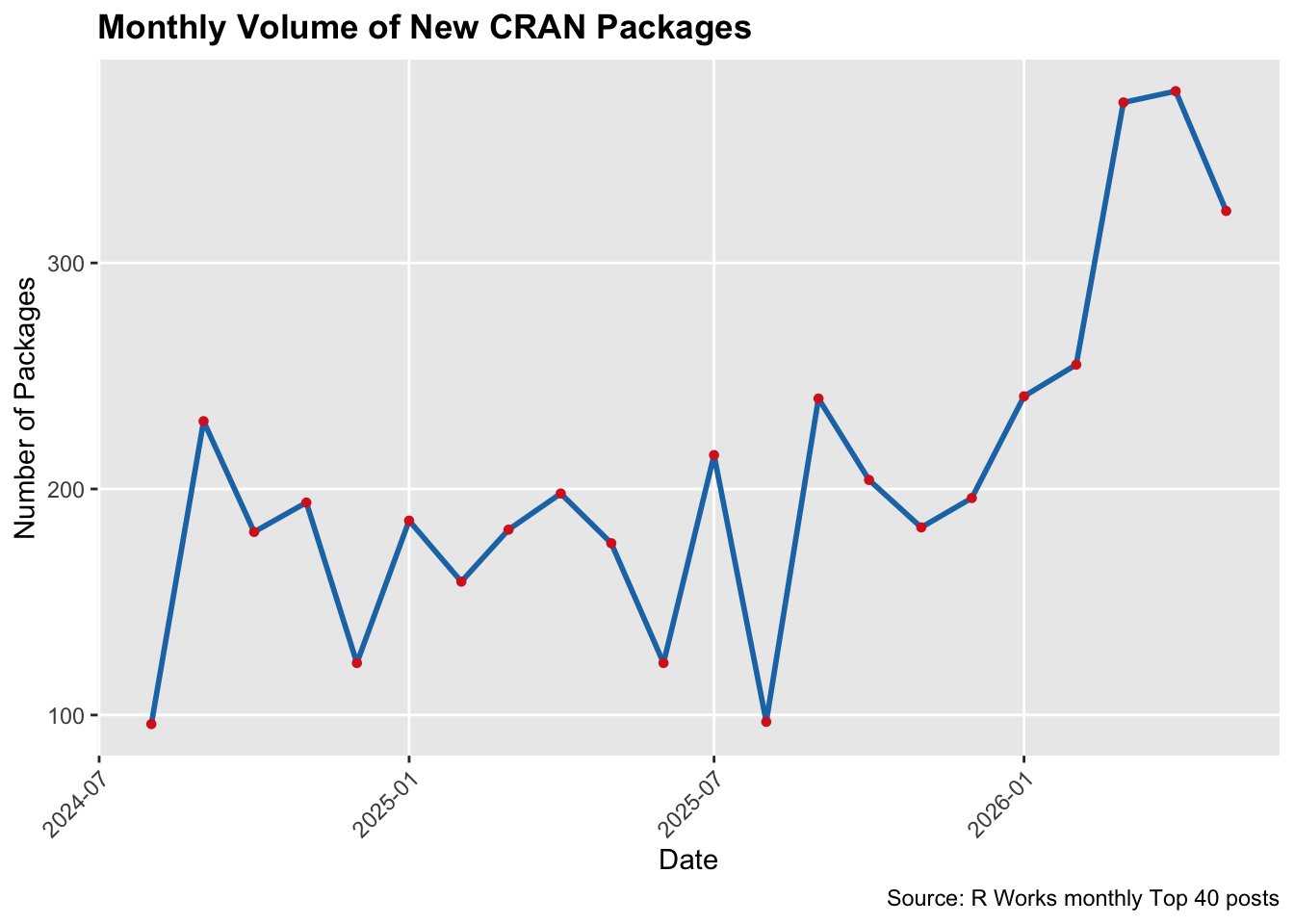
323 new R packages in one month — and 40 shipped with no README (rworks.dev)

In May, 323 new packages landed on CRAN; 40 of them had no README, vignette, or repository URL. The curator behind the 'Top 40' roundup says the work is now exponentially harder.

The thread splits on the cause. Some blame AI-generated 'slop' and tidyverse over-reliance; a recent first-time submitter pushes back, noting CRAN still put his package through two rounds of human review.

The gist that says Postgres replaces Kafka, Redis and Neo4j (gist.github.com)

The gist sets a deliberately high bar: pick a separate system only after you have pushed Postgres to its limits, documented why it fell short, and accepted the operational cost. PGMQ stands in for Kafka, pgvector and ParadeDB for Elasticsearch, Apache AGE for Neo4j, TimescaleDB for time-series.

Then a Google SRE flips it: you only reach for Kafka or Snowflake at the point Postgres stops being viable, so the comparison runs backwards. And a 20-year ops veteran argues one big database is harder to run than several small ones.

A file format ships a WASM decoder inside every file, and HN argues archival sense (github.com)

F3 is a columnar data format — a Parquet rival — that carries the WASM binaries needed to decode it inside every file. One engineer who builds data connectors called the self-describing trick genius.

The pushback came from people who archive at scale: keeping petabytes for ten years, you don't want to depend on a WASM interpreter being fast in 2051, you want a dead-simple byte spec like Parquet's. And the README, several noted, never says which Parquet shortcomings F3 fixes.

Baidu's Unlimited-OCR reads a 100-page PDF in one pass without exploding VRAM (github.com)

Baidu open-sourced Unlimited-OCR, which parses long documents in one pass instead of chopping them into pages and gluing the text back. The trick (R-SWA): keep the full document image always in view, but cap memory of the model's own output to a small sliding window so the KV cache stops growing.

It openly credits DeepSeek-OCR and PaddleOCR for the ideas. The thread's skeptics ask the obvious thing: how is this better than just feeding one page at a time?

🚀Tech ★ 447 · 💬 102 · Jun 24 · #AI#data#open source#Baidu#DeepSeek-OCR#PaddleOCR+1

Mistral OCR 4 charges $4 per 1,000 pages and a rival founder is skeptical (mistral.ai)

Mistral OCR 4 adds bounding boxes, block classification and per-word confidence scores across 170 languages, and reports a 72% win rate over rivals on 600+ documents. It costs $4 per 1,000 pages.

The founder of an open-source OCR competitor is wary: he points out Mistral leaned on its own internal benchmark while calling the public OmniDocBench and OlmOCRBench results 'limited' — and that earlier Mistral OCR versions tested far worse than promised. Commenters also flagged a truncated benchmark y-axis starting at 50.

When one AI vendor screens hiring for a whole industry, the same people get rejected everywhere (hai.stanford.edu)

A Stanford HAI study traced 4M applications across 150 employers, all screened by one vendor. By the EEOC four-fifths rule, Black and Asian applicants cleared the bar far less often; 40,000 applications would have advanced under equal treatment.

The deeper finding is the monoculture: applicants got rejected across the board at rates you'd never see if employers decided independently — a correlation absent from non-AI hiring data.

🚀Tech ★ 133 · 💬 142 · Jun 24 · #AI#data#policy#EEOC#pymetrics#Stanford HAI

He has drawn the same imaginary city for 60 years and lets a deck of cards decide what to paint (jerrysmap.com)

Jerry Gretzinger's map of a fictional world is over 4,000 8-by-10-inch panels and growing in a slow circle. A roughly 100-card deck dictates each session: which panels to paint, when to spawn new land, even when to edit the deck itself.

The detail that stuck with readers: he works one tile at a time and may go 15 years between seeing a region whole — so whole eras of his world get overwritten before he ever lays eyes on them.

🌍Other ★ 349 · 💬 48 · Jun 24 · #culture#data#Jerry Gretzinger#Jerry's Map

A 1973 road-survey film became San Diego's accidental Street View (beautifulpublicdata.com)

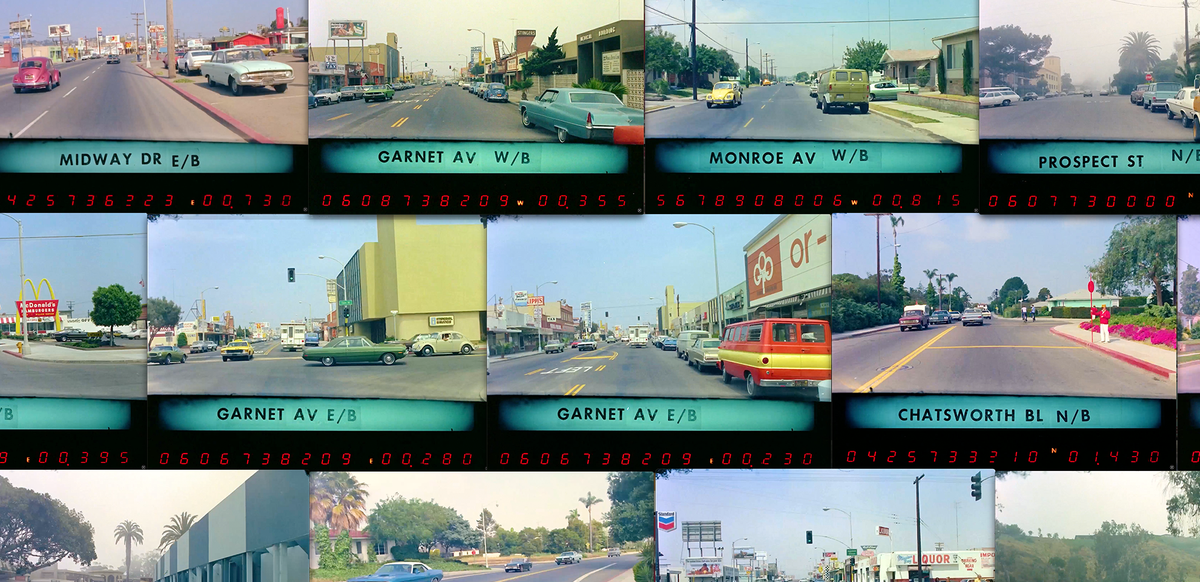
Jon Keegan pulled 35mm road-survey film of 1973 San Diego off the Internet Archive, color-corrected away the 'grey veil,' and stitched the frames into panoramas of a city its government never meant to make beautiful.

A reader who lives there confirmed the strangest detail: the Les Girls burlesque marquee in the footage is still standing, sign newly replaced this year — and now the subject of a podcast.

Switzerland's Apertus is fully open down to the data — and has no GPUs (apertvs.ai)

Apertus ships in 8B and 70B sizes, claims more than 1,000 languages, and bakes in EU-AI-Act compliance: PII removal, opt-out respect, memorization prevention. The pitch is total reproducibility — "to AI as Open is to Source" — not benchmarks. Cutoff: March 2024.

One founder reports building real RAG software on it today; it is not ready for agentic work, but it drives. Skeptics aimed at the institution: a model moving at committee speed, a country with no domestic GPUs, and a project whose best output may be the people it trained.