How a watch keeps time with 28,800 beats an hour, shown in 3D
A spring the size of a fingernail stores 40 hours of power, and a wheel ticks back and forth eight times a second to ration it out. Bartosz Ciechanowski lets you drag every part apart on the screen.
The whole machine exists to slow one spring down. The mainspring wants to unwind in seconds; the escapement releases it one tooth at a time, locked to a balance wheel swinging on a hairspring at 8 beats per second.
Ciechanowski builds it from nothing: barrel, gear train, escape wheel, pallet fork, then the crown and the self-winding rotor on your wrist.
It is a 2022 piece, and the thread's real ache is that the author has gone quiet since.
The spring that wants to unwind in one second
A mechanical watch is a fight against a spring that is too eager. Bartosz Ciechanowski's Mechanical Watch is an interactive explainer where every diagram is a draggable 3D model: you rotate the movement, pull sliders, and watch the parts move.
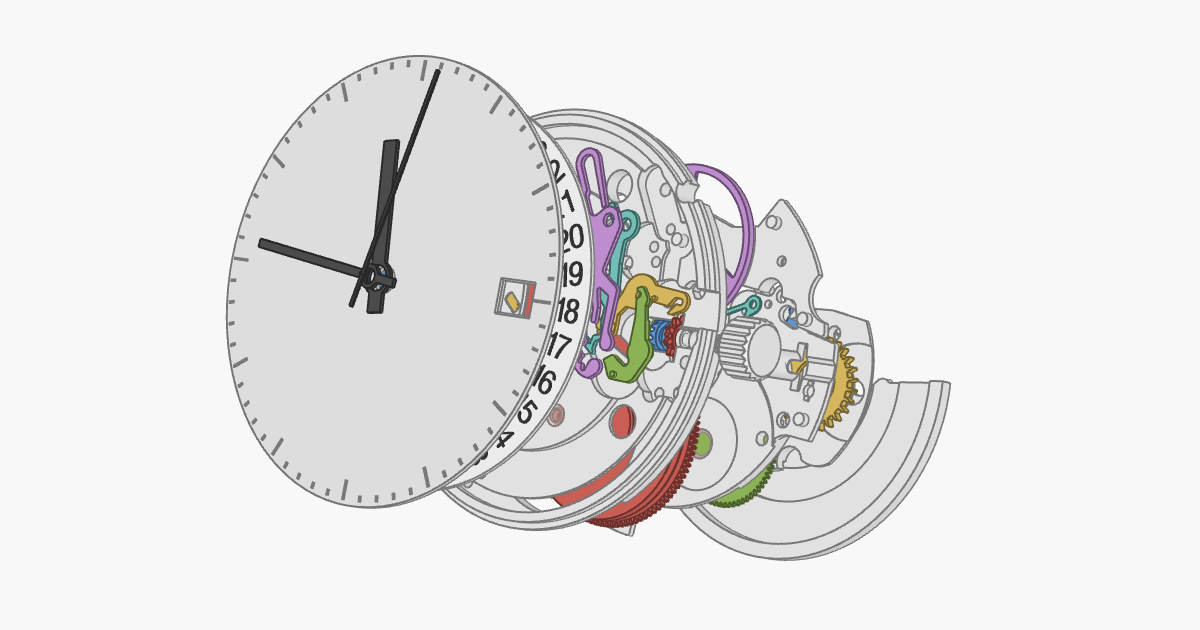
The energy lives in the mainspring, a torsion spring coiled in a barrel. Wound through the crown, it stores roughly 40 hours of running time. Left alone it would dump all that energy in seconds. So a gear train of four wheels steps the motion up, and an escapement parcels it out one tooth at a time.
Eight beats a second, locked to a hairspring
The escapement is the trick. An escape wheel and a pallet fork with jeweled tips alternately lock and release, producing the tick-tock. The timing comes from the oscillator: a balance wheel swinging on a hairspring of temperature-stable Nivarox alloy. In the watch Ciechanowski models, it runs at 8 beats per second, or 28,800 beats per hour. Ruby jewels cut friction at the bearings; a click stops the mainspring from unwinding backward.
The last act is the rotor. A freely spinning weight, geared so either direction winds the spring, harvests the motion of your arm. The keyless works under the crown switch between winding, setting the time, and advancing the date.
The thread reads like people discovering a craft. A six-year repairer explained why the trade has one name:
to learn to repair them is to learn to make them, as you need to know how to fabricate every single piece … thus why … repairers are called clockmakers and watchmakers — a six-year clock-and-watch repairer
A parent described what the page does to an eight-year-old:
My 8yo son plays with this any chance he gets. We've started building watches together as a result — a father building movements with his son
And a teacher named the thing that is actually hard:
The simplicity of the language and explanations disguise how difficult this is to do. This is the original use of the internet — a teacher on explaining complex topics
The asterisk: the explainer that stopped explaining
The story under the story is scarcity. These posts take Ciechanowski months each, and the top question in the thread is when the next one lands: it has been over a year since his last. One commenter called on-demand articles of this caliber "a pretty good AGI indicator." The rule the page quietly teaches is the opposite of software's: precision here is not free abstraction, it is hundreds of hand-fabricated parts, and the person who can draw it that clearly only ships when he is ready.
Get breakdowns like this every day
The top Hacker News stories, unpacked — by email, Telegram, or RSS.
Apple hides a car-sickness cure in Accessibility, and it splits the room
Animated dots drift along the screen's edges, moving against the car's motion. For some passengers they erase decades of nausea; for others, five minutes of reading still ends the same way.