To Verify a Teen's Age, the UK First Has to Verify Everyone's Identity
The UK plan blocks under-16s from Snapchat, TikTok, Instagram, Facebook, X and YouTube within three months. The mechanism it requires — checking the age of every user — is the part the policy debate keeps skipping.
The bill leaves messaging out (WhatsApp, Signal) and exempts YouTube Kids, then threatens multimillion-dollar fines for non-compliance, plus floated extras: overnight curfews and limits on infinite scroll for under-18s.
The author discloses he sits on a social-media board, which the thread treats as both a tell and a reason to discount him.
The harder asterisk comes from Australia's live version: a 15-year-old visitor reported it didn't touch existing accounts at all, because age checks there only gate newly created ones.
The mechanism nobody costs out
Techdirt's piece, "The UK's Teen Social Media Ban Is Political Theater," argues the proposal is built to win votes, not protect kids. The factual spine: a ban on under-16s using Snapchat, TikTok, YouTube, Instagram, Facebook and X, with messaging apps (WhatsApp, Signal) and YouTube Kids exempted, three months to comply or face multimillion-dollar fines, and curfews and anti-infinite-scroll rules under consideration for under-18s.
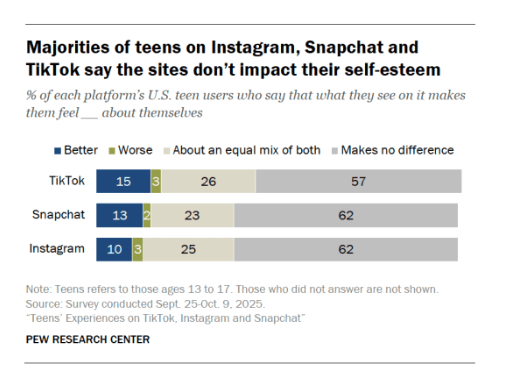
Author Mike Masnick, who discloses he is on the board of Bluesky, leans on a Pew finding that only 3% of teens report negative experiences, and asserts "pretty much all experts agree that age verification technology itself makes kids way less safe online."
Self-reported "the kids are fine" is a weak load-bearing beam
The sharpest pushback in the thread is methodological: the studies showing teens are unharmed are mostly the teens grading themselves.
"the kids think that the kids are doing alright, which is a different statement from the kids are actually doing alright… Actually testing kids is showing a startling reverse Flynn effect." — a builder of physical-AI systems
A reply notes the cited Flynn-effect paper doesn't actually name social media as a cause, so both sides are waving thin evidence.
Age verification is identity verification
The technical core, repeated across the thread: you cannot gate by age without attaching identity to accounts, which pulls every adult into the dragnet.
"You can't verify age without verifying identity." — a commenter on the surveillance mechanics
Smaller sites are the collateral — they likely can't afford verification vendors and shut down, while the incumbents already know who the kids are:
"They are already fully aware of how old their users are. The kids post photos and messages every birthday… They don't need our biometric data to know that we're adults, they just want it anyway and this is their excuse." — autoexec, on what platforms already track
Australia is the working prototype, and it leaks
The enforcement reality check is empirical. A commenter relays that his 15-year-old niece's Australian cousins kept their accounts, because the checks only apply to new sign-ups:
"the age checking there only applies to newly created accounts." — a relative of teens who tested it in Australia
The changed rule for evaluating this kind of law: ignore the headline goal, read the technical surface. One side reads "ban" and pictures fewer kids on Instagram; the engineering reads "age check" and gets a national identity layer that grandfathers in the exact accounts it claimed to target.
Get breakdowns like this every day
The top Hacker News stories, unpacked — by email, Telegram, or RSS.
His real ID unlocked stream keys for every World Cup camera
The Angular app showed an access-denied page. The backend handed over everything: RTMP ingest URLs and stream keys for all five camera angles of every World Cup 2026 match. He confirmed a live feed in VLC.