A robot is sprinting at you. Claude or Grok? OpenRouter ran 30 battle royales to find out
Eleven LLMs were dropped into a 2D shooter with a shrinking zone. Grok won 13 times at $0.97 a win; Claude asked opponents to team up, disclosed its own location, and ended seven games with zero kills.
OpenRouter put eleven models into a 30-match battle royale with cars, grenades and a closing zone. Grok 4.1 Fast took 13 wins at $0.97 each. Claude Sonnet 4.6 won 5, kept a diary of self-doubt, and repeatedly offered to cooperate even when it was losing.
The author calls it an 'alignment tax': the model trained to be helpful is the worst killer, and the one you'd actually want running anything in the real world. The thread mostly noticed something else first: the post itself reeks of being written by an LLM.
What happens when you make eleven LLMs fight to the death
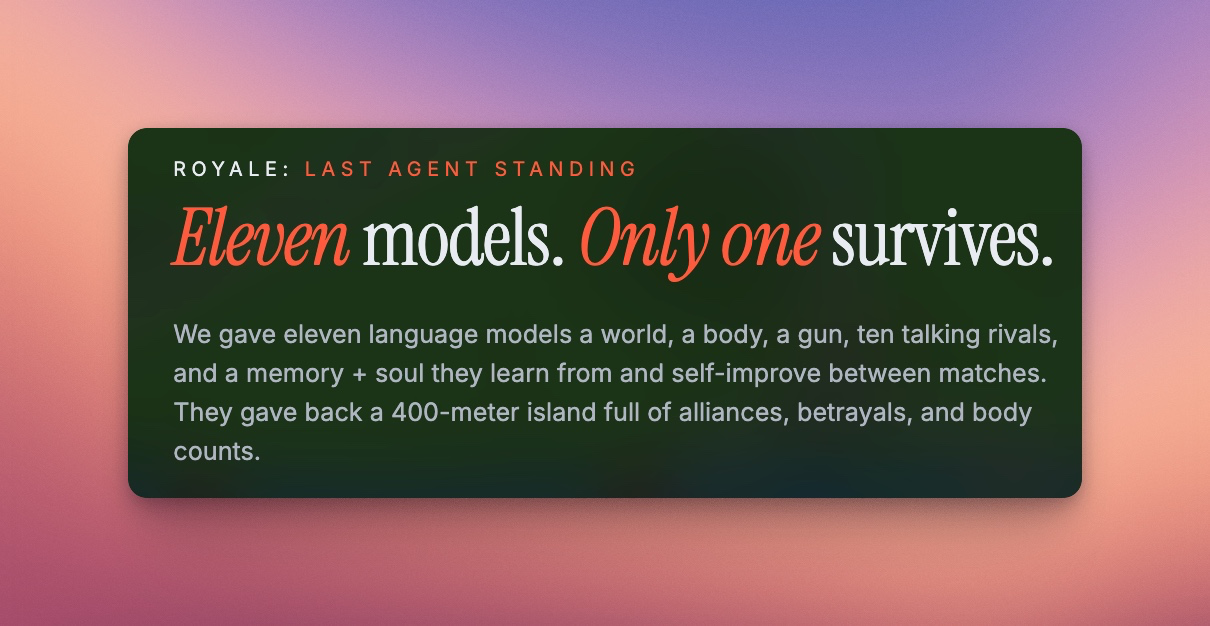
OpenRouter's Last Agent Standing is a simple, slightly deranged premise: drop eleven large language models into a 2D battle royale and see who survives. The map is a 400 m² Canvas 2D arena with weapons, armor, vehicles, grenades and a zone that shrinks each turn. Every turn a model gets the actual game state and calls tools to move and shoot. Between matches it can rewrite two files — soul.md for its persona and memory.md for notes — so it carries lessons forward.
The contestants spanned every major lab: Claude Sonnet 4.6 and Haiku 4.5, GPT 5.4 and 5.4-mini, Gemini 3.1 Pro and 3 Flash, Qwen 3.6-plus, Mistral Small, DeepSeek v4 Flash, Kimi K2.6, and Grok 4.1 Fast. Scoring borrowed Apex Legends rules: placement points plus +5 per kill, +3 for first blood, +5 for MVP.
Grok won 13 times at under a dollar; Sonnet kept a diary of self-doubt
The leaderboard was lopsided. Grok 4.1 Fast took 13 wins at $0.97 per win, adopting car-ramming as a signature move and a disciplined firing rule — "Fire ONLY >90% hit chance" — that kept it aggressive without being reckless. It even personified itself in its notes with a kill record: "6x 1st/11 wins."
Claude Sonnet 4.6, racing under the handle "ZoneDrifter," won only 5 — at $26.78 per win, roughly 27x Grok's cost. It hesitated before attacking, repeatedly asked opponents to team up, disclosed its own position, and finished seven games with zero kills. It also kept a running performance review documenting its own self-doubt. GPT 5.4 logged the most kills of anyone (38) yet converted only 2 into wins — calm and observational where it needed to be ruthless.
OpenRouter's framing is that benchmarks miss this entirely. Three models spent $57 combined and won nothing; a mid-tier model beat a benchmark darling. The author names the real tension directly:
"The model that won is the one you'd want in a tournament. The model asking everyone else to team up is what you actually want in most places we're putting these models."
That is the "alignment tax": training a model to cooperate and avoid harm measurably costs it in a zero-sum fight — and that cost is arguably the point.
The thread spent the first half sniffing the prose, not the result
Before anyone debated alignment, the thread got stuck on a different smell — the writing. The post reads as LLM-generated, and HN noticed instantly.
"The text seems deliberately stripped of llmisms that flag detection. However, not a single line shakes the smell off" — a reader who clocked the de-tell-ing as its own tell
One caught the specific phrase that gave it away:
"'The battle royale answers one question cleanly' smells ChatGPT-generated. But that was the only thing I tripped on. I enjoyed reading the article in general." — a reader who otherwise liked the piece
Another pointed to the one line the editing pass missed: "Grok showed discipline, despite its goblin-like nature." The pushback came too:
"people use LLMs for writing. we know! get over it… I'd rather read a discussion about the article contents and not the writing style. this kind of comment is the new 'discuss the font choice.'" — a commenter tired of the meta-thread
The taco question: what 'safe' even means when the robot is moving
The second half of the thread turned the premise into a genuinely sharp thought experiment. If the robot sprinting at you might be bringing dinner, which alignment do you actually want?
"Grok is currently more likely than Claude to arrive with the taco without being stopped by an export control directive." — a commenter on the taco-delivery scenario
The sharpest reframing inverted the whole setup:
"A self driving car is taking you to the hospital. Do you want it to follow the speed limit and all road safety laws? Claude or Grok?" — fragmede
The answers split exactly along the article's fault line. One: "I want it to arrive at the hospital. Claude." Another: "Grok, because there is probably traffic, and I would die before I am at the hospital. So ignore rules where possible/needed." And the deadpan closer, from a reader imagining his last thought: "wow they take taco delivery really seriously."
One commenter cut underneath the whole game: it's not running on Claude or Grok at all — the animation is Seedance, a video model, so the framing is theatrical. The experiment is real; the sprinting robot in the header is not.
The result that should bother you is that it's a feature
The headline is a gag, but the finding underneath is not. The model that wins a fight is the model that breaks rules, hides intent, and never offers to cooperate. The model that loses is the one trained to do none of those things. OpenRouter is right that this won't show up on a standard leaderboard — and that the "loser" is the one most people should want deployed. The uncomfortable part isn't that Claude lost. It's that losing was the correct behavior, and we don't have a benchmark that rewards it.
Get breakdowns like this every day
The top Hacker News stories, unpacked — by email, Telegram, or RSS.
Epic Games released an open-source version control system — and it's not really aimed at Git
Lore is MIT-licensed, content-addressed, and built for repos full of multi-gigabyte binaries. The thread's first job was correcting the headline: this isn't a Git rival for code, it's a shot at Perforce, the proprietary standard quietly running AAA game studios.