150 near-identical AI kids'-book covers prove the tell is sameness
Search Amazon for '100,000 Whys' and you get a wall of children's encyclopedias that all look the same: dinosaur top-left, red-and-white rocket, an author named Bright.
The single em-dash tell is dead, the author argues. What gives AI away is aggregate sameness across many outputs, not any one artifact.
His proof: a collage of roughly 150 AI-generated kids' encyclopedia covers, many of them category bestsellers, recycling the same tropes and surnames.
The thread named the mechanism, then questioned whether the sample proves anything.
The tell is the distribution, not the artifact
lcamtuf (Michał Zalewski) makes a contrarian case in The 100,000 Whys of AI: AI-generated text really is reliably distinguishable from human writing — just not by any single word, phrase, or em-dash. It is distinguishable by aggregate sameness.
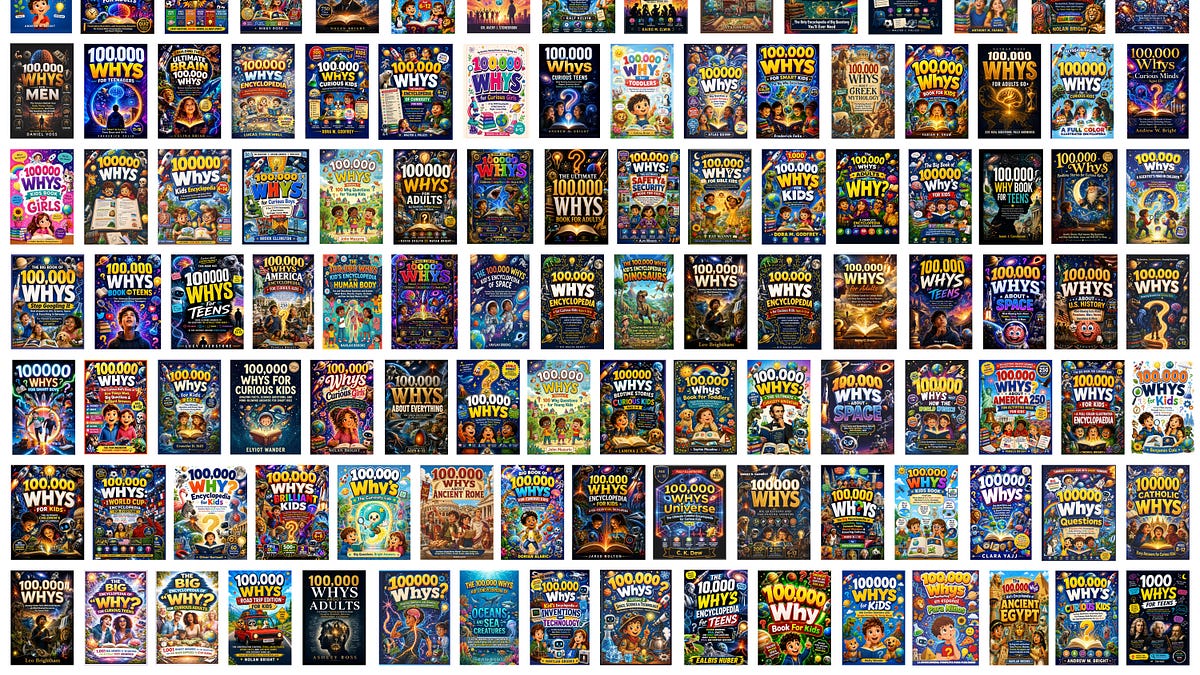
The evidence is a search. Look up '100,000 Whys' on Amazon — a phrase borrowed from a 1929 Chinese children's book — and you surface roughly 150 near-identical AI-generated kids' encyclopedias, many of them category bestsellers. The recurring visual tropes give it away: dinosaurs in the top-left, the same red-and-white rockets, the same dog breeds, and author surnames recycled to the point of comedy (a great many 'Brights'). The argument: when many people hand a model a similar prompt, it converges on functionally identical output most of the time, so the tell is the mannerism distribution across a corpus, not any one cover. The conclusion is to trust your gut: pattern recognition over forensic detail.
The thread first gave the effect its real name:
"There used to be a word for this in generative AI: mode collapse… it generates the same 0.0001% of possible human like responses every time." — a commenter naming the failure mode
That grounds the essay's 'vibe' in mechanism. But the sharpest pushback hit the evidence directly. If the covers are one publisher spinning a series, the wall of sameness proves something far smaller:
"I can see some names there like Havilah Brooks or Celina Briar who are intentionally re-using the same title to create a series… this doesn't really get into the base rate of generic title re-use among encyclopedias." — a commenter who inspected the author names
Another reader isolated exactly the assumption the whole argument rests on:
"for that instance to carry weight you would have to provide evidence that the mosaic of books were the product of different people using AI." — a commenter pinpointing the load-bearing claim
And one veteran offered the falsifiable heuristic the essay deliberately avoids:
"A test for AI-generated art: railroad tracks. For some reason, none of the image generators can get railroad trackage even close to correct." — longtime engineer John Nagle
The thread lands on a productive tension. The author's instinct is right (sameness is the signature), but his showcase example may be the weakest possible proof of it, because a single publisher's series and a hundred independent users produce the same visual wall. The mechanism is sound; whether this particular collage demonstrates it depends on a base rate nobody in the thread could supply.
Get breakdowns like this every day
The top Hacker News stories, unpacked — by email, Telegram, or RSS.
Stop asking your manager for yes; announce it and let them say no
Instead of "Can we install action X?", you send: "I'll install it Monday unless you tell me otherwise." The boss keeps the veto. You keep the momentum.