A researcher spent 700M tokens having an AI build the TikZ editor LaTeX users always wanted
Drawing diagrams in TikZ means writing coordinates by hand. A CNRS researcher built a WYSIWYG editor that drags nodes around and emits the code — and disclosed that he generated it through Codex on 700M tokens, ~$15k of API value he paid $500 for.
TikZ Editor lets you draw figures visually and outputs TikZ/LaTeX code, open source and on the web. The most-praised use isn't drawing from scratch — it's editing old TikZ without turning the source into generated soup.
Maker DominikPeters says it took 700M tokens since February via a ChatGPT subscription. A LaTeX user in the thread flagged the catch: every node lands at absolute coordinates, which is rarely how good TikZ is written.
The editor that finally makes TikZ point-and-click
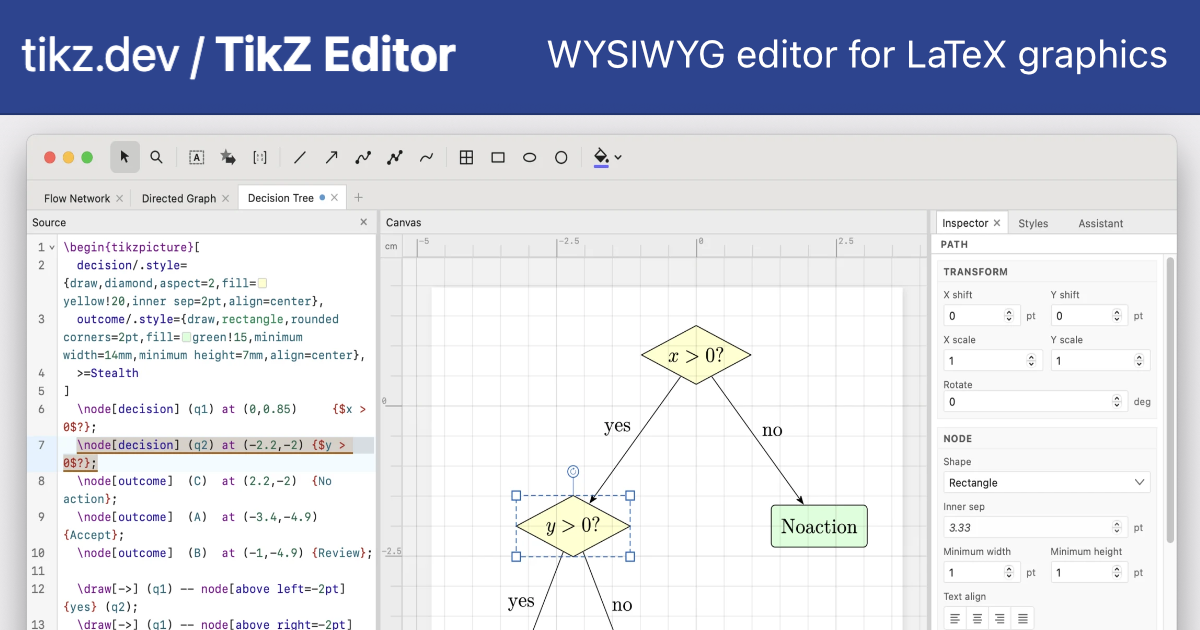
TikZ is the standard way to draw figures inside LaTeX, and it's notoriously unfun: you describe shapes, nodes and arrows in code, often placing things by hand. TikZ Editor is a WYSIWYG canvas: you drag nodes around and draw, and it emits the corresponding TikZ source. It's released open source and available both in-browser and as desktop builds. The running joke even made it into the thread: the name backronyms to "TikZ ist kein Zeichenprogramm," German for "TikZ is not a drawing program."
The maker, who posted as DominikPeters, is a CS researcher at CNRS / Paris-Dauphine, and he was unusually transparent about how it was built. He worked on it consistently since February 2026 through Codex, burning roughly 700 million tokens, "which at API rates would have cost $15k (but I actually paid only around $500 in ChatGPT subscription fees)."
What people actually want it for — and where the code gives itself away
The Show HN drew a wave of "wish I'd had this in college," but the most interesting praise pointed away from the obvious drag-and-draw use case:
"The killer feature for me is not drawing TikZ visually, but being able to touch old TikZ without turning the source into generated-looking soup." — a user whose pain point is editing legacy TikZ
The substantive critique came from someone who knows the language well, and it's a direct consequence of building a visual editor: WYSIWYG drag-and-drop wants absolute positions, but idiomatic TikZ leans on relative placement and anchors.
"the generated TikZ code is not good in my opinion. Everything uses absolute coordinates, which in TikZ is seldom needed… if I place a single node I get absolute coordinates for it. Why?" — a commenter critiquing the absolute coordinates
The recurring feature request was telling about where typesetting is heading: several users asked whether it could target cetz, the TikZ-equivalent for Typst, with one flatly saying he won't touch LaTeX anymore if he can avoid it. Others wanted pgfplots, circuit diagrams, and Obsidian integration.
And because the build method was disclosed, the thread doubled as a referendum on AI coding. One commenter used the project as a cudgel — "the people who seethe with hate for AI… are going to have to admit they were wrong" — while a maintainer-minded reader asked the more useful question: how much did the agent structure the architecture on its own versus heavy steering, and were there tests rendering the TikZ through real LaTeX to check the JS pipeline against it? That a polished, genuinely-wanted tool came out of a $500 subscription is the part that lingers, not whether it writes textbook-perfect TikZ yet.
Get breakdowns like this every day
The top Hacker News stories, unpacked — by email, Telegram, or RSS.
Anthropic ships a Slack bot that writes 65% of its own product team's code
Anthropic's pitch for tagging @Claude in a Slack channel rests on one number: 65% of its product team's code is now written by the company's internal version of the tool. Half the thread read that as a confession, not a credential.