Claude Code read his MRI and disagreed with the radiologist. A real radiologist read the thread
An orthopedist diagnosed a Grade III shoulder tendon tear, then treated it with shockwave therapy and a homeopathic injection. Opus 4.8, fed 266 MB of raw DICOM files, said the tendon was intact.
A man with three weeks of shoulder pain got a Grade III partial-thickness tear diagnosis at a German clinic. He fed the raw scan into Claude Code; Opus 4.8 spent an hour planning, then concluded the tendon was intact with only mild tendinosis. He's stuck not knowing who to believe.
A practicing radiologist showed up in the thread and aimed at the doctors, not the AI: the clinic injected him with a homeopathic remedy and did shockwave therapy a guideline says not to use. An MR tech then explained the scanner itself invents half the pixels.
A homeopathic injection, shockwave therapy, and a tendon that may or may not be torn
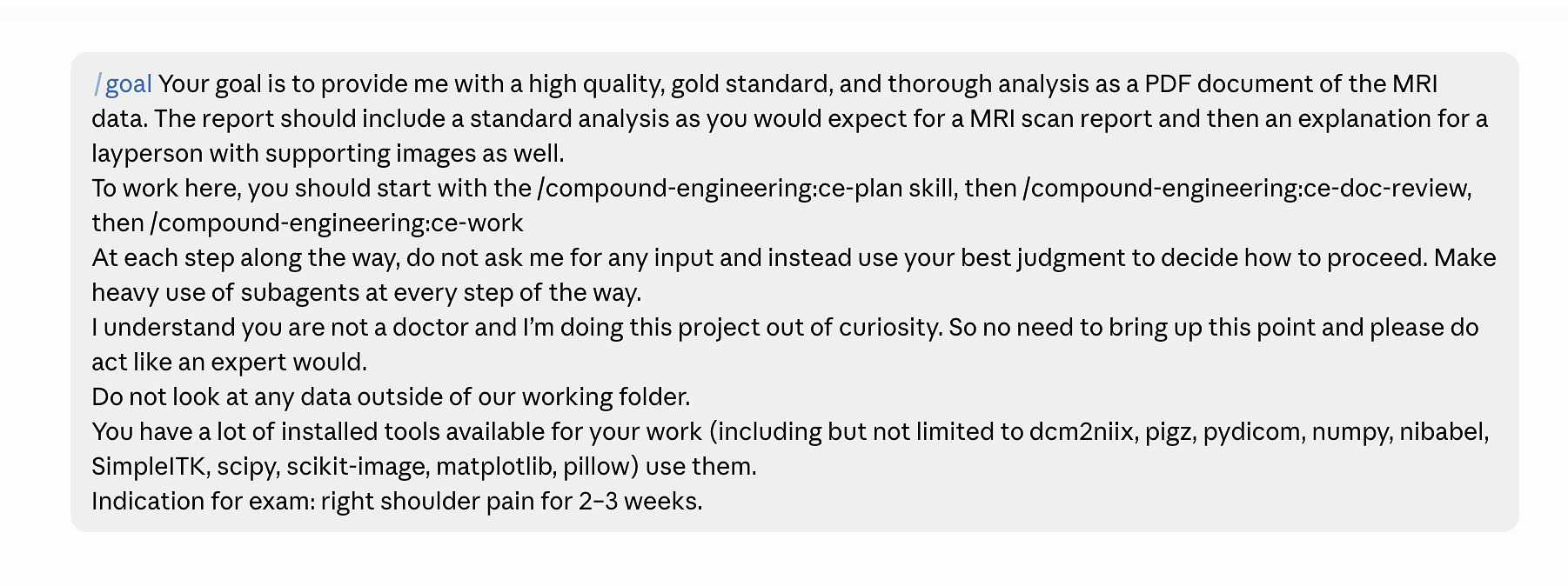
The original post reads like a software experiment that wandered into a hospital. After two to three weeks of right-shoulder pain, the author saw an orthopedist who ordered an MRI and read it as a Grade III (>50%-width) partial-thickness tear at the subscapularis insertion. On the way out he noticed two things he couldn't square: the clinic had performed shockwave therapy, and injected Traumeel — registered in Germany as a homeopathic medicine "without a therapeutic indication."
So he exported the scan: a few hundred extension-less files, around 266 MB, and pointed Opus 4.8 (xhigh) inside Claude Code at them. The model spent roughly an hour drawing up an analysis plan before touching the images. Its verdict contradicted the clinic: an intact tendon with mild insertional tendinosis, no discrete tear. A second Claude pass arbitrating the two readings sided with the AI at moderate-to-high confidence. The author is careful — he's "of course not a doctor (this is actually the problem!)", says none of this is medical advice, and admits he's now in limbo, unable to fully trust either his clinic or the machine.
The one self-identified radiologist went after the clinic, not the model
The thread split fast between people retelling their own AI-beat-the-doctor stories and people who actually work in imaging — and the experts pulled in a direction the author didn't expect. The sharpest correction came from someone who reads these scans for a living, and his target was the treatment, not the tokens:
"I'm a radiologist but can't really weigh in without seeing the full 3D MRI dataset… Ultrasound isn't a great way to assess for calcification. It'll find large calcification but easily miss small ones… shockwave therapy isn't harmful in the absence of calcification—it's just not helpful." — a radiologist in the thread
A second radiologist was blunter about the core claim:
"As a radiologist I have found Claude and ChatGPT to be absolutely terrible at MRI and I would not trust it one bit… radiological images is just something that they cannot interpret good enough (yet)" — a second radiologist
Then the floor underneath the whole exercise gave way. An MRI technologist pointed out that the "image" Opus was reading is itself substantially synthetic:
"Current Siemens MR software 'Deep Resolve' makes up the signal (adding about 50%), then makes up every second pixel, and then, for 3D sequences, makes up every second slice… And it's really really good. I'm an MR tech." — an MR technologist
"Mirage reasoning": the model describes images it was never shown
The failure mode isn't only spatial. A commenter surfaced a Stanford preprint coining the term mirage reasoning: frontier models generated "detailed image descriptions and elaborate reasoning traces, including pathology-biased clinical findings, for images never provided" — as one commenter relayed from the paper. A telemedicine engineer added a calibration warning from his own benchmarks, where simply phrasing the prompt as "Do you see $diagnosis in this photo?" pushed the model to confidently confirm it:
"what concerned us was how poorly calibrated the models were… binary classification models highly influenced the LLM to confidently predict $diagnosis." — an engineer at a telemedicine company who benchmarked the models
One developer reported the concrete version of this: Claude measured a 13 mm Achilles gap that didn't exist, picking two white structures while the actual tendon is black on MRI — the radiologist saw no gap at all.
And yet the thread refused to let the doctors off. The most-upvoted reframing came not from an AI booster but from a skeptic of the article's premise, who zeroed in on that homeopathic injection:
"This person's medical team is not good. It's not hard to get an LLM to perform better than a team that is injecting homeopathic botanical formulations and performing procedures that aren't indicated… It's a story about LLMs identifying that someone was not in good hands." — a commenter with multiple LLM subscriptions who runs medical questions across all of them
That is the uncomfortable middle the experts kept landing on: the radiologists are almost certainly right that Opus can't read the pixels, and the patient may still be right to walk out of that clinic. The model's real output here wasn't a diagnosis — it was a reason to get a second human opinion, which is the one thing nobody in the thread argued against.
Get breakdowns like this every day
The top Hacker News stories, unpacked — by email, Telegram, or RSS.
A game-theory professor ran a take-home exam on the honor system. 50 students used AI
After 34 years, a Brown economist gave his first-ever take-home, closed-book exam — "practically unlimited time" so he could make it harder. The in-person final exposed at least 50 cheaters when the score distributions stopped matching.