A graphical shell for SSH where every app is its own tiny HTTP server
Marcus Lewis built Outer Shell so a remote server can serve a native GUI over SSH instead of a monospaced character grid. His demo runs a live graphical 'top' over the link. The thread's first reply: this already exists, several times over.
The pitch: skip the dance of 'ssh -L 24601:localhost:8889' tunnels for Jupyter or TensorBoard. Each remote app becomes a small HTTP server talking over a Unix socket, encrypted by SSH itself, rendered as a real native interface on your machine.
Then the veterans arrived. Cockpit has done socket-based remote server consoles for over a decade; MobaXterm, X11 forwarding, Windows Admin Center and webmin all got named. One reply, in full: 'Cool, I hate it.'
Killing the character grid: a server that ships its own GUI
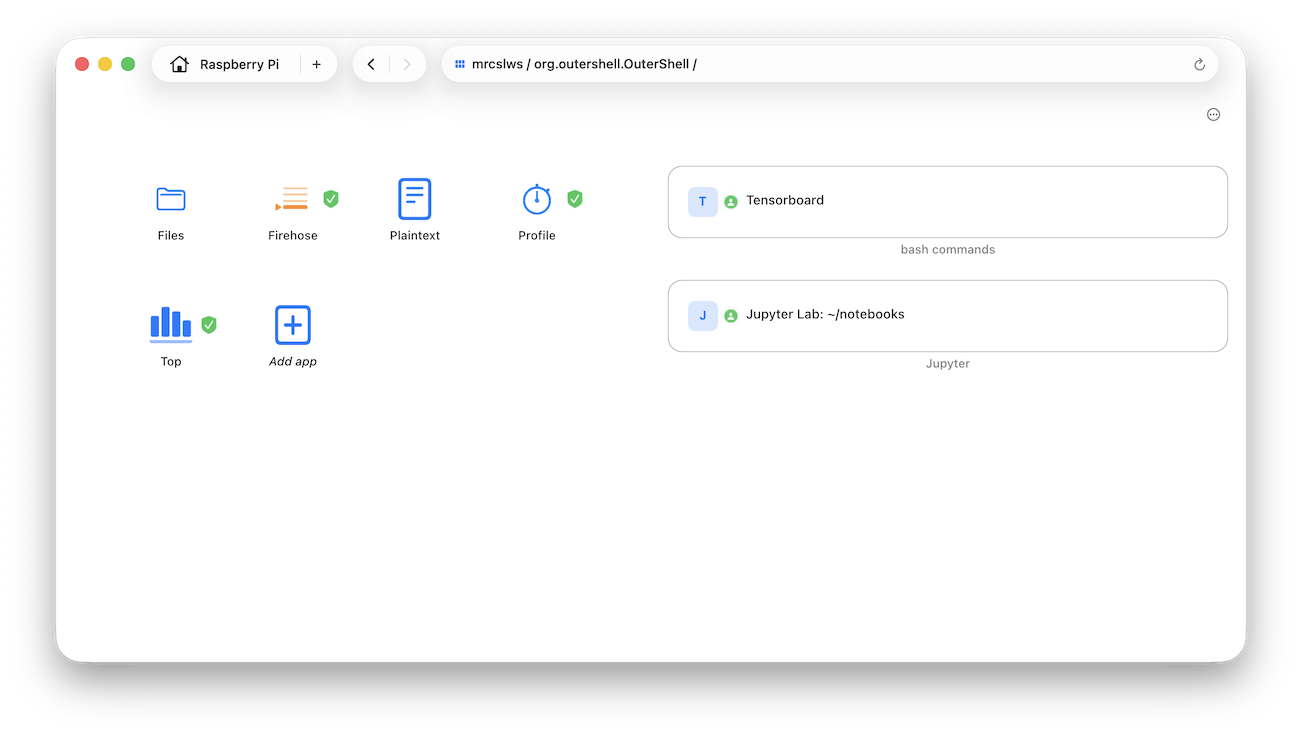
Marcus Lewis's post, A native graphical shell for SSH, opens on a question he clearly thinks is rhetorical: "Isn't it weird that this doesn't already exist?" His complaint is the daily friction of reaching apps on a remote box (Jupyter, TensorBoard) that bind to a local port the wider internet can't safely touch, forcing the familiar incantation ssh -L 24601:localhost:8889 user@host.
His answer is a three-part stack: Outer Loop (an SSH browser), Outer Shell (an open API that acts as a home screen for apps), and Outer Frame (a native app framework). The architecture is one line: "Every app is a small HTTP server, serving up a web user interface." Instead of localhost ports, apps speak over Unix domain sockets with explicit file permissions; encryption happens at the SSH layer, so the app carries none itself. Apps can render as HTML or as truly native interfaces, which Lewis frames as the web's natural split: "HTML for reading and casual apps, and native platform-tailored apps for getting work done." The screencast drives the point home with a graphical top running over the link, load generated live to watch the readout move.
"It has existed for ages": the thread names six predecessors
The reception in the thread was a roll call of prior art. The most pointed came from someone who'd evidently run the incumbent for years:
"Author apparently has never heard about Cockpit. Everything they mention as 'missing', or 'novel' has been part of Cockpit for over a decade… To answer them: 'Isn't it weird that this doesn't already exist?' - No, it's not, because it has existed for ages." — guhcampos
Others piled on with their own references: MobaXterm's side file manager and X11 passthrough, Microsoft's Windows Admin Center, plain old X11Forwarding yes, webmin. A YC-alum founder simply pasted a link: "this exists as https://xpipe.io/". The most economical verdict ran three words: "Cool, I hate it."
The security crowd was less amused. The whole reason browsers can't open generic sockets, one argued, is deliberate:
"There are many, many excellent long-standing security and 'web control plane isolation' reasons browsers are not permitted generic socket permissions. The closest mechanical analog… is why 3-wheeled ATVs are a bad idea." — a commenter who walked through the socket-permission threat model
But the experiment found defenders who'd chased the same idea themselves. One had built a near-identical proof of concept around 2013 — SSH in, a process emits data, a localhost web app renders a live remote top — and called this "a fully-baked version" of his half-baked hackathon nugget. A different voice wanted Lewis to go further than premade apps:
"this stuff becomes really interesting when you put a real 'shell' on top of this. And I don't mean a classical posix shell, something that can leverage the full power of the custom ui and frontend." — a developer who prototyped the same thing with a Go backend over SSH
And a few wanted the inverse: not premade GUIs but a VNC-like channel where ordinary TUI tools like top and micro escape the monospaced grid into real graphics. That tension — is the value the native UX, or just a lower barrier to entry that a tunnel and a self-hosted web app already cover — is the one Lewis didn't settle. The prior art proves the itch is real and old. Whether his particular cut through the stack is the one that sticks is the open question the thread left him with.
Get breakdowns like this every day
The top Hacker News stories, unpacked — by email, Telegram, or RSS.
Tidal will host AI music and tag it — but pay it zero royalties
Tidal built its brand on hi-fi audio and paying artists more than rivals. Its new AI policy keeps the AI tracks, slaps an 'AI' badge on the wholly-generated ones, and refuses to send any of them a cent.