A lab-built cell that feeds, grows and divides, yet still isn't alive
Kate Adamala's team at the University of Minnesota assembled a cell from off-the-shelf molecules inside a fat bubble, then watched it copy its DNA and pinch in two by skipping the cytoskeleton every real cell uses to divide.
The wall the field kept hitting was division. Adamala's fix was to ditch the cytoskeleton: protein tags on the membrane pull in crowding proteins that bend it until the sac splits. Everything else runs on borrowed parts, 36 off-the-shelf enzymes plus feeder bubbles of sugar and ribosomes.
The team is candid that it is "not alive by any definition" and can't make its own ribosomes. The same lab also drew grumbling: the manuscript was rejected by Cell, then mailed to reporters before a preprint went up for peers to check.
A Wright flyer, not a Dreamliner
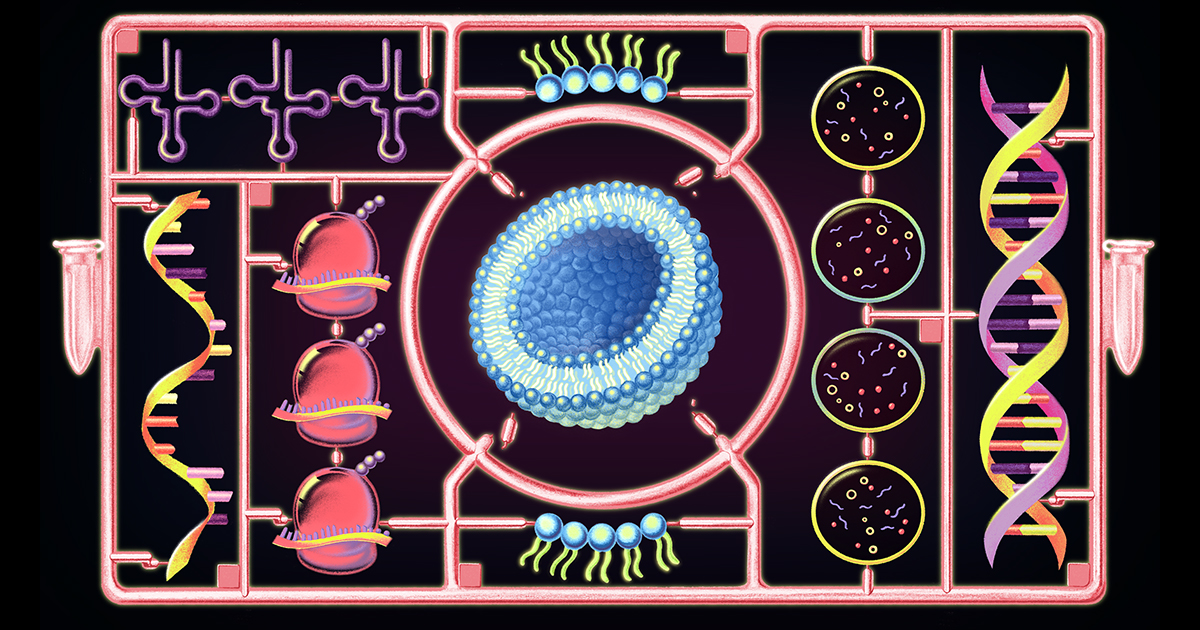
Kate Adamala, a synthetic biologist at the University of Minnesota, reports building a cell from non-living parts that does the three things textbooks reserve for life: it feeds, grows, and divides. Her team assembles each "SpudCell" inside a liposome, a bubble of fat, packing in a minimal genome, transfer RNA, ribosomes, and a kit of 36 commercial enzymes that read DNA and make protein. Fed sugars and lipids from feeder bubbles, the cell copies its own DNA.
Division was the wall the field had hit for years. A normal cell rebuilds its cytoskeleton to pull itself in two, and no one could reproduce that step in synthetic cells. Adamala's team skipped it: protein tags anchored to the membrane recruit crowding proteins that physically bend it until the sac pinches apart.
She is blunt about the limits. The cell is "not alive by any definition," cannot make its own ribosomes, and dies without constant deliveries of food. Her own framing likens the modern cell to a Dreamliner and this to a Wright flyer: the first winged frame that manages a short hop.
The lab, the embargo, and an open AMA
The pedigree behind the result caught one reader's eye.
"led by the same Dr. Kate Adamala who ended the right-handed-proteins experiment a couple of years ago" — a healthcare CIO
How the work reached the public drew more scrutiny. A reader surfaced Science's more measured account: the paper was "rejected by Cell after one reviewer said SpudCells were not real biology," after which the manuscript went to journalists under embargo before a preprint her colleagues could assess.
"It's an unusual way of doing things" — a synthetic biologist at Heidelberg University
The team did not stay behind the paper, either.
"I;m one of the co-founders, AMA :)" — a biophysics PhD student on the founding team
The open question is procedural rather than chemical: SpudCells have not cleared peer review, so the claim that dead components can be coaxed into dividing still waits for another lab's bench to repeat it.
Get breakdowns like this every day
The top Hacker News stories, unpacked — by email, Telegram, or RSS.
Meta Kills Its Token Leaderboard After Staff Burn 73.7 Trillion in a Month
Meta's engineers consumed 73.7 trillion AI tokens in about thirty days, and someone turned the bill into a game: a leaderboard ranking staff by how many they burned. Now the company is pulling the plug.