The case for Costco as the anti-Amazon runs into a study saying its 'greener' model is the dirtiest option
Costco sells 4,000 items where Walmart sells 130,000, pays more, loses fewer workers, and makes you drive to the warehouse. The essay calls that model efficient and green and wants New York's public groceries to copy it. A University of Michigan study says driving to the store is the highest-emission way to shop.
The argument: Costco is Amazon's mirror image and the better one — SG&A near 10% of sales versus Amazon's ~40%, over 90% membership renewal, higher wages, single-digit turnover. Constraint beats infinite assortment, and the customer's own last-mile trip is the efficiency.
The thread inverts the green claim: in-store pickup by a gas car was the dirtiest option in an emissions study — and Costco already outsources delivery to Instacart, quietly running the very last mile the essay says it avoids.
Why the numbers make Costco look like Amazon's opposite
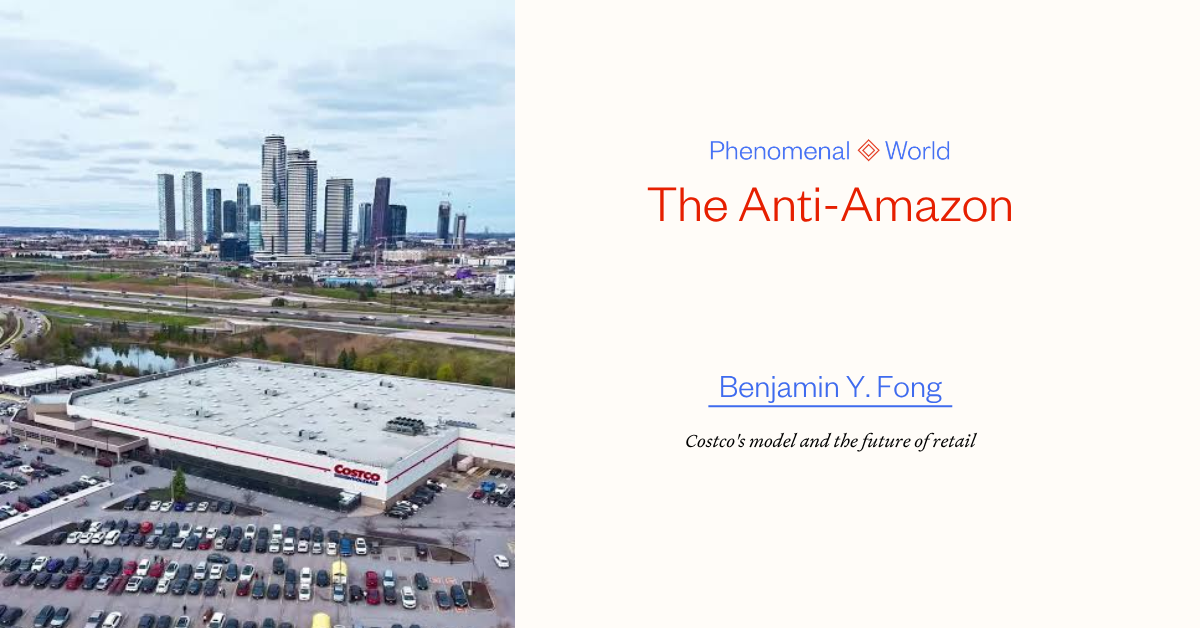
*The Anti-Amazon* argues Costco is the logistical inversion of Amazon and the healthier design. The evidence is a wall of ratios:
| Metric | Costco | Amazon / peers |
|---|---|---|
| SG&A as share of sales | ~10% | ~40% (Amazon non-AWS) |
| Distinct SKUs | ~4,000 | ~130,000 (Walmart) |
| Membership renewal | >90% | — |
| Front-end wage | $21.29/hr | $19.14 (Amazon), $16.23 (Walmart) |
| Employee turnover | ~6% | ~150% (Amazon) |
Fewer choices, bought in bulk, carried home by the customer — Fong frames the constraint itself as the efficiency, and extends it into policy: New York's planned public grocery stores should copy Costco, not Amazon-style delivery. E-commerce, he notes, is still under 17% of US retail.
The green claim, turned inside out
The thread went after the environmental logic first, with data:
"In-store pickup using a internal combustion engined vehicle produced more emissions than any other option studied." — a commenter citing a University of Michigan emissions study
Then the framing that Costco "avoids" the last mile:
"But they don't avoid solving it, they offer it by partnering with instacart." — a reader pointing to Costco's own delivery arm
The policy leap took the heaviest fire. The mechanics that make Costco work, one commenter argued, are exactly the ones a public store can't adopt:
"You can't buy small quantities… you're not allowed in the building without a membership, so there's little need to invest in behavior policing or loss prevention." — a commenter on why the model resists being made public
And the premise that single-item delivery can't scale cheaply drew the sharpest counterexample:
"this argument is easily refuted by the US Postal Service, which physically delivers individual pieces of paper in a few days, for pennies." — a commenter invoking USPS
The read that survives: Costco is a genuinely great retailer, but the essay's efficiency case leans on a membership gate and a bulk-only floor that a public grocery legally can't erect — and its "you drive, so it's greener" story is the one claim the data flatly reverses.
Get breakdowns like this every day
The top Hacker News stories, unpacked — by email, Telegram, or RSS.
A guide sells a $40k rig that runs 'almost Opus' locally. The thread does the math: that's 17 years of the subscription
Jamesob's local-LLM buyer's guide tops out at a four-GPU, 384 GB machine it says approaches Claude Opus. A commenter converts the price into API terms and the pitch deflates: forty thousand dollars buys almost seventeen years of the cloud model it's imitating.