The one ingredient in DayQuil that works is also the dangerous one
In The Argument, Eli Richman makes an odd case for pulling combination cold medicines like DayQuil off the shelf: they bundle the one ingredient that works with two he says do nothing.
Acetaminophen sends more than 50,000 people to US emergency rooms and kills 500+ a year, about half of them by accident. It's the one part of the combo bottle that works, hiding beside two ingredients Richman calls placebo-grade.
Readers fired back with counter-studies, accusing the essay of citing only the research that agrees with it.
Two "active" ingredients the FDA itself doubts
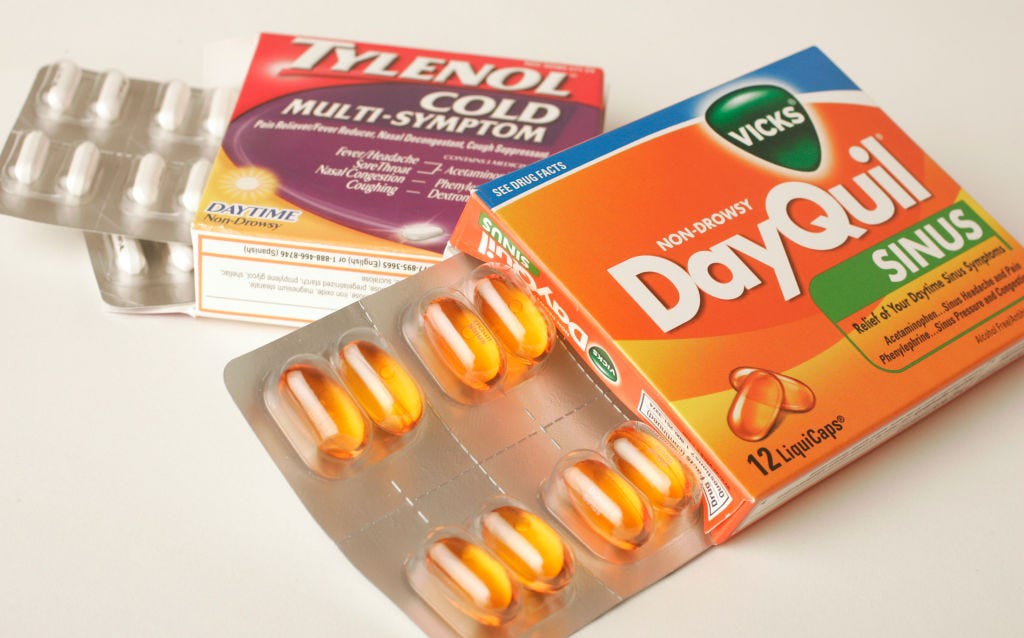
Writing in The Argument, Eli Richman argues that a bottle of DayQuil is mostly theatre. Its lone effective ingredient is acetaminophen, the same drug sold plainly as Tylenol and about 2% of a $15 bottle. The other two do the marketing. Dextromethorphan, the cough suppressant, "performs the same as a placebo" in the studies he cites, and worse than honey in others. Oral phenylephrine, the decongestant, is something the FDA has itself proposed pulling as ineffective; Richman accuses manufacturers of leaning on its resemblance to pseudoephedrine to confuse shoppers.
His real worry is safety. Acetaminophen has a hard ceiling of 4,000mg a day, yet it hides inside roughly 40 combination products, which makes accidental overdose easy. His proposal is narrow: unbundle acetaminophen from the combo formulas. He points to 2011, when the FDA capped acetaminophen in prescription opioid combinations and hospitalisations fell. And note what the headline actually asks: whether misleading consumers should be legal, not whether these drugs should be banned.
Read the article
The thread's loudest correction wasn't aimed at Richman but at commenters who assumed he wanted a ban. A reader who went back to the source:
Read the article. It doesn't even ask if dextromethorphan and phenylephrine should be illegal. It asks if intentionally misleading consumers about their efficacy should be.
The efficacy claim drew a methodological jab. A commenter with a counter-study:
This article uses the trick where you pick studies that support your argument and ignore all of the studies that disagree with it. There are other studies where Dextromethorphan improves both objective and subjective measures of coughing: https://pubmed.ncbi.nlm.nih.gov/37232330/
A second correction sharpened the decongestant point:
Oral phenylephrine is considered to be ineffective, phenylephrine in a nasal spray is considered effective.
The most practical fix reframed the whole fight as a packaging problem, not a pharmacology one:
Make it so the active ingredients have to be listed prominently - the largest text on the front of the product package - and these concerns diminish greatly.
Get breakdowns like this every day
The top Hacker News stories, unpacked — by email, Telegram, or RSS.
An open model at $4.40/MTok threatens frontier labs' 90% inference margins
Martin Alderson argues the frontier's real weakness is the cost of serving tokens, not training them, and that GLM 5.2 from Z.ai now lands near-Opus quality at a fraction of the price.