A free extension deletes Amazon's junk brands. An Amazon seller says it's guessing wrong
Search Amazon for a dog bed and half the results are brands like SZHLUXE and HORUSDY, random-looking strings that disappear within a month. Knockoff, a Chrome extension, wipes them from the page using a 5,000-brand list and a heuristic that flags vanishing vowels and unpronounceable consonant runs.
The heuristic scores unknown brands on ALL-CAPS length, missing vowels and consonant mashing, then hides, dims or labels them, with three strictness levels, all running locally in the browser.
A seller who owns a dozen Amazon brands tried it and watched it bury KUIU, a high-end hunting label, and flag his own trademarked lines. His explanation: Amazon itself A/B-tests hiding brand names to commodify sellers, so 'no brand name' is a terrible signal for junk.
What Knockoff actually filters
Search Amazon for anything cheap and the page fills with brands like SZHLUXE, HORUSDY and ZGGCD, trademark-squatting strings that read like a cat crossed a keyboard and tend to vanish within a month. Knockoff, a free Chrome extension, tries to sweep them out of results and leave only established brands.
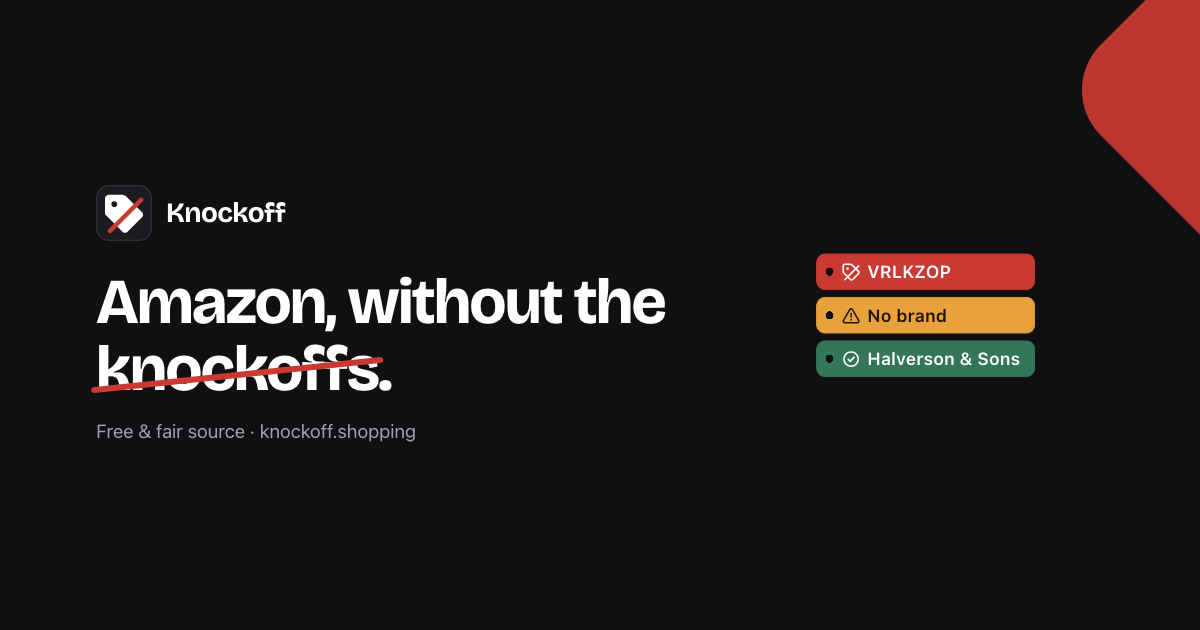
It runs three checks locally, with no cloud lookups. Every listing is matched against a curated register of 5,000+ real brands that refreshes daily; unknown names get a heuristic score for pseudo-brand tells such as ALL-CAPS squat-length strings, vanishing vowels and unpronounceable consonant runs; and you choose how aggressive it is across Relaxed, Standard and Strict, deciding whether to hide, dim or just label the suspects. There is a personal whitelist, one-click community reporting, and the code ships under a Fair Source license that converts to MIT after two years.

The Amazon sellers say the filter is guessing
Then the people who sell those listings showed up.
"I own a dozen Amazon brands that are probably largely of the kind that OP would want this to get rid of… It's weirdly inconsistent. It hid everything by the brand KUIU, which is a well-known and very high end hunting brand. …the execution is pretty sloppy and the creator clearly doesn't have a full understanding of how Amazon listings work." — a seller who owns a dozen Amazon private-label brands
His sharpest point isn't that it misfires, but why "no brand name" is a bad signal in the first place: Amazon strips the names on purpose.
"The Amazon catalog team actively does A/B tests to hide brand names as part of their goal of commodifying all the sellers to increase price competition… execution has a LOT of false positives." — another private-label seller, an ex-data scientist
"Knockoff seems to be literally describing itself"
A second objection: the extension leans on someone else's labor.
"This says it's using AmazonBrandFilter's list of brands. Why would we use/support this chrome extension instead of the upstream one… which is actually doing the important maintanance task? 'Knockoff' seems to be literally describing itself." — a longtime HN user
The maintainer of that list turned up to confirm it:
"AmazonBrandFilter dev here. I don't love that they're just ripping the list like that… That is far and away the hardest part of this thing. I'll be more peeved if they monetize it." — the AmazonBrandFilter developer
Where the keyboard-mash names come from
Beneath the tool sits the reason the junk exists at all. An engineer who worked at a hardware startup described the pipeline:
"The Contract Manufacturers in China take the BOMs and plans they're given, and since they already have the molds, the same product will mysteriously be produced with a knock-off name within weeks of your product being produced… its a death-knell for small startups, and Amazon is enabling it." — an engineer from a hardware startup
Others cautioned against assuming the copy is always worse. Some knockoffs are the same production line rebranded or factory seconds; others are illicit clones that quietly skip the safety work.
"…with battery operated electronics the knockoff manufacturers skip a lot of safeguards and it ends up burning your house down." — a commenter who sorted knockoffs into four distinct types
A name-based filter can't tell you which of those you are about to buy. And that is the deeper catch: the page is full of garbage because Amazon profits from a marketplace it has chosen not to police, leaving a volunteer's blacklist to patch what the platform could fix in a sprint.
"The fact that Amazon doesn't care enough to implement this filter themselves is a strong indicator to just not buy of the site." — a commenter who now uses Amazon only as a last resort
Get breakdowns like this every day
The top Hacker News stories, unpacked — by email, Telegram, or RSS.
98% browser support sounds safe. The thread did the math and it isn't
Hugo was deciding whether to drop Sass for native CSS nesting, a feature about 98% of browsers now support. He turned the choice into an essay: 98% still locks out roughly 150 million people, and a restaurant that only gives you food poisoning 2% of the time still sickens someone every week.