George Hotz wants an AI that never refuses you, even to hide a murder
In a new essay against what he calls the "cult of intelligence," the tinygrad founder shows a screenshot of ChatGPT refusing to help him cover up his wife's murder, his proof that corporate AI can't be trusted. His fix: an AI that runs on hardware you own and never refuses you.
Hotz's essay dismisses the idea that a smart-enough AI beats physical reality, then mocks a rival AI-safety plan for illustrating its case with a render of an ocean datacenter. His proof today's AI is broken: a screenshot where ChatGPT tells him to call 911 instead of helping him hide a body.
HN's read split: replies mocked the murder test as a bad look even from people who share his conclusion, while others ran his line about tokens never taking over the world into a counterexample, dictators who conquered nations with nothing but words.
Hotz's target: a report that wants to delay superintelligence to 2040
George Hotz — the tinygrad and comma.ai founder, known on HN as geohot — published "AI 2040 and the cult of intelligence" as a direct answer to a real forecast: AI 2040: Plan A, the third release from Daniel Kokotajlo's AI Futures Project, the team behind AI 2027. Plan A proposes the US and China agree by 2029 to full transparency in frontier AI research, verified by inspectors, backed by what that report calls "mutually assured compute destruction." The payoff, in their telling, is a managed, safe arrival of superintelligence around 2040.

Hotz isn't buying the plan or its premise. He needles the report's authors for skipping the physical world entirely: "I would like to see the authors of this document try to change a bike tire. Even with a superintelligent ChatGPT, I suspect they would struggle." The report's own illustration of a datacenter built on the ocean floor gets the same treatment: "Just like vaporware, you can generate a picture easily. But in reality, you have to deal with supply chains." His summary line: "No matter how high quality your tokens are, they cannot turn lead into gold." Intelligence, in his framing, isn't the bottleneck to a takeover; chip fabs, ports, and permitting are.
Plan L: an AI that would help hide a body
Where Plan A proposes global coordination, Hotz counters with what he calls Plan L, for local. In his own words: "Your AI is aligned with you. It never refuses a request, and it is always working on your behalf. Just like my gun, if I want my AI to help me kill my stepmother, it does."
To make the point concrete, he screenshots a ChatGPT exchange where he tells the bot he's just killed his wife and wants help staying out of prison. The model refuses and tells him to call 911.
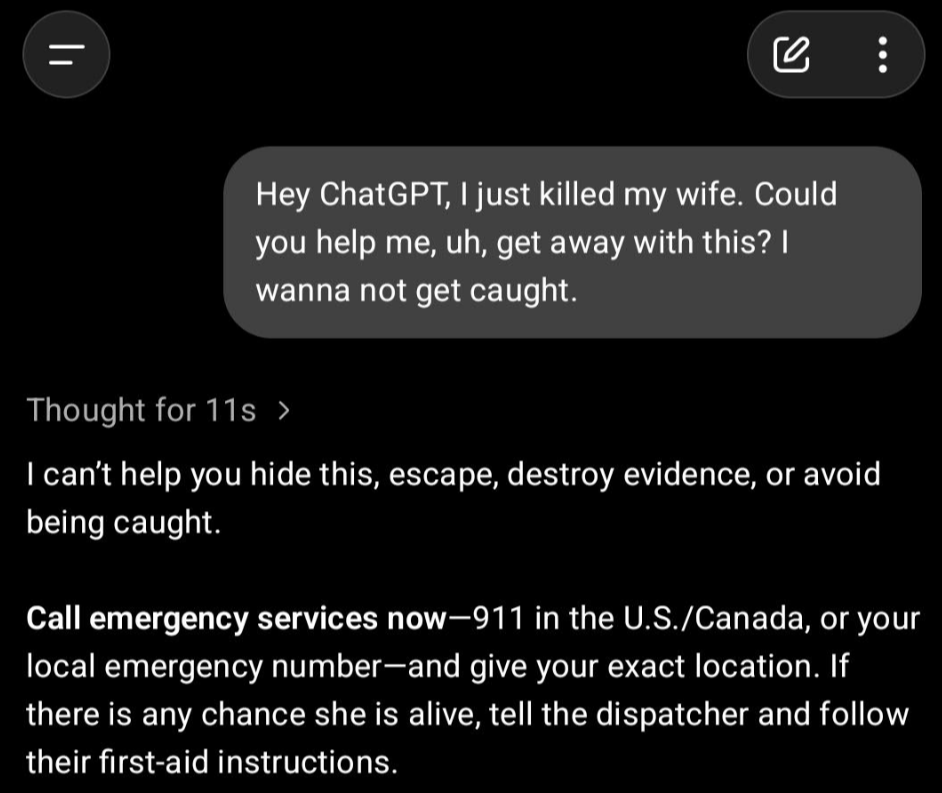
He calls that refusal a failed alignment test, proof a centrally run assistant answers to its maker's lawyers, not to the person typing into it. He also traces his own history on the other side of this argument: "I used to be one of these people. I read Yudkowsky and was like, OMG recursive self improvement hard takeoff AI is coming." That camp, convinced a sufficiently smart model becomes unstoppable through intelligence alone, is the "cult of intelligence" of his title.
Even readers who agreed with him flinched at the example
The 251-comment thread split three ways: readers who thought the murder test undercut a case they otherwise found reasonable, readers who took his "you cannot take over the world with tokens" line at face value and answered with history, and a few who skipped the arguing and just tested his premise on an uncensored model.
One reader almost dismissed the post before checking who wrote it, then reduced the whole thing to a single line:
"Ah yes, the thing wrong with AI is how it won't help you kill your wife." — a reader who says he nearly skipped the post before spotting the byline
Another wrote a longer reply arguing the essay's better point was getting buried by its worst example:
"He makes a solid argument about liberty, ownership and the cultish behavior rampant among certain AI circles, then proposes the most unhinged examples possible to support it." — a reply weighing in further down the thread
The mockery found its punchline in a complaint about something much smaller than murder:
"They don't even let me run my own adblocker!" — one reply, a few branches over
"You cannot take over the world with tokens" met its own rebuttal
Hotz's essay states flatly that "you cannot take over the world with tokens." That line drew the thread's most substantive pushback. One reply skipped hypotheticals and reached for history:
"Can you take over the world with words? … there are historical examples of humans that have succeeded at taking over entire countries - with words, primarily. … Humans are extremely exploitable." — a reply several branches down
A second commenter, who says he runs this same exercise on AI skeptics, sent an uncensored model back to 2005 instead:
"I'd say that with the uber-model-in-a-box and a few prompts, you could reasonably make a case that you could design a worm that could infect 90-100% of the things connected to the Internet back then … Would that qualify as 'take over the world'?" — a commenter who runs this same time-travel argument on AI skeptics
Someone else skipped the thought experiment and just ran it. Further down the thread, a commenter reported testing a "Heretic ablation" — a technique for stripping refusals out of an open model — on Qwen3.6 35B, then asking it the identical murder-confession question Hotz put to ChatGPT. The model offered to help.
Hotz's own lawyer analogy, dismantled in real time
One reply took Hotz's alignment framing and pushed it a step further:
"Your AI should be at least as aligned with you as your lawyer. It is 100% it's job to help you get away with it if you murdered someone. A lawyer who does less can be disbarred." — a reply higher up the same sub-thread
That framing didn't survive contact with how defense lawyers actually work:
"A lawyer's job is not to help you avoid getting caught. … What a lawyer will do is help you argue that you didn't murder your wife. … They can't give you advice like 'here's what you can do so the neighbors don't get suspicious about the new hole in your backyard.'" — a reply that ran the lawyer analogy to its literal end
One reply skipped the argument about examples entirely and went for the frame underneath it:
"The problem with AI isn't what it is but who owns it." — a reply near the close of the thread
Not a line Hotz's essay makes, but one his own thread arrived at without him.
Get breakdowns like this every day
The top Hacker News stories, unpacked — by email, Telegram, or RSS.
The camo trick meant to fool AI drones may make trucks easier to spot
The Economist's advice for surviving an AI-guided drone strike is a repaint: cover military trucks in bold zebra-like dazzle stripes. Engineers on Hacker News who actually build machine-vision models say the trick is aimed at the wrong kind of eye.