An app named 'Nativ' for native Mac AI ships with a bundled Python runtime
Nativ promises "frontier" open models running locally on Apple Silicon — no accounts, no subscriptions, no cloud. It comes from Prince Canuma, the maintainer of MLX-VLM, a library much of the Mac local-AI ecosystem already leans on for faster-than-llama.cpp inference — and despite the name, it ships with a full embedded Python runtime, something one early commenter flagged within hours.
The three flagship models are small by frontier standards: Google's Gemma 4 E2B (10.28 GB, 128K context), Cohere's North Mini Code (19.38 GB, 500K context) and Liquid AI's LFM2.5-VL (3.2 GB) — all sized to run comfortably on a single MacBook.
Not everyone bought the pitch: one reader questioned whether 'frontier' still means anything at this size, and another couldn't say what Nativ does that LM Studio and Open WebUI don't already do today.
What Nativ actually ships: MLX, three small models, and a coding-agent hookup
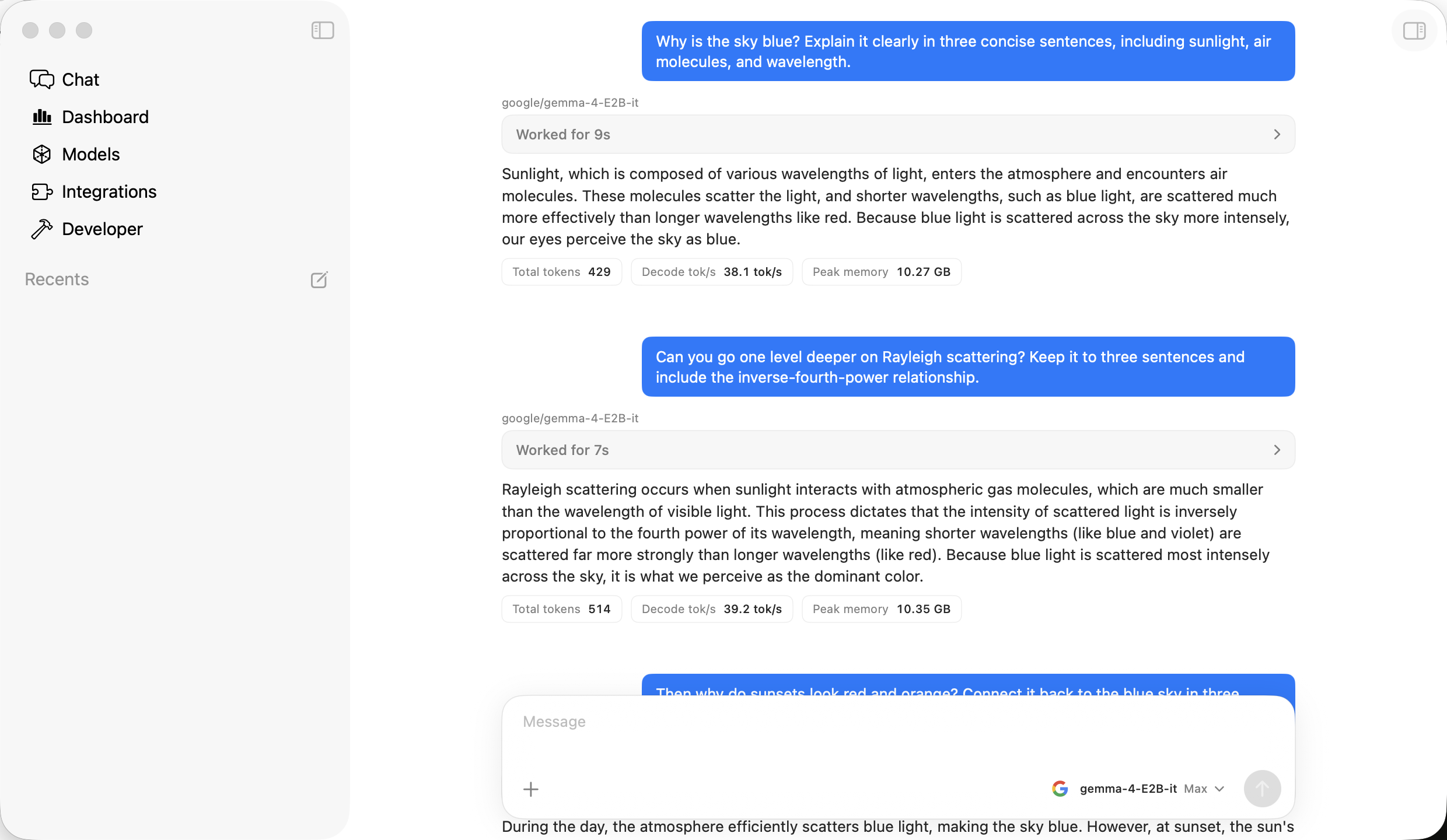
Nativ is a free, MIT-licensed Mac app for running open AI models entirely on-device — "no accounts, no subscriptions, no cloud," as the site puts it — across text, images, video, code and audio. It curates three partner models rather than offering an open catalog: Google's Gemma 4 E2B (10.28 GB, 128K context), Cohere's North Mini Code (19.38 GB, 500K context) and Liquid AI's LFM2.5-VL 1.6B (3.2 GB, 128K context). The engine underneath is MLX-VLM, built to use Apple Silicon's unified memory and Metal acceleration directly, without a CUDA-style translation layer. The project's manifesto takes a swing at rival local-AI apps as "proprietary shells built on top of open-source engines they don't own" — Nativ's pitch is that it's open, all the way down.
For developers, Nativ exposes a local endpoint that plugs into coding agents — Pi, Codex, Claude Code, Hermes, OpenCode — along with live telemetry on tokens per second, memory pressure and thermal load while those agents run.

The dev nobody named on the landing page
The page itself doesn't say who built it. The thread filled that in fast:
"This MIT-licensed app is from the very same dev, 'Prince Canuma', who maintains the popular MLX-VLM library... MLX-VLM is a long-time dependency of the excellent LM Studio and others because it can provide faster inference on Apple devices than llama.cpp... Possibly vibe-coded landing page notwithstanding, the app is mostly written in Swift language. That suggests it will be easy to port this inference stack to iPad and iPhone." — a reader familiar with the MLX ecosystem
That context matters: this isn't a stranger's side project wrapping someone else's engine — it's the engine's own maintainer building a front end for it, which is also why several commenters expected fast support for new model formats.
Native in name, bundled Python at runtime
The name invited its own joke:
"Ironic that the app is named Nativ(e) and yet bundles a full Python runtime. Nonetheless, still less bloated than LM Studio, which bundles a full Python runtime and electron.js (which in turn bundles a whole browser runtime)." — a bootstrapped founder in Dublin who previously worked at Facebook, Reddit and Google
The qualifier at the end is doing real work: bundled Python is an odd look for an app selling itself on native performance, but it's still leaner than the Electron-plus-Python stacks it's positioned against.
Running Deepseek locally for weeks, and still asking what's different
Not every reaction was about branding. Some read the pitch as simply late:
"I'm surprised that their home page basically acts as if LM Studio and others don't already do this. It's not clear what the difference is from a glance. It also omits Open WebUI. I've been running Deepseek V4 Flash locally on my Macbook Pro for weeks using Open WebUI + DS4." — a Mac user who's been running Deepseek V4 Flash locally for weeks via Open WebUI
The honest differentiator, several replies down, wasn't the model roster — it was the MLX-first engineering and the direct line to whoever maintains it. In a field where most "local AI" apps are wrappers around someone else's runtime, being the runtime's own author is the actual pitch, whether or not the landing page ever says so.
Get breakdowns like this every day
The top Hacker News stories, unpacked — by email, Telegram, or RSS.
A blog said perfection has one right answer. Then HN built a concrete treehouse.
A developer argued that a "perfect" piece of software is just whatever's left once you tighten every constraint enough — and that over-engineering only happens when you've solved the wrong problem. WebAssembly co-founder Ben Titzer had a rebuttal in one line: build a treehouse out of concrete and steel, and see how perfect that looks.