A 360M-parameter model pretends to be a terminal, and vim and tmux still work
WorldTUI has no shell or filesystem behind it. Each keypress goes in, and the model predicts which screen rows change and where the cursor lands.
The author fine-tuned Qwen2.5-Coder-0.5B on about 336k synthetic terminal sessions, trimmed the vocabulary to 333 tokens, and shipped a 4-bit 208 MB build that runs in the browser on WebGPU.
It scored 80 on a 106-command benchmark; prompted models of similar size scored 52 and 60.
A terminal with nothing underneath
WorldTUI starts from Qwen2.5-Coder-0.5B, trims the embedding table from about 136M parameters to fit a 333-token terminal vocabulary, and ends at 360M parameters. Training data is roughly 2B tokens from 336k sessions recorded from real programs in Docker, with randomized users, window sizes and typing errors. Training on its own mistakes lifted PresetBench from 24/47 to 38/47 at int4, in about 75 GPU-hours on an RTX 4090.
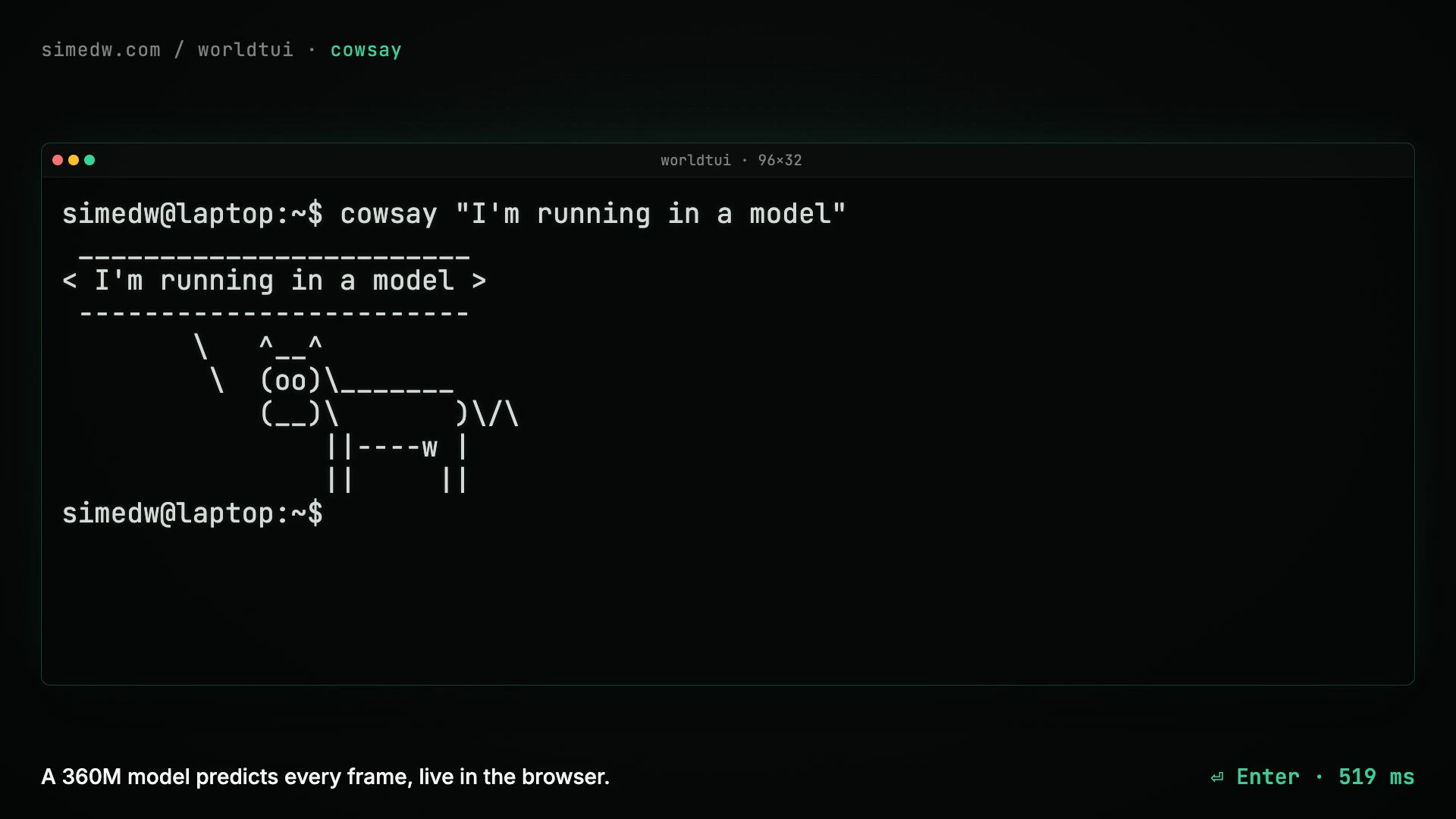
On ShellBench the model scores 80 against 52 for prompted Qwen2.5-Coder-0.5B and 60 for prompted Qwen3-0.6B. Decoding rows in parallel with speculative decoding cut large-frame p95 latency from 6.7 s to 0.87 s. The limits are real: appended lines sometimes vanish from a later cat, Python answers are often wrong, and nested directories get lost.
Is this where UI is heading
"I regretfully suspect this actually is the future of UI. You just need smart local models running fast enough to keep the framerate high" — a commenter, speaking about UI generally
A developer who builds fast local classifiers answered with his own version of the idea, a "lossy git" that stores code by training a neural network and regenerates it on checkout, running entirely in the browser:
"Very very cool! Impressed that it can be done with only fine tuning" — the creator of the lossy-git web demo
The author calls it a weak world model, yet one that keeps a fairly consistent world without implementing any of the underlying rules.
Get breakdowns like this every day
The top Hacker News stories, unpacked — by email, Telegram, or RSS.
Arc browser stops working on December 22, and The Browser Company cites security
New Arc accounts closed on October 22, and Arc will be deactivated on macOS and Windows on December 22. Personal data is deleted within 30 days after.