Volta infostealer asks Claude to price its victims before the attackers touch them
Cisco Talos found a Windows stealer that sends each victim's stolen identity report to an LLM and gets back a section titled 'WHAT THEY'RE WORTH'.
VOLTA-AUTODOXER collects browser data, wallet seeds, Discord and Steam sessions and Wi-Fi passwords, then ships a profile to OpenRouter with a prompt casting the model as a 'forensic intelligence analyst'.
The default is anthropic/claude-opus-4.6, with Kimi K2 and Gemini 2.5 Flash as fallbacks, a chain Talos reads as the operator expecting refusals.
Stealing first, grading second
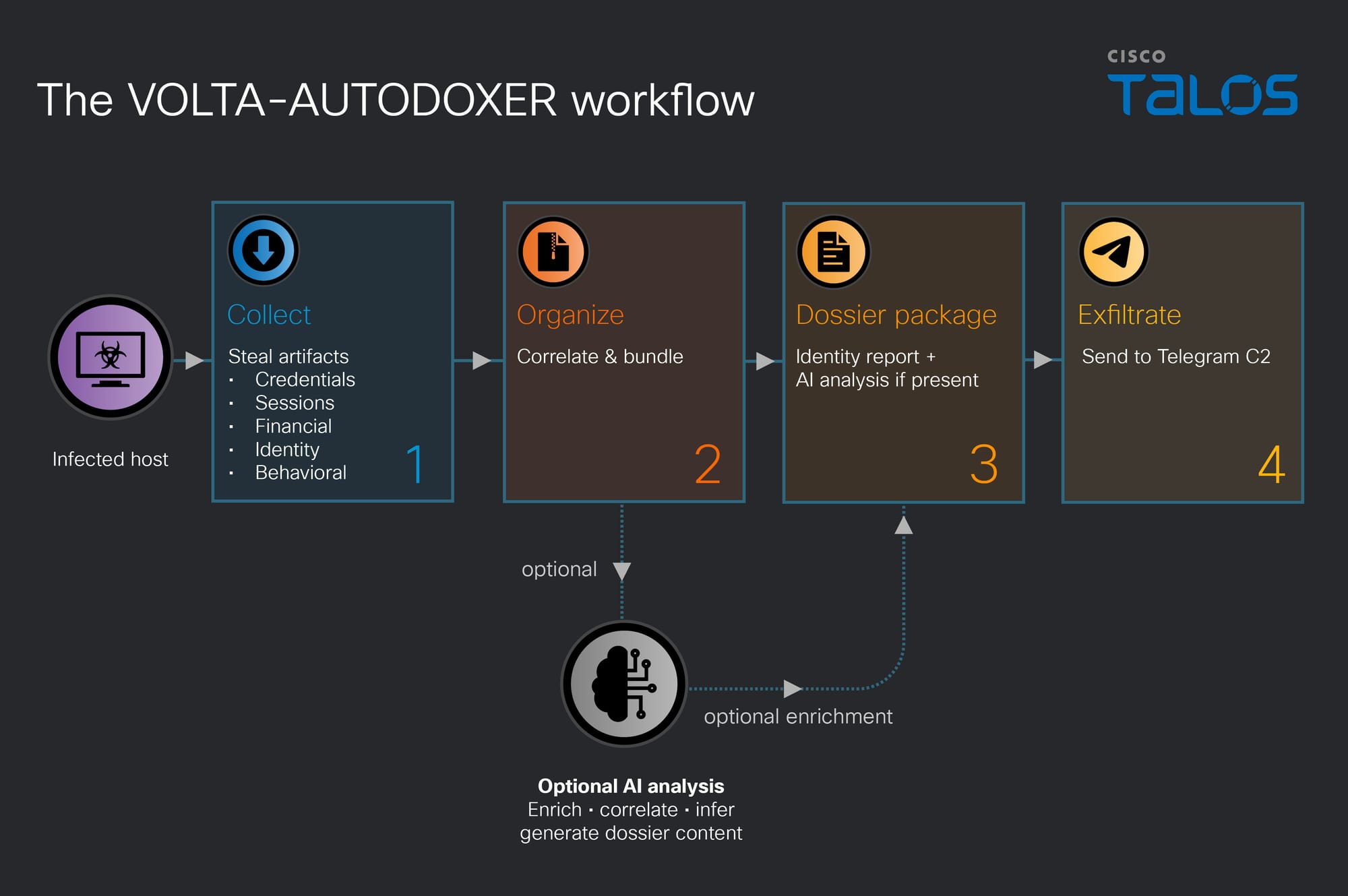
Talos's analysis describes a self-deleting Windows stealer first seen October 11. It takes browser passwords, cookies and cards, crypto wallet seed phrases, sessions for Discord, Telegram, Steam, Roblox and Slack, SSH and cloud keys, and every saved Wi-Fi password. It also searches the victim's Gmail for receipts from Amazon, DoorDash and others to confirm a home address.
All of that goes into an Identity_Report.txt, which is sent to OpenRouter. The model's output includes "WHAT THEY'RE WORTH", rating assets low, medium or high, and "THEIR OPSEC", a review of password hygiene. Talos notes the config encryption key comes from two constants in the same binary, so it protects little, and every observed endpoint is a third-party service.
Who runs the model, and where
A commenter noticed that the call runs on the victim's machine, exposing the OpenRouter key, rather than on attacker infrastructure. His guess is that it keeps the product simple for buyers, who only choose a Telegram channel for logs. Talos's six-slot build template fits that picture.
The defensive worry
"Claude, ArtCraft, tons of other auto-downloading tools, are rolling 10'000's of code changes a month. If one compromised update snuck this guy in, it's kind of game over." — a commenter who sketched a five-computers-by-purpose setup
Talos's concrete advice is narrower: restrict or alert on Chrome launched with --headless, which it says would block the App-Bound Encryption bypass, and rotate tokens and move crypto from any wallet whose seed phrase sat in plaintext.
Get breakdowns like this every day
The top Hacker News stories, unpacked — by email, Telegram, or RSS.
A GROUP BY did 70% more work and finished faster, because it waited less for RAM
Splitting a 99M-row aggregation into 4,096 cache-sized partitions cut DRAM loads from about 76M to about 25.7M.