A manifesto says open AI must win. The thread can't agree on what 'open' means
Ahmad Osman's one-page manifesto warns of a 'subscription economy for cognition.' The same day a US directive killed access to the best closed model, HN argued whether 'open source AI' is even a coherent thing.
The manifesto's pitch: if intelligence becomes something you can only rent from a few closed institutions, you lose operational freedom, not just software freedom. It wants the freedom to study, repair, audit, and run models yourself.
The thread's puzzle: a model you can't run on your own computer isn't open by the classic definition, and nobody can say who funds open frontier training when a single run costs a fortune.
A manifesto that lands the day the best model went dark
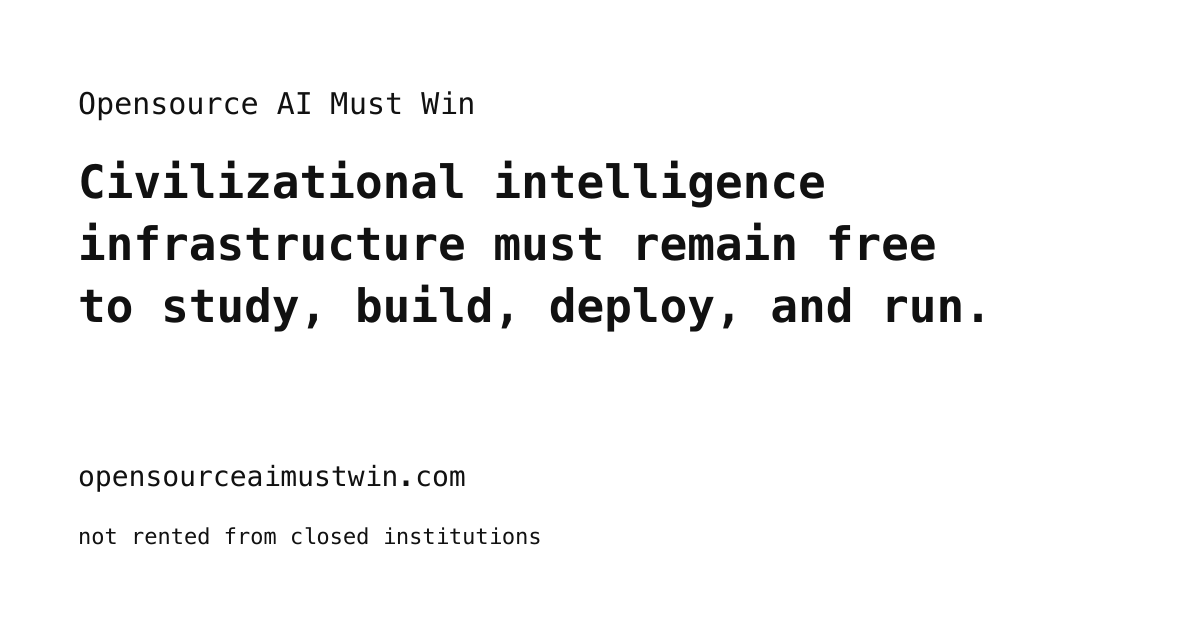
"Open source AI must win" is a single-page manifesto by Ahmad Osman. It makes no benchmark claims and cites no numbers; its argument is about power. The thesis: "If intelligence becomes something people can only rent from a few closed institutions, the public does not just lose software freedom. It loses operational freedom." Osman frames AI as civilizational infrastructure spanning work, education and science, and argues the public must retain the ability to "study, build, repair, deploy, audit, adapt, teach, preserve, and run intelligence systems" without asking permission. His preferred path is "American capacity with global open standards," not dependency on proprietary platforms.
It does not mention the Fable suspension. It didn't have to. Landing the same day a US directive cut public access to the strongest closed model, the manifesto read in the thread like a prophecy with timing.
"What is Open Source AI even?"
The sharpest pushback wasn't against the goal. It was against the words. A developer and CTO-on-demand argued the title is incoherent under the classic definition:
"to me Open Source, like Free Software, is something i can run on my own computer. any AI system that runs on a computer that i do not control is by my definition not Open Source. so how then can Open Source AI win? it can't even compete." — a developer and CTO-on-demand
Others said the manifesto conflates two things and should pick the precise one:
"Not to be that guy, but the correct term is Open Weight LLM. And I'd argue it already has. Many open models are already very competitive with closed models at a fraction of the cost." — a commenter drawing the open-weight distinction
One reader wanted the debate to escape the open-weights-vs-closed-API axis entirely:
"applied AI also needs open infrastructure around the model… cognition rented from a few institutions with access changing based on policy, geopolitics and platform incentives like advertising" — a commenter pushing past the weights-vs-API framing
The funding problem nobody solved
The recurring objection was money. Frontier training runs cost a fortune, and open projects have no obvious sponsor that isn't a VC chasing returns or a state chasing control. The Fable news sharpened it into a pointed bet:
"Anthropic just kneecapped themselves, and possibly OpenAI and Google as well, with their FUD strategy that got fable shutdown by the government. But that doesn't impact Chinese providers." — a commenter linking the suspension to open source's opening
The voice that didn't want it to win
Not everyone in the thread cheered. A neuroimaging scientist made the uncomfortable case that fully democratizing the most capable models is not automatically safe:
"Democratization of AI can be good up to a point, but existential threats can also be real, and democratization of existential threats is not a survivable policy." — a neuroimaging scientist
Why the slogan keeps tripping on itself
The manifesto's force is its framing: not features, but who holds the off-switch. Its weakness is the one the thread kept exposing: "open" is doing two jobs at once. Open weights you can download are not the same as software you can fully run, inspect, and own, and the gap between them is exactly where a government directive or a metered API can still reach in. The Fable ban gave the slogan urgency. It did not answer who pays for the run, or where you get the hardware to do it yourself.
Get breakdowns like this every day
The top Hacker News stories, unpacked — by email, Telegram, or RSS.
A CRISPR enzyme that reads a cancer's mutant RNA, then shreds the cell from inside
Cas9 cuts DNA at one spot. Cas12a2 does something stranger: once it spots a tumor-only RNA transcript, it goes berserk and chops up everything in the cell. The trigger is a single-nucleotide difference between a sick cell and a healthy one.