Ken Shirriff dissolved a 1980 Intel chip in acid to read its adder. The author took questions
The 8087 made math up to 100x faster than the CPU it shipped beside. Shirriff stripped the metal layer off the die to photograph the transistors of its 69-bit adder — the nanomachine at the chip's core.
The design is a hybrid: a Manchester carry chain with carry-skip in 4-bit blocks, chosen because faster adders existed but cost too many transistors in 1980 NMOS. Addition takes two clock cycles.
Ken Shirriff answered questions in the thread — including a sharp one on how power reached circuits in the layer he'd just etched away. One reader noted nobody has ever rebuilt the 8087 in HDL, unlike the 8086.

A nanomachine, read under a microscope
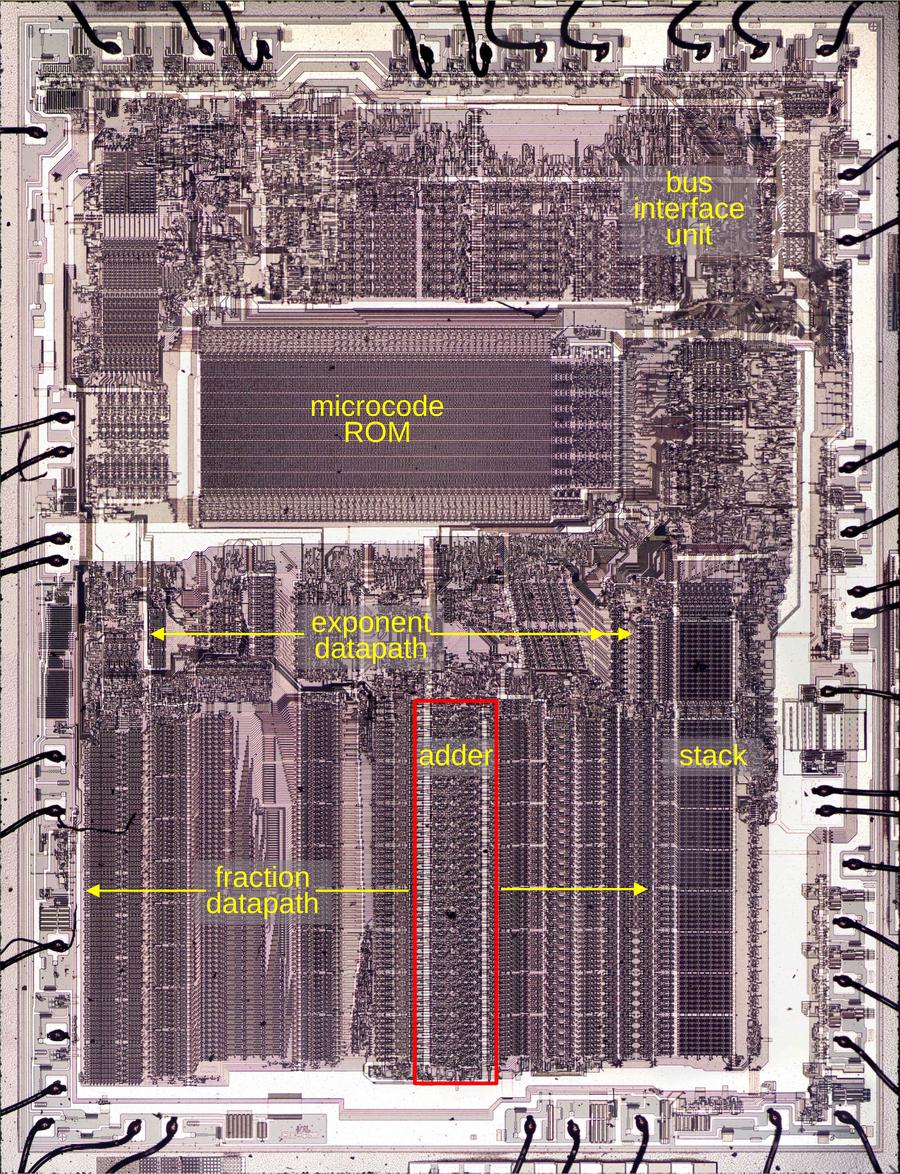
Ken Shirriff's teardown reverse-engineers the adder inside Intel's 1980 8087 floating-point coprocessor — the chip that made transcendental math up to 100x faster than the main CPU. His method is physical: dissolve the metal layer off the die with acid, then photograph the polysilicon and silicon transistors underneath. The subject is a 69-bit adder (70-bit output), the computational heart of the chip's execution unit.
What it reveals is constraint-driven engineering. The adder isn't a textbook carry-lookahead or carry-select design; it's a hybrid — a Manchester carry chain with carry-skip optimization in 4-bit blocks — chosen because the faster pure designs existed but demanded too many transistors for a 1980 NMOS budget. Addition takes two clock cycles. Every choice is speed traded against silicon you couldn't spare.

The author in the thread
Shirriff showed up to field questions, which is part of why these teardowns travel:
"Author here for your 8087 questions. I find adders and ALUs interesting because they are key to the performance of a system and every system implements them differently." — Ken Shirriff
The most pointed question went straight at a limit of the method — etch away the metal and you've removed exactly the layer that answers some questions:
"Do you have any insights on how power was delivered to these circuits? Maybe it's done in the metal layers that were dissolved? Also, is it correct that there is no on die capacitance surrounding these circuits?" — a reader probing die physics and decoupling
The reconstruction nobody has done
One reader pointed out a curious gap in the retrocomputing record — the 8087's more famous siblings have been rebuilt in hardware-description languages, but its math core hasn't:
"people have produced synthesizable RTL HDL for the 8086/8088 and later… but no-one seems to have produced similar for the 8087." — a reader noting the missing 8087 HDL
Why a 45-year-old adder is worth the acid
The 8087 is interesting precisely because its designers couldn't brute-force the problem. With transistors scarce, they reached for a carry scheme that balanced speed against count — the kind of judgment modern synthesis tools make invisibly and modern engineers rarely see. Shirriff's photographs turn that judgment back into something legible: a specific, hand-reasoned trade-off, frozen in silicon, still teaching how computation gets built when every gate has a price.
Get breakdowns like this every day
The top Hacker News stories, unpacked — by email, Telegram, or RSS.
'Too hot to work' isn't a forecast in the Gulf and South Asia. It's the current labor model
A Bloomberg feature asks what happens to an economy when heat makes work impossible. People who grew up in Dubai and worked through Russian heatwaves answer: the rich reorganize the day, the poor absorb the damage.