A decade of work, killed by a keyword search: scientists describe US research in freefall
Christopher Reynolds spent nearly ten years building a NASA X-ray telescope. It was never formally cancelled. "We were just starved to death," he says.
AXIS lost twenty team members to DOGE buyouts, missed a budget deadline after the shutdown, and quietly died after a decade of work. One Harvard researcher in the thread watched a study get flagged because it "engendered a robust hemodynamic response" — a keyword match.
Then a computational-biology PhD who left the field for software said something the room didn't expect: US science actually does need some cuts. The argument over how it was done, versus whether it should have been, runs through 800 comments.
A telescope that wasn't cancelled, just starved
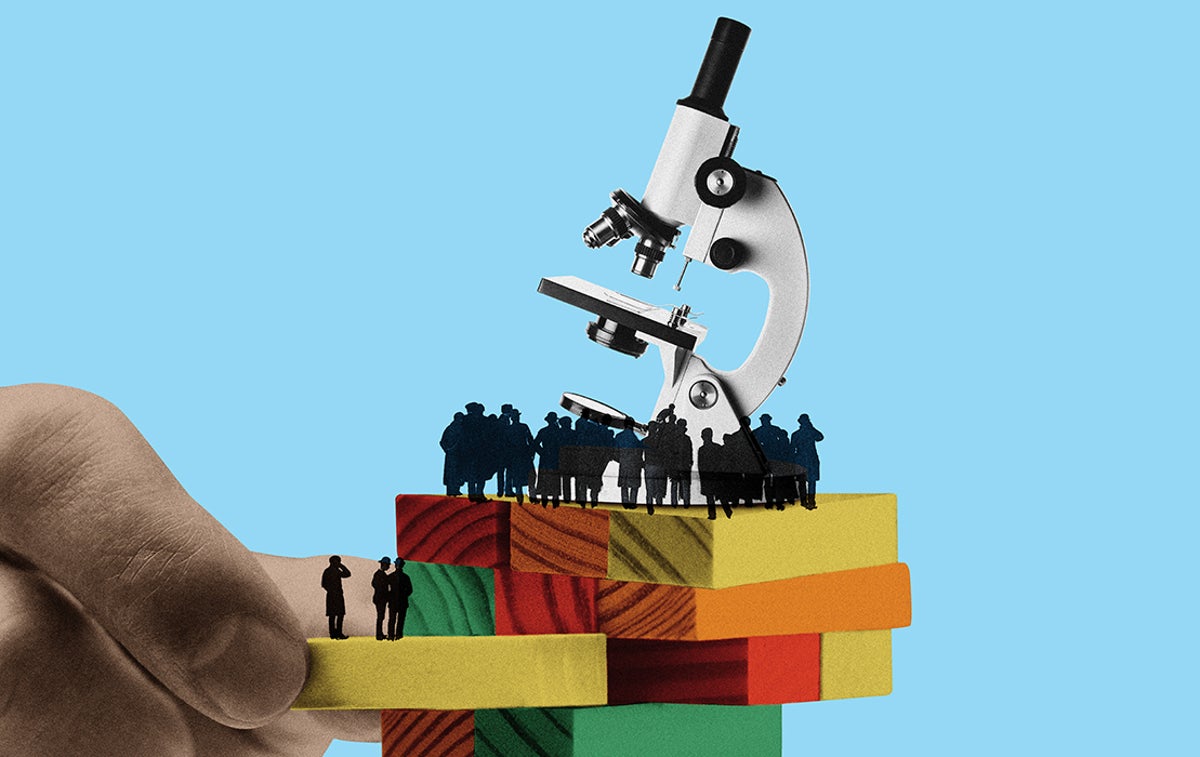
The Scientific American piece opens on Christopher Reynolds and AXIS, a NASA X-ray telescope nine years in the making. When the government shutdown ended in mid-November, his team had two weeks to come in on budget. The plan they submitted cost too much and took too long. They hoped NASA headquarters would understand and grant some leeway. It did not. After nearly a decade, the mission was dead.
"We were never canceled. We were just starved to death."
That line — Reynolds's, quoted in the article — is the thesis in miniature. The magazine's larger argument is that the roughly 70-year compact between the US government and its scientists, in which the state funds basic research and gets progress in return, has broken. The numbers it marshals are blunt: around 4,000 NASA staff took buyouts, NIH funding notices fell from about 850 a year to 14 by early 2026, and a Nature poll of 1,650 researchers found three in four weighing whether to leave the country.
The keyword search that killed a study
What made the thread explode past 800 comments wasn't the macro picture — it was how mechanical the damage felt up close. The detail that stuck:
"One of the researchers in my department had a study canceled because something they did 'engendered a robust hemodynamic response'. Whoops, keyword match." — an IT director at a Harvard-affiliated neuroimaging center
The phrase a reader first quoted from the article cut the same way: a decade of someone's life "erased because someone did a keyword search for science projects to stop, in the name of saving money, while at the same time wasting even more money on other things."
An academic researcher described the second-order effect — the chilling, not the cutting:
"If the government can cut your grant at any time without notice or appeal you will think twice before publishing results that go against their ideology… This is true especially if you are not tenured, which accounts for the majority of the academic world." — a commenter on grant precarity
The voice nobody in the thread wanted to hear
Then the reversal. A reader who had walked the road himself broke the consensus that every cut is vandalism:
"As someone who spent far too much of my life pursuing that goal, I have an unpopular opinion: US science needs some cuts." — a computational-biology PhD who left research for software
He drew a line all the same: the pure-science projects — the space telescope, climate and ocean data — are exactly the ones that wouldn't get done any other way, and exactly the ones being lost. His complaint wasn't with cutting; it was with cutting by politics.
A practicing physicist pushed on what "a better way" would even look like, and didn't like his own answer:
"What's a better way, that's not the Chinese way? … more centralized oversight over research priorities, metric-driven rewards, and preference for political favorites?" — a physicist and electronics enthusiast
That unease has history behind it. One reader noted academia was drifting toward being "toxically metrics-driven, authoritative and political" long before any of this — a slow squeeze from the top that pushed scientists into sales jobs at deep-tech startups well before the buyouts hit.
Why the "this happens all the time" defense doesn't hold
A recurring counter in the thread was that big science always lurches — the LHC, ISS, JWST, Hubble and ITER all got paused or nearly killed and later revived. True, as far as it goes. But the article's framing, echoed by other commenters, is that the mechanism here is different: not a debated, reversible budget decision but an indiscriminate one, a thresher run by keyword. As Reynolds put it in the piece, the DOGE cuts "sliced through American research grants like a thresher, but this was much murkier."
The quieter worry underneath the whole thread is investment horizon. Basic research is a bet that pays off in decades. If the funding can vanish on a quarter's notice for reasons no scientist can predict or appeal, the people best at making that bet stop making it — and, as the article and the thread both conclude, many already have.
Get breakdowns like this every day
The top Hacker News stories, unpacked — by email, Telegram, or RSS.
OpenAI burned $34B to earn $13B — and the thread can't explain $5.7B of marketing
The leaked 2025 numbers triple revenue to $13B and still book a $21B operating loss. The line that stumped Hacker News wasn't compute — it was the $5.73 billion spent on sales and marketing for a product people say markets itself.