Mammals didn't lose the ability to regrow limbs, they switched it off, and two growth factors can switch it back
A Texas A&M team regrew bone, joints, ligaments and tendons in animals with no stem-cell transplant, using a two-step signal: FGF2 to steer cells away from scarring, then BMP2 to build. The thread's biologists added the part everyone fears - get the speed wrong and you get cancer.
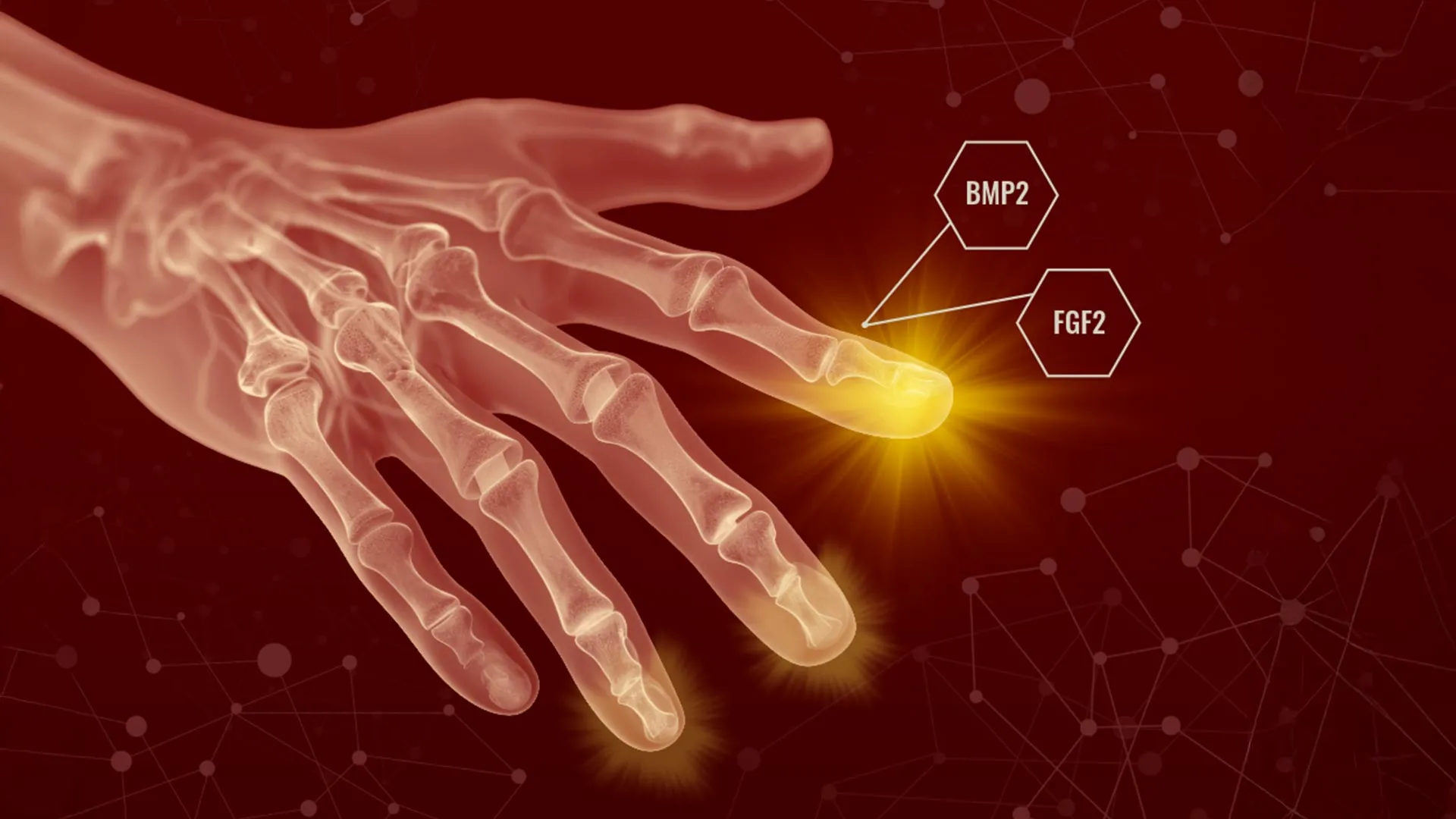
The finding: the regenerative cells are already there, you just have to make them behave. After wound healing, FGF2 redirects cells toward a blastema-like structure, then BMP2 tells them to build new tissue.
A reader with permanent retinal damage noted the same trick in retinas often triggers tumors, the recurring asterisk of the whole field.
What the study actually showed
ScienceDaily reports a Texas A&M study, led by Dr. Ken Muneoka and Dr. Larry Suva and published in Nature Communications, finding that mammals retain a dormant capacity to regenerate rather than having lost it: "they're already there — you just need to learn how to get them to behave the way you want." No external stem-cell transplant is required. The mechanism is sequential. After initial wound healing, applying FGF2 redirects cells away from forming scar tissue and toward a blastema-like structure — the same regenerative engine a salamander uses — and then BMP2 signals those cells to build. In amputation studies it regrew bone, joints, ligaments and tendons, though not as perfect anatomical replicas.
The recurring asterisk: cancer
The thread's biologists were quick to supply the catch that haunts every regeneration result. A reader who lives with the consequences named it precisely:
"Zebrafish can regrow damaged retina, but while mammals have the same stem cells (Muller glia), they dont repair the retina, but form scar tissue… they have managed to modify rat genome, so that their retina has shown some repair abilities. The problem is that it often causes tumors." — a commenter with permanent retinal damage
An engineer distilled the whole design constraint into one sentence:
"The trick is to make regeneration fast enough to heal the wound without making fast enough to cause cancer." — a commenter on the speed-versus-cancer trade-off
The other school: it's about voltage, not chemistry
The most surprising contribution pointed the discussion at a completely different control signal, and faulted the article for ignoring an entire research program:
"Not a single mention of the work on limb regeneration by Professor Michael Levin's lab at Tufts?" — a commenter flagging the omission of Levin's bioelectric work
"In a frog they were able to grow legit eyes in the gut just by artificialy inducing a certain voltage in that area. No need for any cell transplantations: the voltage really seems to be the only signal needed." — a commenter citing the bioelectric eye-induction research
Dormant, not gone — and that's the whole shift
The reframing is the point. If the capacity were truly lost, regeneration would mean engineering it from scratch. "Dormant" means the wiring is intact and the task is to find the right switches — growth-factor timing in one lab, electrical fields in another. Both face the same wall: a body that builds tissue eagerly is a body one mutation away from a tumor. The Texas A&M result is a real step because it produced structured limb tissue with off-the-shelf signaling molecules and no transplant. Whether the switch can be thrown in a human without also throwing the cancer one is the question the thread, correctly, refuses to wave away.
Get breakdowns like this every day
The top Hacker News stories, unpacked — by email, Telegram, or RSS.
Wired exposed a secret network of tech elites planning the future, and the most damning detail is that it runs on Airtable
Esquire called it a cabal of crazies. The thread read the underlying Wired report and reached a flatter verdict: it's a Bilderberg-style social club whose membership records sit in a no-code spreadsheet, and whose big idea is that AI will reorder everything within a few years.