Did my old job only exist because of fraud? A decade later, the SEC answers
A software engineer's first job carried him from the UK to the US, where he built a life and met his spouse. Years on, regulators alleged the acquirer ran an incubator mostly to harvest management fees.
A single 2014 internal email reframed everything: "Right now we need 2 more companies to cover our costs." If a startup is kept alive only to justify the fees charged against it, was its work ever real?
The author's verdict cuts the other way. The core database tech was real and his code shipped; the chef-and-cleaner expenses were someone else's scheme. The fraud sat above him, not in his commits.
The thread surfaced uglier cases: engineers who had unknowingly stood inside far larger frauds, from markups to a $10B telecom collapse.
A 2014 email turns a happy memory into a question

David's first software job was at GenieDB, a UK startup later acquired by Frost VP, run by Stuart Frost. The acquisition is the reason his life looks the way it does: it brought him to the United States, where he settled and met his spouse. For a decade it was simply the origin story of a good career.
Then he read the filings. The SEC and a group of investors alleged that Frost operated an incubator whose real product was management fees — spinning up portfolio companies, charging them excessive costs, and funding ventures with what regulators described as "no viable products or business plan." Some of those billed costs were strikingly personal, down to a chef and a cleaner. Investors won in arbitration; the SEC moved to bar Frost from the industry.
The line that suggests a company was kept alive for its fees
The detail that unsettled David most was an internal 2014 email projecting that the operation needed "2 more companies to cover our costs (with Genie coming out in June)." Read in context, it implies GenieDB wasn't a bet on a product so much as a unit of accounting — something to keep solvent long enough to justify the fees skimmed off it.
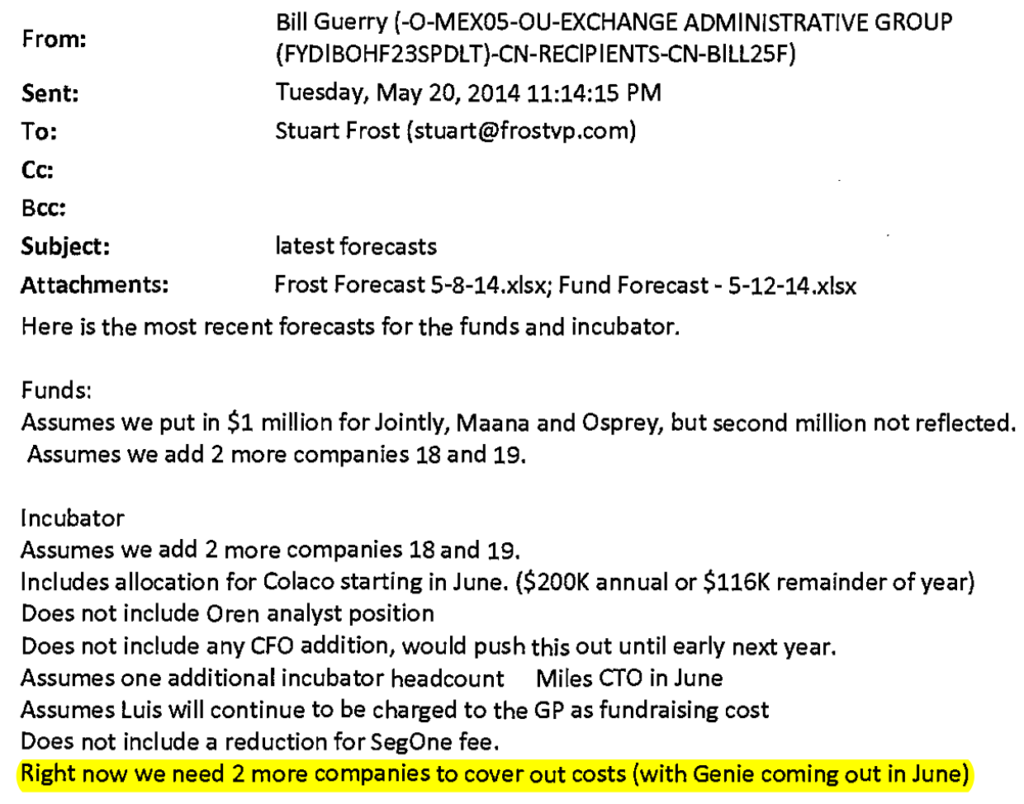
His own conclusion resists the spiral. GenieDB had real core technology, and his work on it was genuine engineering, whatever the people above him were doing with the cap table.
Engineers who were inside bigger frauds than they knew
The thread filled with people who recognized the feeling. One described waste so routine it barely registers as scandal — the same engineer billed back at a markup after being made redundant.
"One pattern I saw repeatedly was a contractor being let go, only to return via a large outsourcing provider. The provider must have added a substantial markup despite supplying the same engineer back to the same team…" — James Robinson, co-founder of cactus.bm
Others had been much closer to the fire without knowing it. A retired engineer of 28 years across ISPs and multinationals laid out a quiet horror story of acquisition by acquisition.
"I worked for Advanced Network and Services, which operated the NSFNET … later acquired by America Online. Then … by WorldCom. A few years later the CEO was sentenced to 25 years in prison for a ~$10 billion fraud." — retired engineer of 28 years in the industry
Not every account stayed abstract. One commenter found his own hours being rewritten under him on a government contract and took the evidence to a lawyer.
"He had gone into our billing software and edited my entries … I gathered as much documentation as I could and went to a law firm." — engineer who found his billing entries altered on a government project
And then the aphorism the whole discussion had been circling.
"Often the only difference between fraud and IPO is whether it worked or not." — a commenter with a hands-on startup background
The comforting answer, and why it doesn't fully close
The consoling read is the one David lands on: the fraud lived above the engineering, so the engineering stays clean. The harder read is the thread's — that the layer where management harvests fees, books fictional revenue, or marks up the same contractor is not an aberration bolted onto otherwise honest companies, but a structural feature of how a lot of them are financed. The reason the question can drive you a little crazy is that the books and the code are kept in different rooms, and the person writing the code almost never gets to audit the room next door.
Get breakdowns like this every day
The top Hacker News stories, unpacked — by email, Telegram, or RSS.
Jira pencils out at 4 hours a month; Salesforce demands 1.5 engineers
LLMs made software cheaper to clone, not free. Brandur draws a narrow band where buying still wins — and puts a price on exactly where building back becomes folly.