Google's IPv6 traffic crosses 50% — a success story 15 years in the making
On April 23, 2026, more than half of Google's users reached it over IPv6 for the first time. APNIC's own metric says 42% — and the 8-point gap is the interesting part.
Adoption crept up almost linearly, roughly 10 points every three years since 2018, which reads like failure until you notice it's the curve of a mature protocol driven by ISPs making rational cost decisions. Jio, Vietnam and Saudi Arabia climb far steeper.
China's traffic goes unmeasured, so the true global figure is likely higher, perhaps 65 to 75 percent. The long timeline isn't a stall; it's winning slowly.
The thread torched the lazy explanations: no, the growth isn't just AWS bots, and no, you couldn't have "just" extended IPv4.
Two numbers, eight points apart, both correct

APNIC's George Michaelson reports that Google's measure of users reaching its services over IPv6 crossed 50% for the first time, as of April 23, 2026. APNIC Labs' own population-weighted metric puts it at 42%. Both are right; they sample different worlds. Google's figure reflects how its ads are distributed across the population, while APNIC weights by the size of each economy, and the 8-point gap is what that methodological difference looks like in practice.
The trend underneath is almost boringly steady, roughly 10 percentage points every three years since 2018.
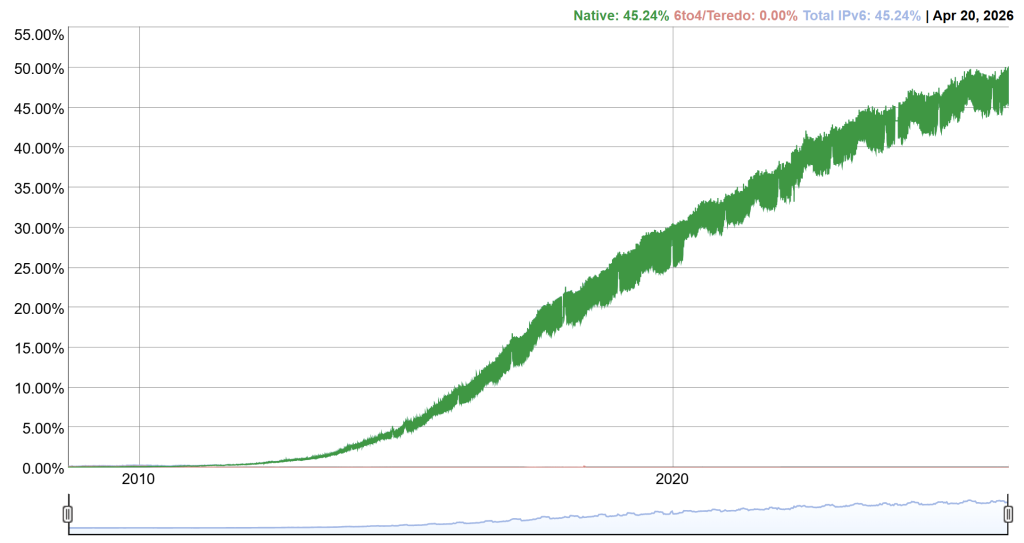
Michaelson's framing is the contrarian one. A 15-year crawl reads like a protocol that failed; he argues it's the signature of a mature protocol succeeding, pulled forward by ISPs making rational decisions about the cost of IPv4 scarcity rather than by mandate. The steepest curves are in India via Reliance Jio, Vietnam, and Saudi Arabia. And because China's vast traffic goes unmeasured here, true global adoption is probably higher still, plausibly 65 to 75 percent.
The thread kills the easy explanations
The reflexive cynical read — that the growth is just scrapers and LLM bots renting AWS addresses — got shut down by someone who fields that traffic for a living.
"As someone on the fighting end of scrapers, this is absolutely not true. If anything I should bais towards v6 as the traffic is on par better than v4" — benjojo, who works on the receiving end of scraper traffic
The upside, another noted, is concrete latency: IPv6 sidesteps the carrier-grade NAT now wedged in front of most IPv4 users.
"IPv6 is often faster because most ISPs these days use cgnat for IPv4." — a commenter on ISP CGNAT deployment
The perennial "they should have just made IPv4 bigger" myth surfaced, as it does in every such thread, and got a flat correction.
"There is no 'just' in expanding the address space" — a commenter correcting the "extend IPv4" myth
And the old enthusiast escape hatch — tunnel your way to IPv6 — turns out to be closing.
"HE tunnel IP space is now sufficiently penalized as non-residential/office that I've had to turn it off anyway." — a self-described physicist
Slow was always the plan
The rule that survives the thread is that infrastructure transitions don't have a finish line so much as a slope, and 50% is the point where the slope stops needing apologists. The penalized Hurricane Electric tunnels make the deeper case: the workarounds that once papered over native IPv6's absence are now actively worse than the real thing, which is the clearest sign the protocol has shifted from chore to default. The remaining holdouts will move not on principle but on the same arithmetic that moved Jio, because running IPv4 costs more than the addresses are worth.
Get breakdowns like this every day
The top Hacker News stories, unpacked — by email, Telegram, or RSS.
On Bluesky, your server operator holds the keys to be you
A breach of your data server merely leaks posts that were already public. But whoever holds your rotation keys can post, like, and follow as you — with valid signatures no one can tell apart from the real thing.