China bought 41% of ASML's machines in 2024, partly to take them apart
A single EUV machine weighs 150 tonnes, costs $350 million, and contains a Zeiss optical system of 65,000 parts that takes a year to build. China spent $10.45 billion on ASML gear last year, and some of it was bought not to make chips but to reverse-engineer how the subsystems fit together.
Nikkei's question is whether China can clone the world's most complex machine. Beijing's Big Fund Phase 3 put $48 billion behind the effort, yet China's own SMEE lithography tools still can't reliably hit even mid-range nodes, and one customer said a machine "still doesn't work properly" a year after delivery. A BofA analyst's timeline: 5, 10, or 15 years, and "highly unlikely" to match ASML.
The HN thread mostly answered "of course they can", then split on the real bottleneck. The harder counter wasn't about machines at all: ASML's moat is the partnership web (Zeiss, IMEC, the US Department of Energy), and the West is the side projected to be short 100,000 chip-talent workers.
The machine, by the numbers
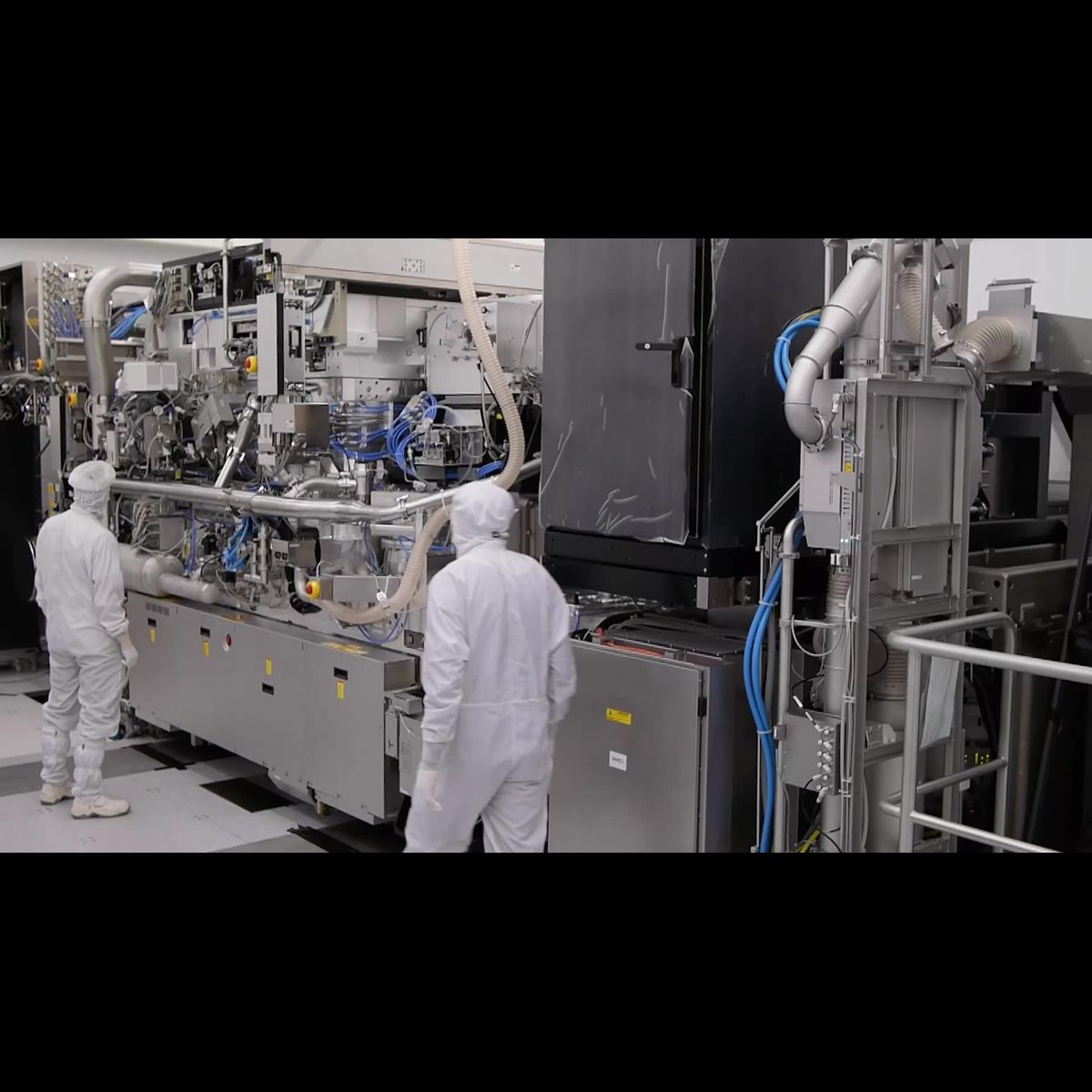
Nikkei's visual feature lays out why lithography is the one corner of chipmaking China hasn't cracked. Chinese firms have already displaced foreign tools in etching, deposition, measurement and polishing; lithography is described as "a blank spot." The flagship High-NA EUV machine is 150 tonnes, 14 metres long, sells for around $350 million, and positions a wafer to under a nanometre using a Zeiss projection mirror called the smoothest surface ever made by humans. Zeiss is an exclusive partner holding a 25% stake; its optical system has roughly 65,000 parts and takes a year to produce.
The money is already moving. Beijing's Big Fund Phase 3, launched May 2024, carries 344 billion yuan (about $48 billion) aimed in part at lithography. China bought 8.92 billion euros ($10.45 billion) of ASML systems in 2024, 41% of the company's system sales, stockpiling before export controls tighten, and in some cases purchasing machines, as the article puts it, "not for production but to research how subsystems and components are put together." Against that, the domestic champion SMEE has tools rated for 90nm but struggling at 65nm and 28nm; one customer reported a machine that "still doesn't work properly" a year in. A Bank of America analyst sums up the timeline as "five years… 10 years… 15 years. We don't really know," and competitive parity with ASML as "highly unlikely. But it's good enough for China."
"Why couldn't they? Why wouldn't they?"
The thread's baseline was near-unanimous: of course China can, eventually. The interesting part is where the optimists and the skeptics actually diverged, which is not on willpower but on economics and on what the moat really is.
One commenter who has read Chris Miller's Chip War and visited IMEC events put the partnership argument plainly:
"ASML can not exists without its partners, first and foremost American Department of Energy but also IMEC in Belgium and Zeiss in Germany… they have to collaborate reach such level… the moat ASML has, in particular partnerships, that is hard to imagine." — a commenter who cites Chip War and a former colleague at ASML
The sharpest skeptic didn't doubt the engineering at all, only who pays for it:
"China is effectively heavily subsidising it's export and research efforts to catch up. But subsidizing with what? They don't have a magic money tree… You can't subsidise something forever… So what's going to give?" — a commenter with 10k karma working through the subsidy math
The most concrete reversal came from someone tracking Huawei's actual roadmap, which sidesteps EUV instead of cloning it:
"The latest from Huawei… is an idea called 'logic folding' which will squeeze more juice out of DUVL by 3D-stacking logic chips… an Ascend AI accelerator - stated performance comparable to leading US products made with EUVL. Products are due in August." — a commenter with 5k karma tracking Huawei's roadmap
And one voice flipped the whole framing, arguing the pressure runs the other way:
"The question is can ASML and western semi keep up with PRC long term. Every western semi player is projected short 100k talent while PRC is only semi power on trend to produce enough IC talent for the entire supply chain… while PRC doing LPP, LDP, synchrotron, nanoimprint, FEL etc all of it." — a commenter weighing the chip-talent pipeline
That last point reframes Nikkei's question. The article asks whether China can reproduce one machine; the thread's most useful answer is that it may not need to. If Huawei can stack DUV-made logic into something "comparable" to EUV-made parts, and if China is the only player not staring at a six-figure talent shortfall, then "good enough for China" stops being a consolation prize and starts being a second, parallel ecosystem that the export controls were meant to prevent.
Get breakdowns like this every day
The top Hacker News stories, unpacked — by email, Telegram, or RSS.
This is the last story in the June 29, 2026 issue.
Go to the issue archive