Switzerland's 25 Gbit fiber isn't the free market winning — it's a regulator forcing four fibers to every home
A Swiss telecom tried to quietly downgrade its fiber rollout in 2020. A small ISP called Init7 complained to the competition authority. Four years later Swisscom ate an 18-million-franc fine and had to keep laying four dedicated fibers to every apartment.
The post's argument: cheap symmetric 25 Gbit isn't a free-market miracle but the result of treating last-mile fiber as a regulated natural monopoly — four strands per home, point-to-point, any ISP gets equal physical access, and you switch providers with a phone call.
The thread doesn't let the framing stand. Speedtest's index shows Swiss average speeds roughly matching the US; the States already sells 25–50 Gbit in places; and the real variable, one commenter argues, isn't speed or density but who controls the last mile.
The 18-million-franc case that forced the fiber
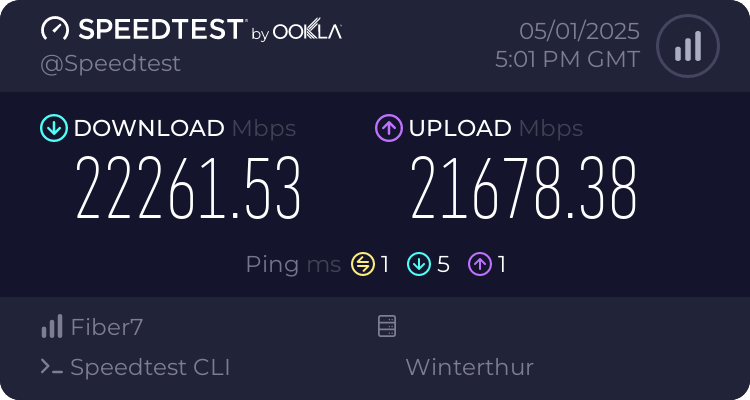
Stefan Schüller's *The Free Market Lie* argues, from Germany, that Switzerland's 25 Gbit symmetric fiber is a policy artifact, not a market one. Three models sit side by side. The US carves territory into monopolies and splits a "gigabit" up to ~32 ways over shared lines. Germany wastes money digging redundant trenches while Deutsche Telekom guards duct access. Switzerland mandates the opposite: four dedicated fiber strands to every home, point-to-point, with every ISP getting equal access to the physical layer — so a customer changes provider with a phone call, not a truck roll.
The load-bearing proof is a court fight. In 2020 Swisscom moved to a cheaper point-to-multipoint design; the ISP Init7 complained to the competition commission COMCO; Swisscom was blocked, the ruling was upheld, and by April 2024 the fine was finalized at CHF 18 million, with the four-fiber rule intact.
"They don't bother using Speedtest in Switzerland"
The thread treated the headline itself as the kind of marketing the article claims to expose. The first crack was empirical:
"I guess they don't bother using Speedtest in Switzerland, as the average speed seems about the same as the US… Must be a sampling bias or something." — a commenter linking the Speedtest Global Index
Others noted the piece cherry-picks the top tier — the US already sells 25G in places — and pointed to a domestic counterexample that predates the Swiss one by a decade:
"We had this in Utah for over a decade now… via Utopia… Unlike Switzerland Utah lets you buy the physical strand of fiber outright for around $3k" — a commenter on the UTOPIA municipal open-access network
The most cited objection — that America's low density makes the comparison unfair — got knocked down from inside the argument, by someone whose day job is exactly this:
"the vast majority of the issue in the US is suburban, where density isn't really a problem… Australia has roughly the same land-mass as the contiguous states… Most people live in cities with good internet infra" — a Google Android SRE
Strip the speed-war framing and the thread converges on the article's real point, stated more cleanly than the article did: the free market does work — when it's given the right rails. The variable that decides your bill isn't fiber speed or population density. It's whether anyone but the incumbent is allowed to light the last mile.
Get breakdowns like this every day
The top Hacker News stories, unpacked — by email, Telegram, or RSS.
An essay begging you to stop the AI hype ends in a paid AI ad — and the thread noticed
Elena Verna's challenge sounds unanswerable: show me one AI tool so critical that without it your work falls apart. Then the post scrolls down to its sponsor — a company selling exactly the AI capability the essay says nobody really has.