He built a product on 'transcripts are the new oil.' Now he reports zero benefit and recants
Amol Kapoor once believed an agent's saved session logs were more valuable than the code they produced. His team measured it across hundreds of sessions and found nothing — so he wrote the post killing his own idea, then had to defend it live against a practitioner who says the opposite works for him.
The claim: giving coding agents search access to their own past transcripts produced zero measurable gain on software tasks when docs, PRs and commits were already available. Worse, agents burned tokens re-reading known context and couldn't purge stale info, causing 'intent drift.'
In the comments a builder with a live logging setup strong-disagrees and lists real wins — forcing the author back in to ask what workflow keeps hitting a context limit that million-token models rarely reach.
The belief he's retracting, and the number that killed it
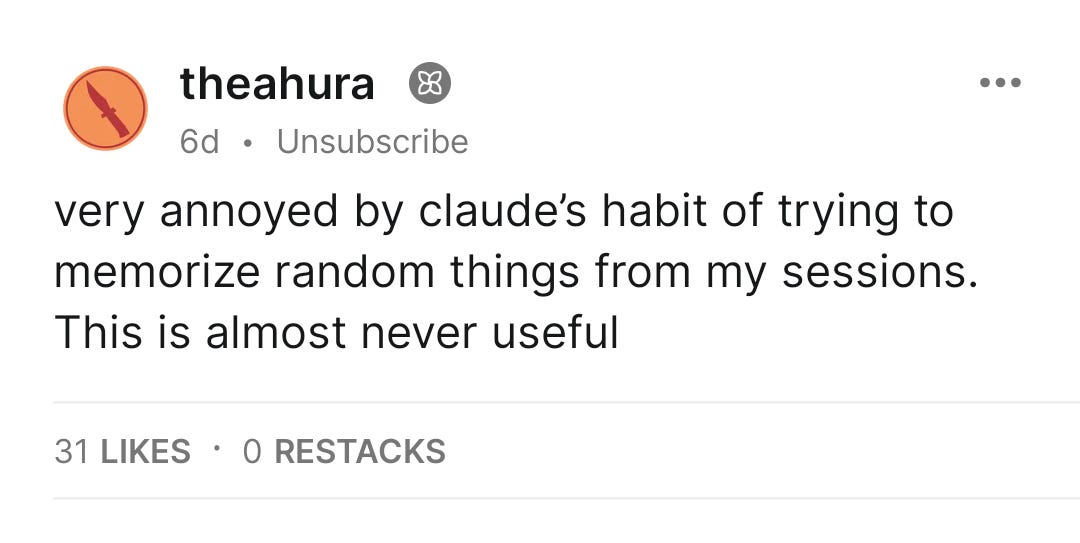
Amol Kapoor built a product around a conviction: an agent's session transcripts were "the new oil," more valuable than the code itself. His new post, *Memorizing session transcripts isn't useful*, is the recantation. His team found zero performance benefit on SWE tasks when agents could search prior sessions, provided the other context — docs, PRs, code — was present. Over months it showed no gain and sometimes made things worse.
The mechanism is the interesting part. Agents waste tokens re-reading information already in commits; they can't reliably purge context that's gone stale or wrong; and because a model treats every token in its window as intentional, contradictory old material causes intent drift. His team's replacement is boringly human: reviewers hand-approve skill updates, and they accept fewer than 20% of the changes an agent proposes automatically.
The practitioner who won't buy it — and the author firing back
The recant did not go unchallenged in the thread.
"Strong disagree on this. I have Claude/Codex keep logs… It's incredibly valuable." — a developer running a live agent-logging setup
Another pushed harder, and this time Kapoor answered in person:
"I refuse to believe this is true. The ability for an agent to find information from before a compaction is incredibly useful." — a commenter who leans on cross-compaction recall
"With the million-context-window models we never hit compaction, observed over hundreds of sessions. What are you doing that has you hitting compaction regularly?" — Amol Kapoor, the post's author, replying in-thread
That exchange is the whole disagreement in miniature: the value of transcript memory may depend entirely on whether your window is big enough to never need it. A third voice offered the diagnosis that stings most — that transcript-hoarding is less an engineering result than a personality type.
"Something about this idea really resonates with certain personality types. I equate it to the Zettelkasten hype phase… People got really wrapped up in the belief that the process was more important than the content." — a software engineer and Manning author
The reader who ships agents gets a usable rule out of the fight: before you build a memory pipeline, measure whether you ever actually run out of window. If you don't, you're indexing a cost, not an asset.
Get breakdowns like this every day
The top Hacker News stories, unpacked — by email, Telegram, or RSS.
Switzerland's 25 Gbit fiber isn't the free market winning — it's a regulator forcing four fibers to every home
A Swiss telecom tried to quietly downgrade its fiber rollout in 2020. A small ISP called Init7 complained to the competition authority. Four years later Swisscom ate an 18-million-franc fine and had to keep laying four dedicated fibers to every apartment.